The Mini 3 Fly More Combo is still the sensible sub-250g buy, as long as your subject holds still
Buy it if you photograph landscapes, coastlines and buildings that stay where you put them; walk away if you want a drone that follows you down a trail, because this one cannot do that at any price and never will.
Based on 3100 owner ratings, 9 owner discussions and 6 other sources. We have not tested this machine ourselves.
We earn a commission if you buy through our links, which does not affect what we say.
Read how this site works →
If this is not your drone, here is the one that is
If what you actually want is a camera that follows you, stop looking at this and start with the DJI Neo 2, which is built around exactly that job, or the DJI Flip, which adds forward obstacle sensing and integrated propeller guards while staying in the same weight class. For running, riding and skiing specifically, the HOVERAir X1 is the machine designed for it.
If the blindness is what bothers you and the budget can stretch, the DJI Air 3S is the drone that fixes it properly, with real sensor coverage, a bigger sensor and enough mass to sit still in wind, at the cost of the weight exemption and the pocketability. If it is the money that bothers you, the DJI Mini 4K is the low-risk way to find out whether you enjoy flying at all, and the Potensic Atom 2 is the credible non-DJI alternative that carries Remote ID without a battery upsell. Our roundup of camera drones under 249g and our travel drone picks put all of these in order.
But if you are the buyer this drone was made for, the one photographing coastlines and mountains and buildings, the one learning to fly and wanting the mistakes to be cheap, the one who wants a controller with its own bright screen and enough batteries to wait out the light: this remains a genuinely good purchase, and it will not feel like a compromise until the day you point it at something that runs away. New drones will beat it on paper every eighteen months. It has been beaten on paper for years and it is still in the top handful of its category, which tells you what the paper is worth.
This is a drone that launched at the end of 2022, and one of the buyers who left a review on the listing works that out unprompted: three years old, no object avoidance, still good enough for what most people actually do with it. That is close to the right verdict, and Quadcopter Bench would only sharpen it. The two things that date the Mini 3 are the two things that decide whether you should buy it. It has no forward, backward or sideways obstacle sensors, only downward vision for landing. And it cannot lock onto a moving subject, in any mode, at all. Everything else about it has aged remarkably well.
So the sorting question is not what your budget is. It is whether the thing you want to film is moving, and whether you intend to fly it near objects. Surfer, mountain biker, solo hiker who wants a camera to trail them: wrong drone, and you can find the right one on our guide to drones that follow you. Coastal cliffs, a property listing, a village from four hundred feet, a first drone you are learning on: this is arguably the best-value thing in the category that DJI still sells, and it is one of the few that will not make you register anything before your first recreational flight.
There is a third group worth naming, because they are the ones who get the most out of this specific configuration. If you have flown a drone with your phone clamped to the controller and hated it, the DJI RC in this bundle is the actual upgrade. One owner who bought it expressly says the phone screen was unreadable with brightness maxed in sunlight and the RC is not, that setup is done entirely on the controller, and that the phone battery stays untouched; another admits they were certain a screen controller was a waste of money and were completely wrong.
Key Specifications
The two absences that define this drone
Look at DJI's own bullet points and notice what is not there. Return to Home, precise hovering, auto takeoff and landing, all present. Obstacle avoidance is never claimed, anywhere, because there is none beyond the downward sensors. The Mini 3 sits between the Mini 2 and the Mini 3 Pro in DJI's own ladder, and downward-only sensing is precisely where it lands, against the Pro's tri-directional system. Independent buying guides list the omission as one of the model's headline drawbacks rather than a footnote.
What makes this worth stating twice is that buyers do not believe it. Two of the thirteen reviews retained on the listing praise the Mini 3's obstacle sensing in detail, one of them citing it as a reason for peace of mind, while three others in the same set say flatly that it has none. Nobody is lying. People assume a modern DJI has sensors because every DJI above this one does. If you buy on that assumption you will discover the truth sideways, which is the specific problem: the direction in which small drones are most often crashed is lateral, and lateral is the direction the Mini 3 is blindest. That is not a reason to reject it, and our piece on what obstacle avoidance actually catches explains why sensors on pricier drones still fly straight through cables and thin branches. It is a reason to fly the first month over open grass.
The second absence is tracking. FocusTrack, MasterShots and Hyperlapse were all withheld from the non-Pro Mini 3, while QuickShots and the panorama modes survived. The most instructive thread on this drone is one where a buyer, a week out from a surf trip, asks why everyone keeps talking him out of the Fly More bundle, insists he does not need active tracking, and then concedes a few comments later that active tracking is the only feature he will miss. He wanted to film a friend surfing. That is the exact job ActiveTrack exists for. If you recognise yourself in that, believe the second answer, not the first.
Where the camera stops
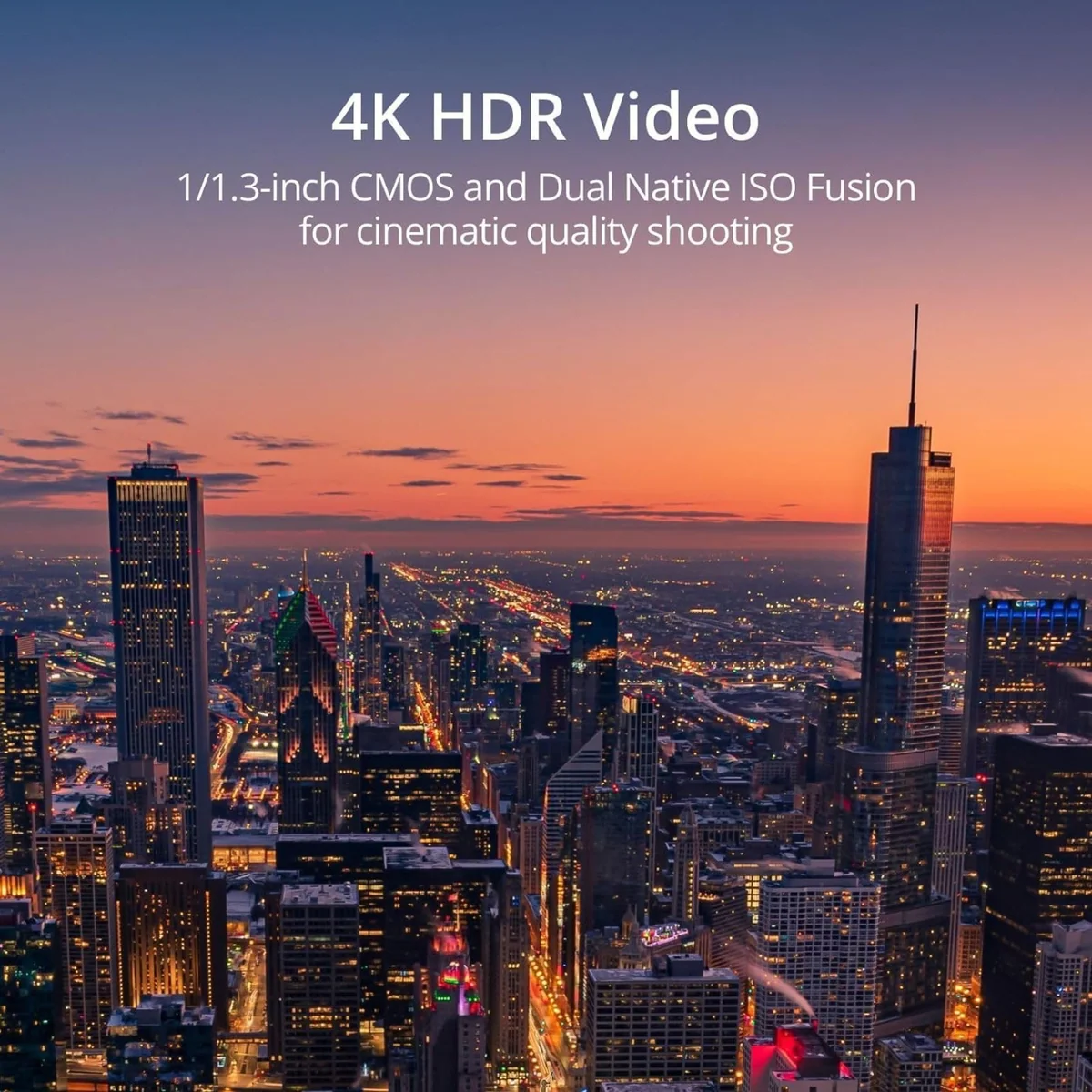
The 1/1.3-inch sensor and f/1.7 lens still produce a genuinely good 4K HDR image, but the ceiling is real and it is written into DJI's own small print: HDR video does not support recording above 30fps, so the headline mode is 4K/30 and nothing faster. Drop to 2.7K and 60fps opens up. There is no log profile and the footage is 8-bit, which is the difference between nudging a grade and building one, and reviewers who shoot professionally reach for a bigger drone for exactly that reason while still rating the Mini 3's out-of-camera Rec. 709 as unusually pleasant.
Be careful with the high-resolution stills claim, which appears in owner reviews rather than in DJI's bullets. A photographer who shot the Mini 3 hard enough to fill a gallery with graded RAW files from it says the 48-megapixel captures always looked to him like upscaled versions of the 12-megapixel ones, with some difference but no meaningful gain in real detail. The same owner reports the drone missing focus in something like five to ten percent of shots, occasionally focusing short when it should have gone to infinity, and the app preview being too small to reveal it; you find out on the computer. Shoot a second frame of anything that matters.
Against all that, one feature here still beats drones costing several times as much. True vertical shooting rotates the gimbal into portrait and uses the whole sensor, so a tall waterfall or a skyscraper arrives full resolution rather than cropped out of a landscape frame. The gimbal also tilts upward, which most of this class cannot do. If your output is vertical video, that is not a gimmick, it is the reason to pick this over cheaper siblings.
Strengths & Limitations
Strengths
- The DJI RC's built-in screen is legible in direct sunlight where a phone clamped to a controller is not, and it gets you airborne noticeably faster.
- Real-world flight time in the low thirties per battery is among the longest in the sub-250g class, and better than DJI's own Pro-badged minis of the same era.
- True vertical shooting rotates the gimbal rather than cropping, so portrait video arrives at full sensor resolution.
- The gimbal tilts upward as well as down, which most drones at this size and price cannot do.
- Three batteries, a hub and a bag mean you arrive at a location ready to fly rather than rationing a single pack.
- At least one owner has put more than 1,600 flights through one before anything wore out.
- Under 249 grams as shipped, it keeps recreational pilots clear of registration in most places.
Limitations
- There is no forward, backward or sideways obstacle sensing, and sideways is the direction small drones are most often crashed in.
- It cannot track a moving subject at all, so filming anyone running, riding or surfing means hand-flying every second of it.
- Video tops out at 4K/30 in 8-bit with no log profile, which limits how far the footage can be graded.
- The high-resolution stills mode adds little genuine detail over the standard files, according to an owner who shot it extensively.
- Autofocus occasionally misses in a way the app preview will not show you until you are home at a computer.
- At 249 grams it wallows in wind that a heavier drone would ignore, and the gimbal has to work hard to hide it.
- Unlocking Remote ID requires an extended battery sold separately, which then pushes the aircraft past the weight exemption you bought it for.
- The box contains no wall charger, no memory card and no ND filters, and the charging hub fills the three batteries one after another rather than together.
Flight time, range, and the wind you can actually fly in
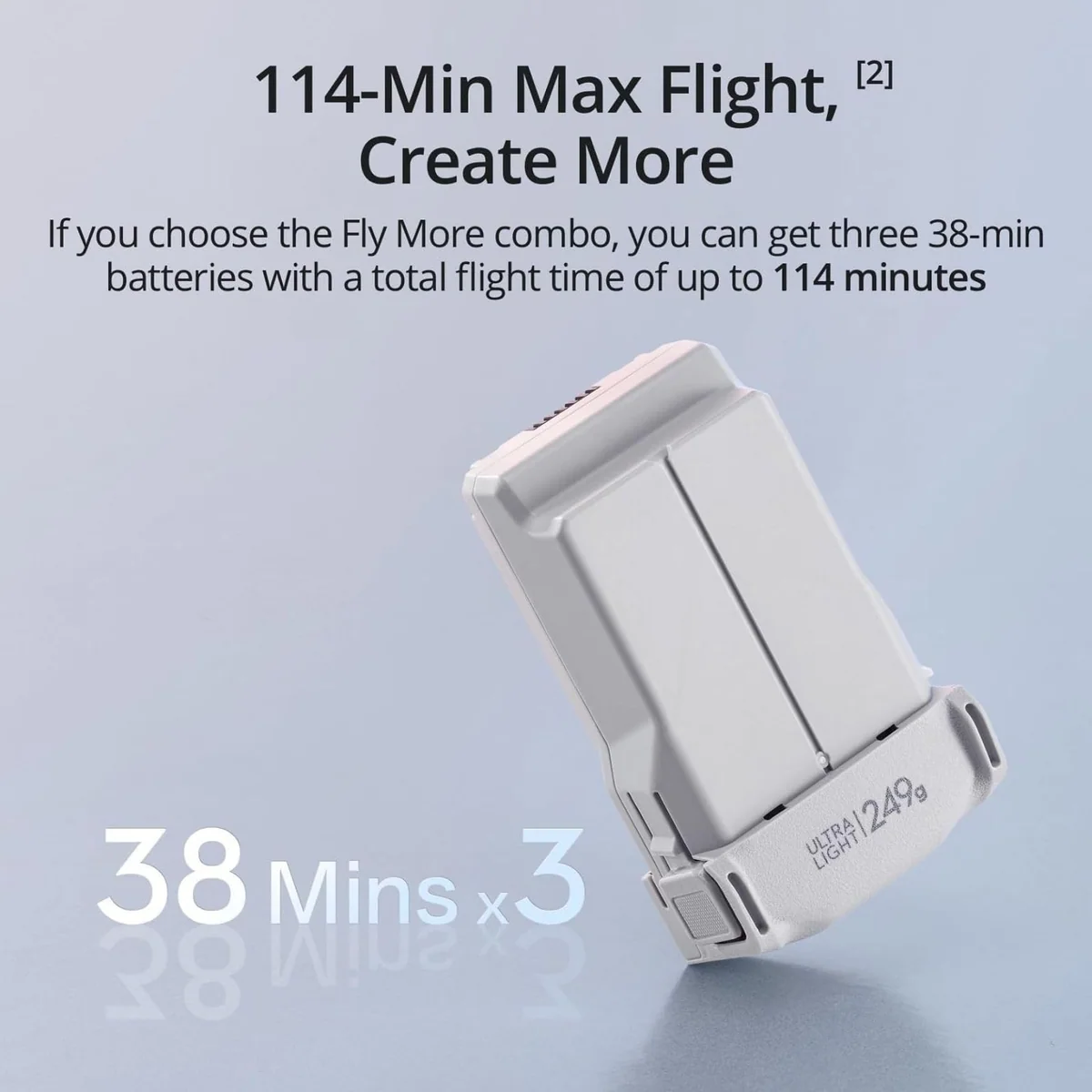
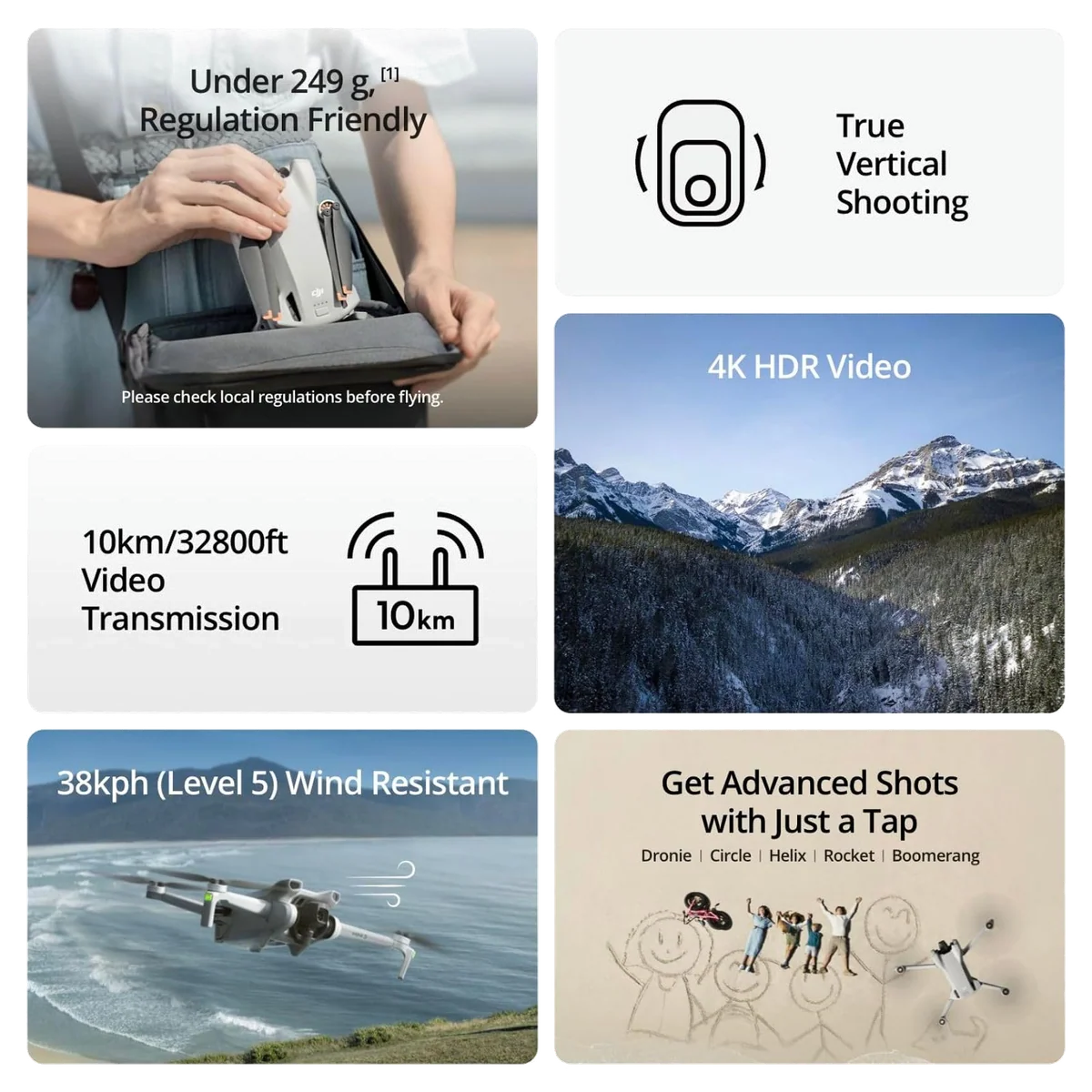
The 38-minute figure is real and it is also a laboratory number. DJI's footnote says it was measured at a constant 21.6kph in windless conditions. Owners of this drone land somewhere in the low thirties: one reports consistently getting past thirty minutes a flight, another says over thirty. The arithmetic that reconciles the two is simple and an owner in the Fly More thread lays it out: lithium packs cannot be run to zero, so you are landing around twenty percent, and thirty minutes at a stretch is about the realistic maximum. That still makes it one of the longest-flying drones in the sub-250g class, and it is the one specification where this model quietly beats the Pro versions. Our explainer on advertised versus real flight time covers why the gap exists across every brand.
Range is where the marketing does the most damage. The listing offers up to 10km, and the footnote immediately qualifies it: 10km under FCC rules, 6km under CE, measured with no obstructions and no interference, and quoted as the farthest one-way distance for a flight that does not come back. A reviewer flying in rural Norway pushed the link to roughly 8,000 feet before losing it entirely, having managed only around 1,500 feet a year earlier in a location thick with interference, and described the failure clearly: the record button stops responding, the image freezes, then the signal goes. Same drone, same controller, five times the range, purely because of where it was flown.
And even that is not the real limit. A tester who took the sibling Mini 4 Pro out to see whether its rated 20km meant anything hit the Return to Home button at 4,544 metres with four of five signal bars still showing, because the battery would not have brought it home. Charge is the constraint, not the radio, and long before either of them the law requiring you to keep the aircraft in sight is the constraint that actually applies.
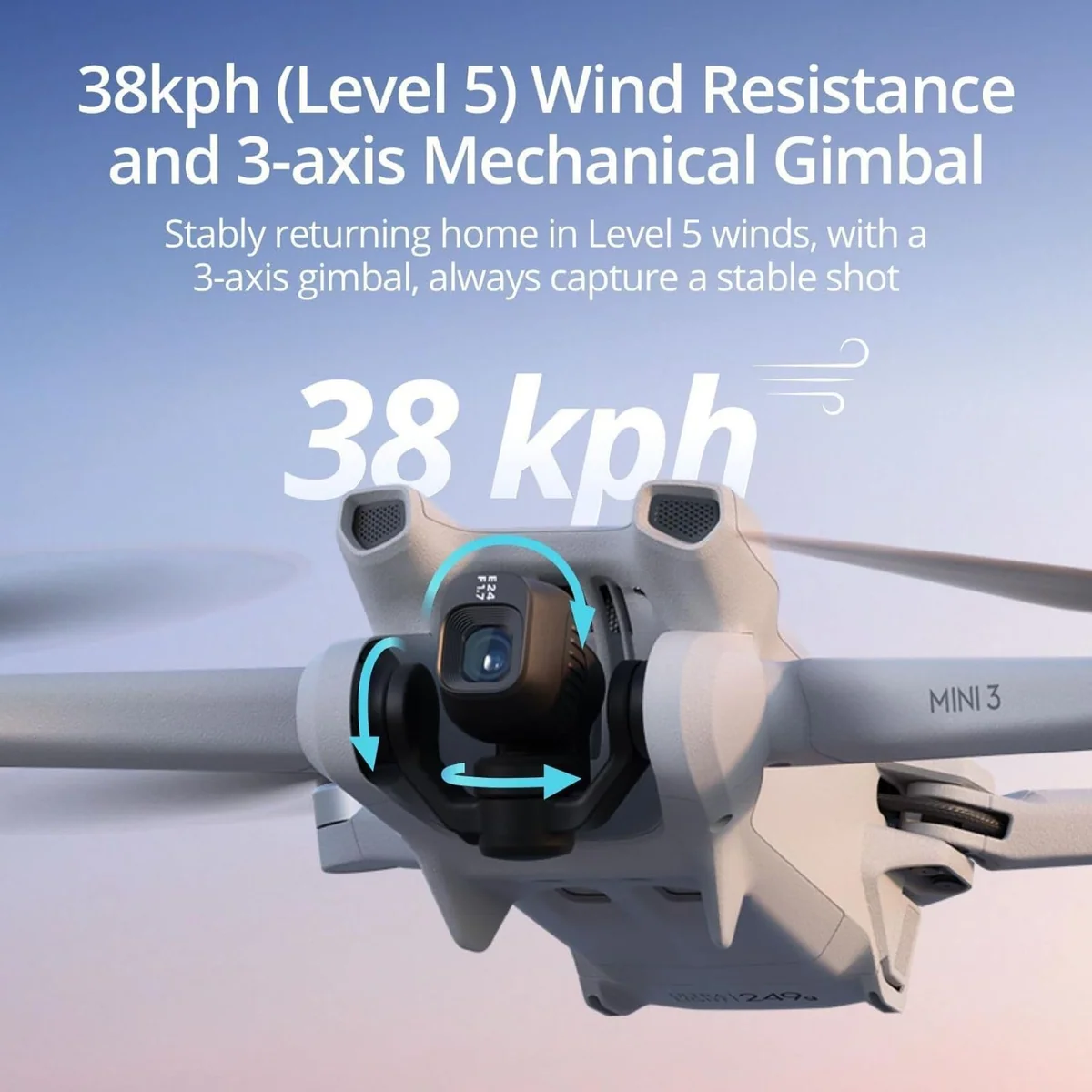
Wind is the honest weakness of the whole 249-gram class, and the Level 5 rating on the box needs reading as "it will stay airborne", not "it will hold a shot". A professional reviewer of the Mini 4 Pro puts it better than any spec table: in wind the airframe sways visibly and the gimbal does an extraordinary job of hiding it, so the drone looks far worse than the footage does. A Mini 3 owner in the same comment thread says plainly that they shoot professionally with theirs and that wind is the limitation. An owner who moved up from the Mini 3 reports getting far fewer "windy, return to home" warnings on the newer, heavier model, which tells you those warnings were a regular feature of Mini 3 ownership. If you fly ridgelines, read how much wind a lightweight drone can handle before you commit, and consider a heavier aircraft.
On noise, resist the tidy answer. An owner praises the Mini 3 as very quiet and says it does not draw unwanted attention, which is largely a point about how invisible a small grey object is at height. An owner who has flown both the Mini 3 and its current-generation replacement reports the newer drone as slightly louder but lower-pitched, and says animals are less frightened by the deeper sound. Small props are quieter in absolute terms and shriller in character, and shrill carries.
What the Fly More box actually buys you
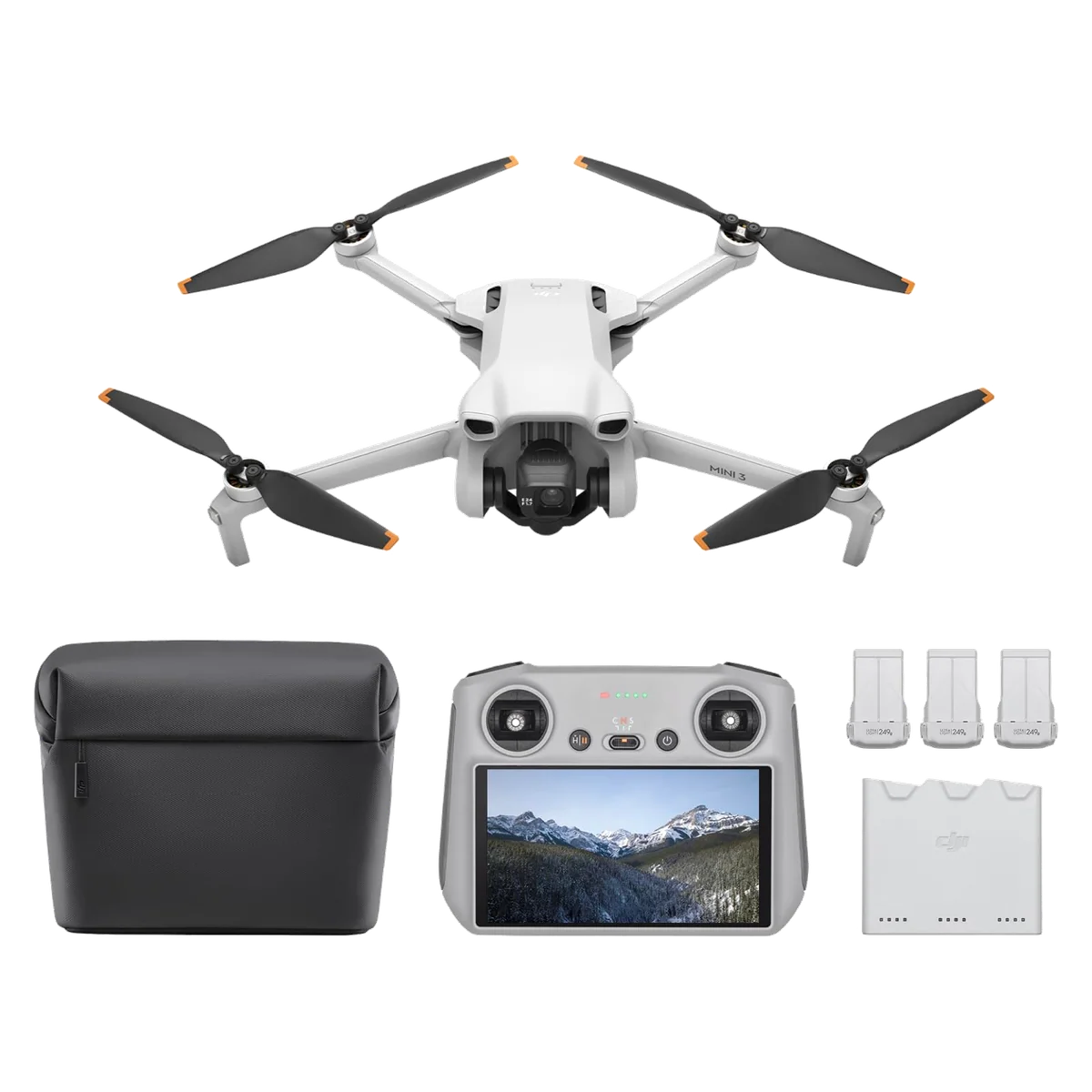
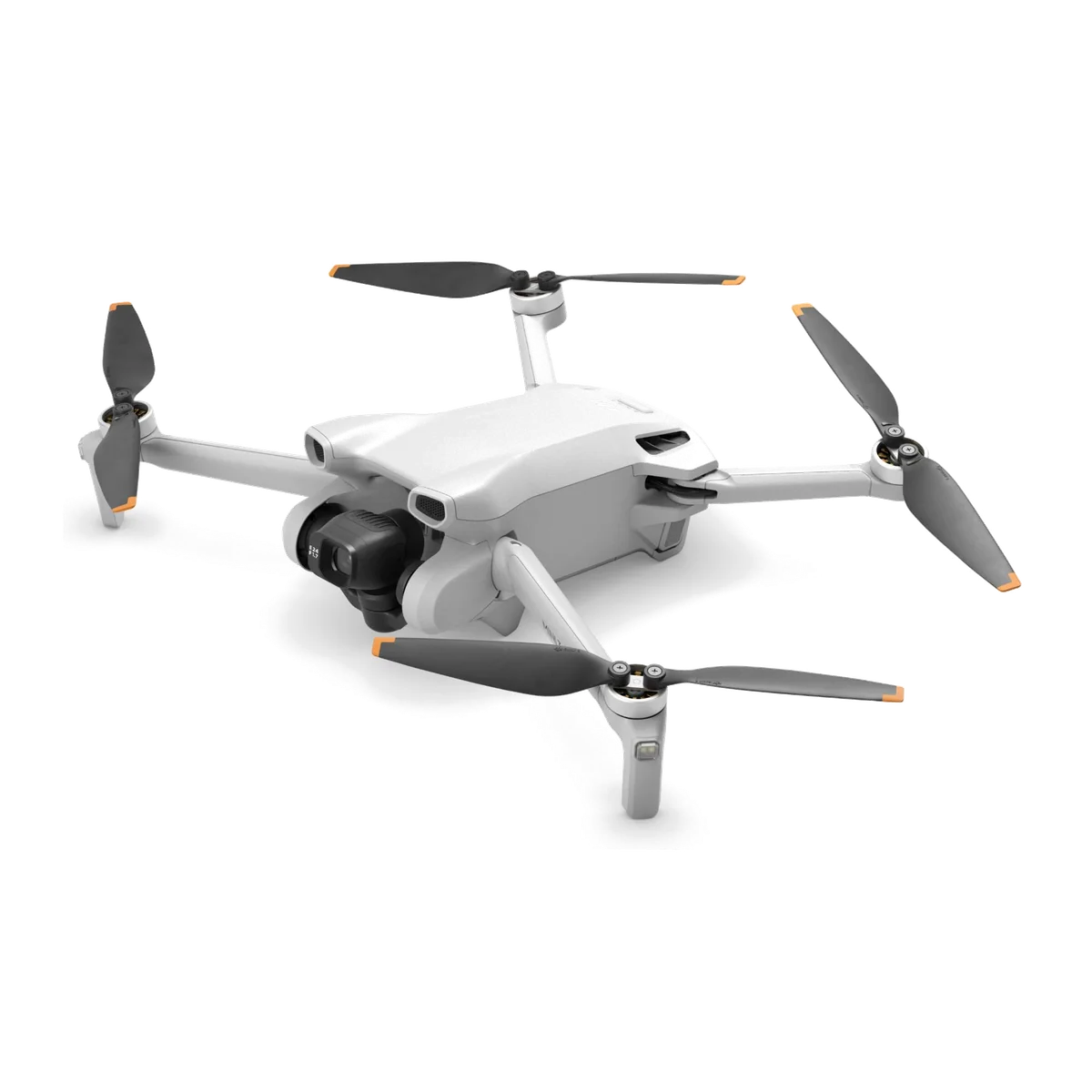
The bundle is the drone, three Intelligent Flight Batteries, a two-way charging hub, a shoulder bag, and the DJI RC with its 5.5-inch built-in display and the Fly app already installed. Two of those items justify the configuration and one of them is quietly less useful than it sounds.
The batteries first. The case for them is made most vividly by an owner who asks you to imagine driving thirty minutes to a location with one battery, and it is echoed by several others who describe how fast a single pack disappears when you are still deciding where to put the drone. The dissent in the same thread is worth as much: one owner a full year in says he bought a single spare and a set of ND filters and has never needed more than two batteries' worth of air time, and a reviewer took just one battery to Norway and topped it up from a portable charger between flights. The split is not about how much you fly. It is about whether you can recharge where you fly. If you drive out, hike in, and get one weather window, buy the three. We work through the general case in whether the Fly More Combo is worth it.
The charging hub deserves a caveat nobody prints on a box. On this class of DJI kit the two-way hub works through the batteries in sequence rather than in parallel, and a reviewer who timed the sibling model's hub found three packs and the controller adds up to a full evening on charge. So what you are buying is three charged batteries at the trailhead, not a fast turnaround between flights. Plan the night before.
Then there is what is not in the box. There is no wall charger; you supply a USB-C one. There is no memory card, and you will want a decent one, since owners note DJI publishes a list of recommended cards and that a card too slow for the job gets rejected outright. There are no ND filters, which for video is the one accessory experienced owners buy first, and no propeller holder or controller lanyard, the latter being genuinely useful with a screen controller you might want to let go of. All of this comes from owners assembling their own first-flight checklists, and the same checklists carry a warning worth more than any accessory: do not assume the app will stop you from flying into restricted airspace. A buyer in the review set found a 256GB card kept up with everything the drone recorded.
The controller is the reason to pick this variant
DJI sells the same drone with a controller you clamp your phone into, for less. Owners who paid the difference are consistent about why. One says the screen on the RC is both larger and brighter than his phone's, and that setup is far easier. Another describes his conversion from thinking a screen was a waste of money to finding it dramatically faster to get airborne. The general question of whether a proper controller is worth it is covered in our piece on flying with a phone versus a real controller. One planning note: this bundle ships the original DJI RC, not the newer RC 2, and the two are not interchangeable across DJI's current line, so if your plan is to buy a controller once and change drones later, read which drones work with the RC 2 before you assume this one carries forward.
Against cheaper options, the thing to know is that buyers agonise over the same choice repeatedly and mostly land in the same place. In one thread comparing this against DJI's budget Mini, the room's answer was that the price gap is justified because the cheaper model is the older technology, and at least one reader in that thread ordered the Mini 3 on the strength of the built-in screen alone. We put the two head to head in Mini 4K versus Mini 3, and set it against the strongest non-DJI challenger in Potensic Atom 2 versus DJI Mini 3.
Buying a 2022 drone in 2026
The reason this review reads differently than it would have two years ago has nothing to do with the drone. In December 2025 the FCC added new foreign-made drones to its Covered List, which blocks the authorisation a product needs to be sold or imported in the United States; DJI filed suit in February 2026, and drones already approved before that point remain legal to buy and to fly. Buying guides have spent 2026 repeating the same summary: new DJI models are not getting approved for the US, and the older ones that were already cleared are the options left standing. That does not make the Mini 3 better. It does mean "just wait and buy the newer one" is advice that no longer works the way it did, and it explains why a three-year-old drone is still near the top of its category. We keep the picture current in whether you can still buy and fly a DJI in the US.
Two consequences follow that a listing will not tell you. Service and spare parts are the first: pilots in the drones community were already warning in late 2025 that sending a unit off for service might mean not getting it back, and that support for older hardware is the thing that quietly disappears. The second is insurance, since DJI's own Care Refresh is no longer purchasable in the US, which is a real change in the cost of a crash and one we cover in insuring a drone now that Care Refresh is gone.
The 249 gram promise, and the trapdoor in it
Under 249 grams means no FAA registration and no Remote ID for recreational flying, and DJI states it in the first bullet. The same listing then notes that the standard weight includes the battery, propellers and a card, and that actual weight varies between batches. That margin matters more than it looks, because it is easy to spend it. One buyer added propeller guards as a substitute for the obstacle sensors the drone lacks, went over the threshold, and had to register the aircraft after all.
The sharper catch concerns anyone who wants to be paid for the footage. PCMag's drone guide, written by a Part 107 certified pilot, reports that the Mini 3 has Remote ID but that you need the extended 51-minute battery to access it. That battery is sold separately, only in some countries, and DJI says outright that fitting it takes the aircraft over 249 grams. So the professional path here costs an extra purchase and forfeits the registration exemption in the same move. For European buyers there is a further wrinkle, since sub-250g aircraft flown under the C0 class are capped at 120 metres above the takeoff point regardless of where the drone was bought, which bites hardest in mountainous terrain, and the larger batteries are not generally sold into that market at all. Sort out what applies to you in registration and Remote ID for sub-250g drones before you buy anything extra.
How well it lasts, and the used-market trap
The best durability evidence for this model comes from an owner who logged more than 1,600 flights in roughly eight months, covering close to half the length of the United States, before grounding it with what he believed was a worn motor bearing, and who volunteered that he flies it far harder than most people ever will. That is a good story, not a bad one. Nothing in the record suggests a systemic defect, though flyaways and units that will not power on after months in storage do come up, and a kit with three lithium packs in it multiplies your exposure to the second of those. Charge them to storage level if the drone is going in a cupboard for the winter.
If the saving tempts you toward a used one, two things. There are a lot of nearly-new small drones for sale, and the honest reason is not that they are bad: people buy them imagining constant use, discover how restrictive flight rules are in the places they actually go, and stop. Ask yourself that question before you spend, not after. And a used DJI can arrive still bound to the previous owner's account, which is not always something you can fix without them; one buyer in the owner threads was offered a used Fly More kit by a neighbour for more than the same bundle cost new at the time. Buy new, or verify the unbinding before money changes hands.
One last piece of friction, and it is on DJI's own listing rather than in any review. The drone has to be activated in the DJI Fly app, and the app is not on Google Play, so Android owners are directed to download it from DJI's website instead. Do that before you drive somewhere scenic.
Frequently Asked Questions
Is the DJI Mini 3 still a sensible buy this far after launch?
Yes for landscape, travel and property work, because the camera, the flight time and the screen controller have all aged well, and no for anything involving a moving subject or tight surroundings, because no firmware update will ever add the sensors and tracking it was built without.
How far can it really fly from you?
The 10km figure is a one-way, no-obstructions, no-interference transmission measurement rather than a distance you can fly and return from, and in practice the battery and the requirement to keep the aircraft in sight will both stop you long before the radio does.
Does it have obstacle avoidance?
Only downward, for landing, with nothing looking forward, backward or sideways, which is why several owners buy propeller guards as a substitute and why the first month should be flown over open ground.
Will it follow me while I ride or run?
No, because FocusTrack, ActiveTrack and the automated tracking modes were all withheld from this non-Pro model, so every shot of a moving subject has to be hand-flown.
What is the difference between this and the Mini 3 Pro?
The Pro is a different, more expensive drone with tri-directional obstacle sensing, subject tracking and a faster video link, and the two are confused constantly because the names differ by one word.
Do I have to register it?
Not for recreational flying while it stays under 249 grams as shipped, but adding propeller guards or the extended battery can take it over that line and change the rules that apply to you.
Is the Fly More version worth it over the drone on its own?
It is if you travel to fly and cannot recharge in the field, and it is less compelling if you fly close to home with a power bank in your pocket, since one long-term owner managed a full year on a single spare battery.
Do I need to buy anything else to use it?
Budget for a memory card and a USB-C wall charger straight away, since neither is in the box, and add ND filters if you intend to shoot video rather than stills.
Sources (8)
- Amazon listings and customer reviews — Dji Mini 3 Fly
- Owner reports across r/dji, r/drones threads
- Owner and reviewer video, 2 channels
- Pcmag — Article — www.pcmag.com
- Firstquadcopter — Article — www.firstquadcopter.com
- Fstoppers — Article — fstoppers.com
- Digitalcameraworld — Article — www.digitalcameraworld.com
- Photo — Article — jvn.photo