DJI Neo 2 Fly More Combo: buy the batteries, ignore the nineteen minutes
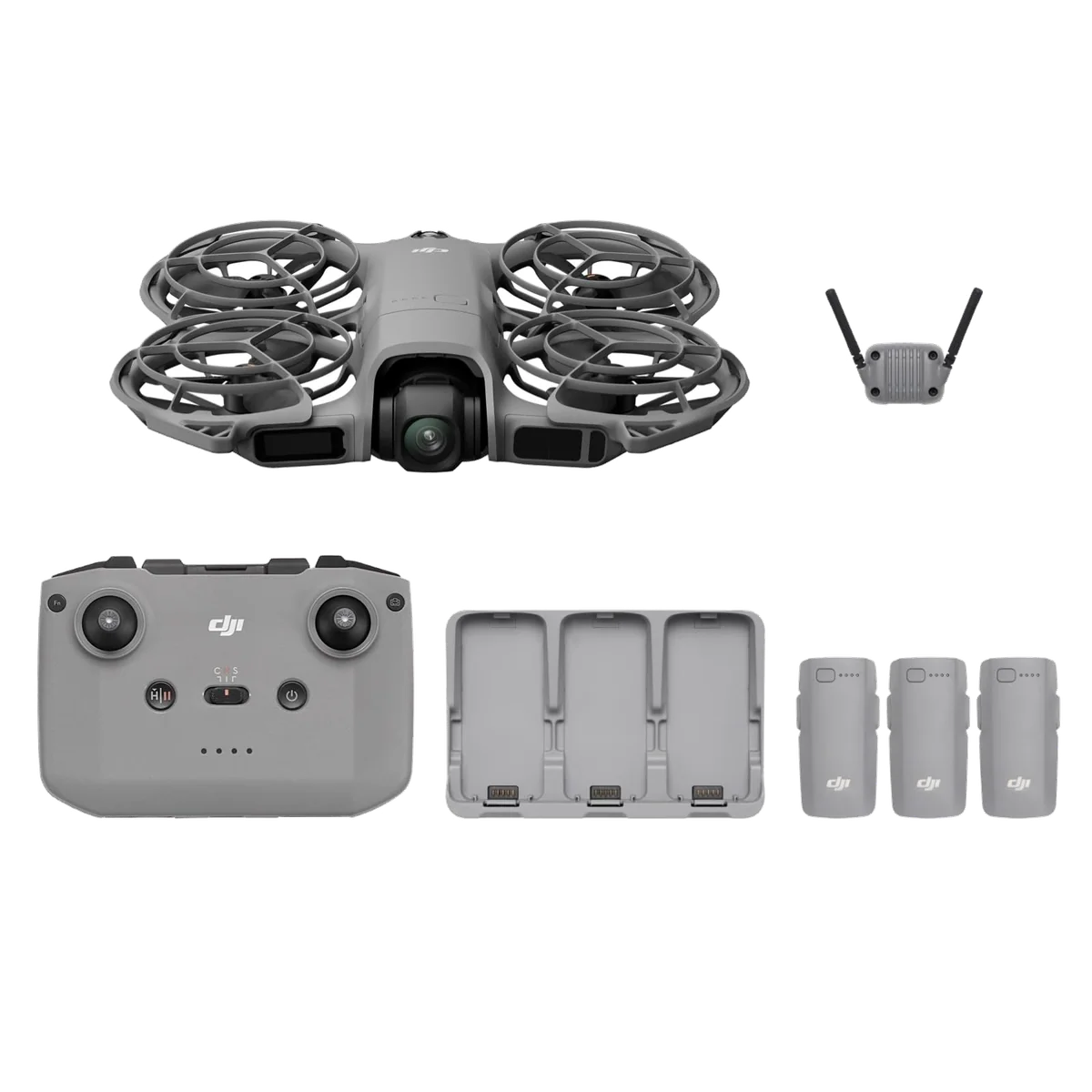
Buy it, in this configuration and no other, provided you understand you are buying a tough little follow-camera with roughly ten to fifteen usable minutes per battery rather than anything anyone should call a camera drone.
Based on 764 owner ratings, 11 owner discussions and 6 other sources. We have not tested this machine ourselves.
We earn a commission if you buy through our links, which does not affect what we say.
Read how this site works →
The call
The best summary of this drone came from an owner rather than a reviewer, and it is worth borrowing: there is better than the Neo 2 in every specific area, and if you can only have one drone, there is nothing better. That is the trade. You give up endurance, low light, wind tolerance and any pretence of a serious camera, and you get a machine that is in your bag on the day something worth filming happens, that a beginner can fly on the first afternoon, and that survives the mistakes that beginner will make.
Buy the three-battery box with the RC-N3. Buy a fourth battery, a case, a mains adapter capable of driving the hub properly, and a power bank, because none of those are included and you will want all four. Fly it in the first hour over grass and close in, to satisfy yourself you did not receive one of the bad ones. Then stop expecting nineteen minutes, because you will never see them, and go and use the twelve you do get.
Buy it if you want a drone that leaves the house. Buy it if the shot you want is you, moving, filmed from eight metres away, and you would rather have that shot at phone quality than not have it at all. Buy it if it is your first drone and you would like the first crash to be funny instead of expensive.
Walk away if your priority is stills, if you grade your footage, if you shoot at dawn or dusk, if you fly anywhere the wind gets up, or if you are being paid for the results. Every one of those readers is better served elsewhere, and this page will say where.
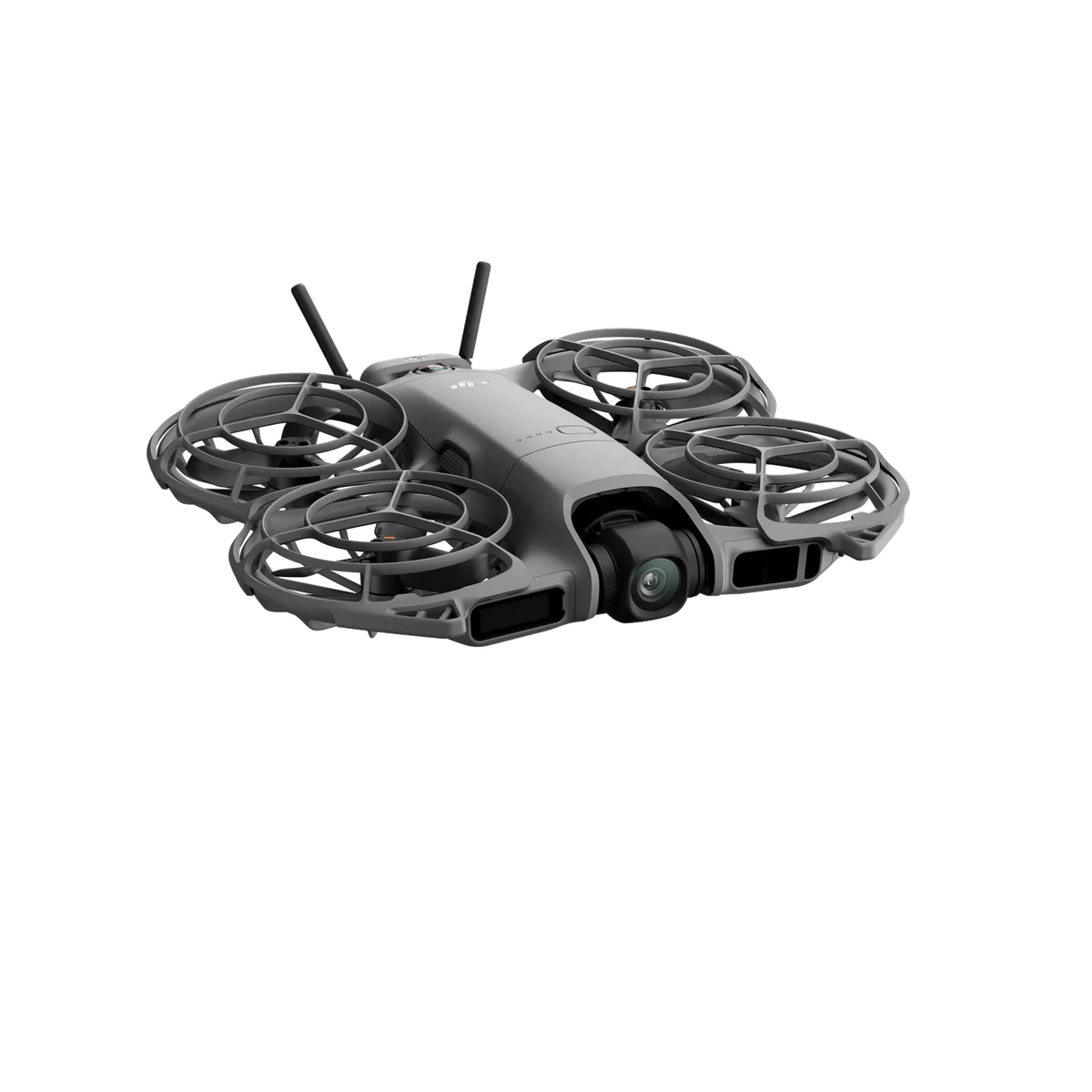
The Neo 2 weighs 151 grams, carries fixed cages around every propeller, and takes off from your open palm. That combination produces a specific and slightly unusual outcome: people who own far better drones report flying this one more. Owners of an Air 3S, a Mini 5 Pro and a Mini 4 Pro all volunteer, unprompted and separately, that the Neo 2 became the aircraft they actually reach for, because the Mini has to be unfolded and the covers taken off and the satellites waited for while the Neo 2 is already in the air. That is the whole product thesis, and it is a real one. The best drone is not the one with the biggest sensor. It is the one that is in your jacket rather than in a cupboard.
Quadcopter Bench went through every Amazon review of this listing and the owner threads that sit behind it, and the pattern is unusually clean for a consumer drone. The praise is broad and consistent across four languages. The complaint is singular, unanimous, and named by almost every five-star reviewer as their only reservation: the battery. That is why the SKU on this page matters more than the drone on it. The Fly More Combo is not an upsell here. It is the minimum viable configuration.
Key Specifications
What it does when you leave the controller at home
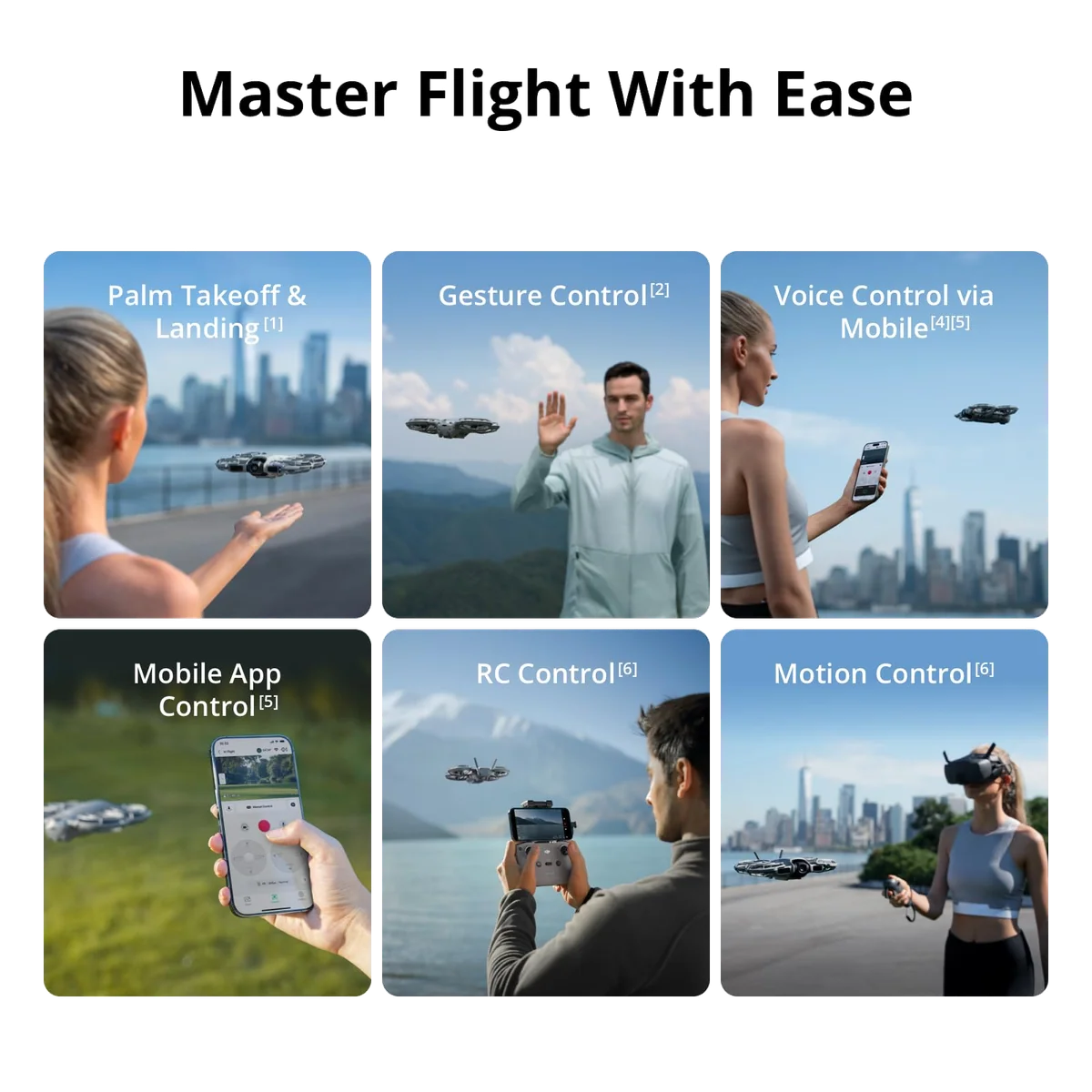
The headline feature is the one that sounds like a gimmick and is not. You hold the drone flat on your palm, press a button, and it lifts off. You put your hand up and it stops and repositions where you point it. You spread both palms and it backs away. You hold out your open hand and it comes down onto it. Owners describe this in three languages with the same reference point, calling it Jedi mode and Obi-Wan mode and, in one case, simply saying that it feels like the drone flies itself. One long-time DJI owner who was ready to write the feature off as a party trick concluded the opposite: being able to reposition a drone mid-follow with one-to-one accuracy by raising a hand, and then land it from a considerable distance by holding out a palm, turned out to be the thing he used constantly.
The clearest evidence that it works is not from a pilot. One owner bought the Neo 2 as a Christmas present for a four-year-old, and the first flight went ahead with nobody reading the manual: they turned it on, waved at it, and it worked. A four-year-old abandons anything confusing within seconds. This passed on the first afternoon.
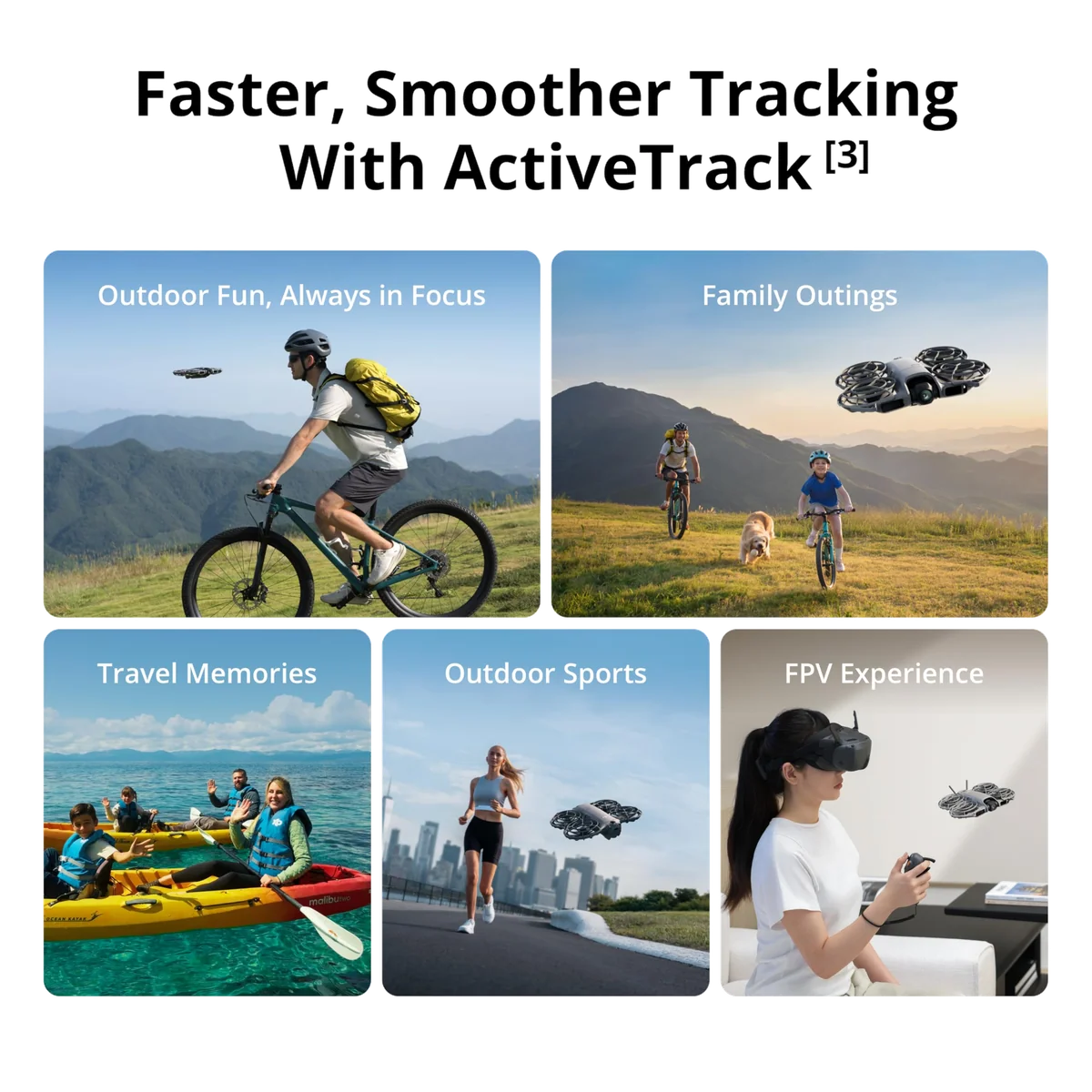
On top of the gestures sit the automated shots. There is a small display beside the camera and a set of buttons on the body, which between them let you configure a helix, a dronie, an orbit or a burst without touching a phone. SelfieShot fires three framings in succession, waist up, full body and wide, so a group photo does not need a volunteer to hold the phone. ActiveTrack is the reason most buyers are here, and it is genuinely good: owners report it holding a mountain biker at over 40km/h through trees, and holding a cyclist at full speed without dropping the shot.
Two limits on the automation are worth knowing before you buy rather than after. The tracking will not lock onto a vehicle, so a follow shot of a car, a side-by-side or a quad is off the table regardless of how slowly it is moving, and at least one buyer cancelled a purchase over exactly that. And the listing's claim that an Apple Watch gives you a live feed and voice control over tracking is DJI's alone. Nothing in the owner record Quadcopter Bench read corroborates it, which is not the same as saying it is untrue, but it is not something to buy the drone for.
Strengths & Limitations
Strengths
- Palm launch, palm landing and gesture control work so well that owners of far more capable drones report flying this one most.
- ActiveTrack holds a cyclist or a mountain biker at speed through trees, and owners rate it above both the Mini series and the HOVERAir Pro Max for follow work.
- The fixed cages make it survivable in a way that changes how boldly you fly, with owners reporting tree strikes and concrete landings that left no marks.
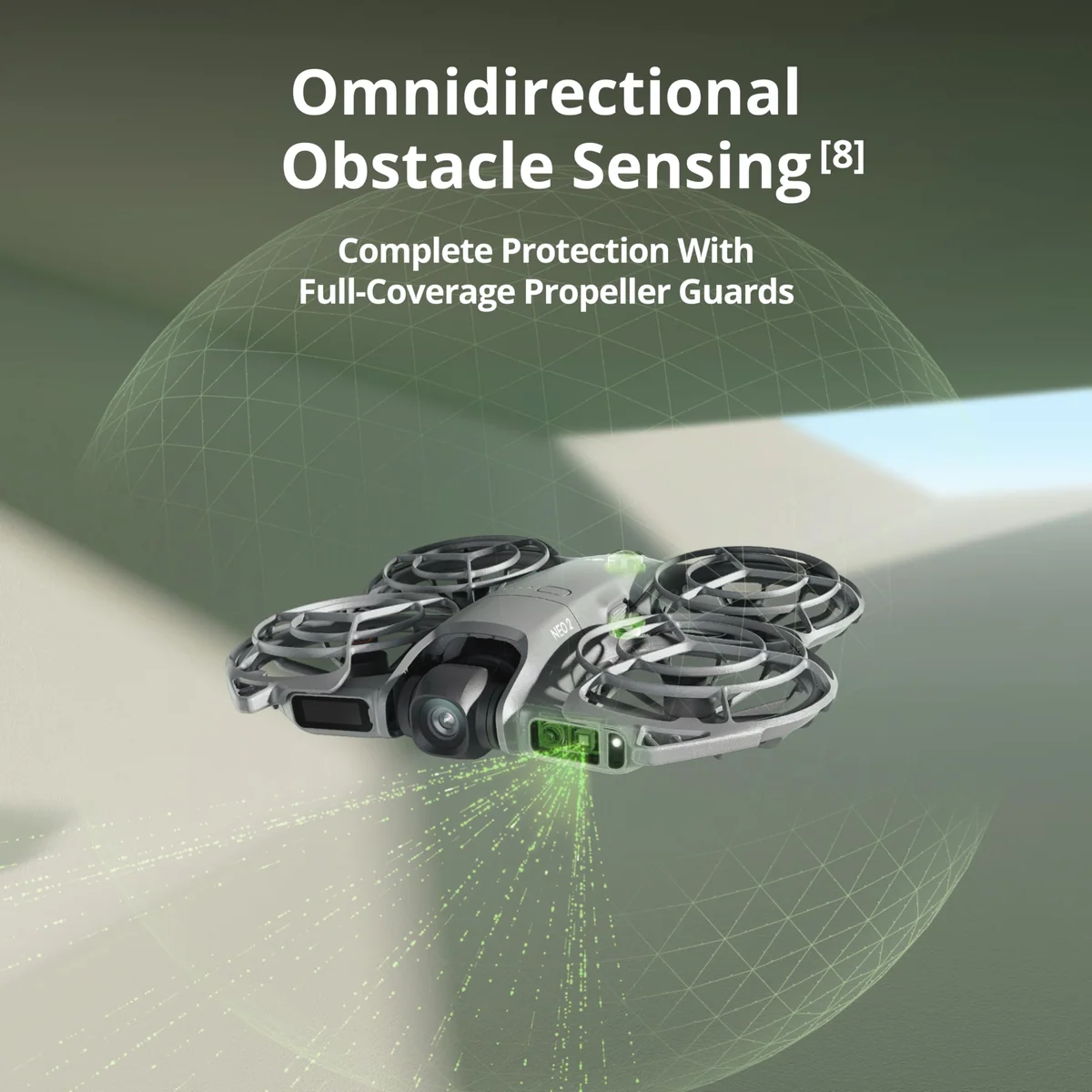
- Omnidirectional sensing plus forward LiDAR is a genuine generational leap over the original Neo, which had no avoidance at all.
- Three batteries, a charging hub that fills them in about an hour and doubles as a phone power bank, and a controller that turns range from the limiting factor into a non-issue.
- 49GB of internal storage means no card to buy, forget or corrupt.
Limitations
- The nineteen-minute claim is not achievable; plan on twelve, and less with the sensors working hard.
- At 151 grams it cannot punch into a headwind, and the breeze that triggers warnings is milder than most buyers expect.
- Auto colour skews blue and fixing it means shooting manual, which means using the controller rather than the palm.
- One colour profile, no log, a shutter floor of a tenth of a second and consequently no usable night footage.
- The two-axis gimbal restricts tilt and therefore framing, and it is the one part the cage does not protect.
- Tracking refuses to lock onto vehicles at any speed, which rules out a whole category of follow shot.
- The transceiver's upright antenna spoils the pocketability that is meant to be the point, and neither a case nor a mains adapter is in the box.
- A minority of owners report erratic control, constant firmware updates and mid-air stalls, and the flyaway threads are active.

Where the physics wins
Everything good about this drone and everything bad about it come from the same number. At 151 grams with cages on, it is light enough to launch from your hand near your own children and light enough that a crash into a tree is an anecdote rather than an insurance claim. It is also light enough to be pushed around by a breeze you would not think twice about on the ground.
The battery, which is the whole argument
DJI's figure is nineteen minutes. Nobody gets nineteen minutes. The owner accounts cluster hard and they cluster low: around twelve minutes even hovering in still air without recording, ten to eleven minutes of ordinary stick flying, thirteen to fifteen for a beginner taking clips, eight to ten if you are flying briskly, and ten to twelve with the obstacle sensors doing their job. One owner put it bluntly as false advertising. The honest planning number is twelve, and it drops in wind because the aircraft burns power fighting to hold position.
Two further details make the real figure worse than the arithmetic suggests. The aircraft starts asking to come home well before the battery is empty, so the last chunk of capacity is reserve you will not spend. And a hot battery needs to cool before it charges, so the constraint is not only minutes in the air but turnaround on the ground. If the gap between advertised and real endurance is new to you, the way manufacturers arrive at those box figures is worth ten minutes of reading before you buy any drone, not just this one.
Owners have converged on the same fix independently: three batteries, the charging hub, and a decent power bank in the bag. The hub takes three cells to full in a little over an hour and doubles as a power bank for your phone. Several owners run four, five or six batteries and a field charger. The upshot is that this drone gives you an afternoon of short flights rather than one long one, and if that is not the shape of flying you want, the shape is not going to change.
Wind is the ceiling, and it is a low one
The most experienced reviewer in the record is unambiguous: wind is the number one enemy of this drone, and at 151 grams with propeller guards it effectively becomes a kite. The threshold is not dramatic weather. He describes the sort of breeze where you notice it getting out of the car, and warnings appearing once the aircraft passes fifteen metres up. Crucially, you cannot bully your way through a headwind the way you can with a heavier aircraft, because there is not enough thrust in reserve to do it.
This is not a Neo 2 defect so much as a weight class ceiling. Reviewers of the DJI Flip, which is heavier, report it refusing advanced modes and throwing return-to-home warnings at around 20mph of wind. Anything at 151 grams sits below that line, not above it. There is a genuine split in the reports, though, and it resolves usefully: the owners who complain loudest about wind are flying from a phone, where fine throttle control is hard, while owners on a controller or goggles describe it as faultless in blustery conditions at several hundred metres. The controller does not add thrust, but it does add the precision to use what there is. If you are wondering where the real line sits for a drone this size, we have written that up separately.
One named use case fails outright. Surfers should not buy this. Unless the sea is glassy and still, an afternoon at the beach is exactly the combination of wind and water this aircraft handles worst. Mountain biking, oddly, is fine: the drone copes better with its own speed than with ambient wind.
Obstacle sensing is real, and it is not a guarantee
Give the Neo 2 credit where it is due. The original Neo had no obstacle avoidance at all, so this is a genuine generational change rather than a marketing refresh. It works well enough that one reviewer repeatedly failed to make it hit bare winter branches with no leaves on them, the classic case that defeats vision systems, and described it as the fastest correction he had seen from a drone. An owner who deliberately flies low near trees and his own house says it simply stops rather than hitting things, and that the app shows a proximity display of what is around it.
Now the other half. One four-star owner, cycling, had it clip a stop sign and, on another occasion, hit a parked car, and his conclusion is the right one: treat the avoidance as a backup, not a guarantee. Another owner, filming a child at a bike park, watched the drone track its subject straight into the child's helmet. His phrase is better than anything we would write: a micro drone does not mean micro consequences. Owners also report it getting confused in dappled, side-lit forest, and a multi-drone owner states flatly that the sensing is not to be trusted and your hand belongs on the sticks. Two behaviours make this concrete: the faster you move, the more the system trades safety for keeping up, and sport mode turns the safety features off entirely. Water is a blind spot, so no jetski shots. If you are buying partly for the sensors, read what these systems actually catch and what they fly through first.
The camera is a good phone in good light
Half-inch sensor, two-axis gimbal, 4K to 100fps, twelve megapixel JPEGs, and 49GB of internal storage with no card slot. The two-axis gimbal is a real upgrade on the original Neo's single axis and keeps the horizon level when the aircraft banks, but two axes also means limited tilt, which restricts framing in a way three-axis owners will notice.
The specific fault worth knowing is colour. Shot on auto, which is how most owners will shoot, the footage skews consistently blue, and the reviewer who identified it also identified the fix: shoot manual and correct the white balance, at which point sunsets come back golden rather than cold. Manual camera settings require the controller. That is one of the quieter arguments for this particular box. There is one colour profile, no log option, and a shutter that will not go slower than a tenth of a second, so night footage arrives at absurd ISO and is not salvageable.
Photographers should read this paragraph twice. Asked directly whether a Neo 2 was the right first drone for stills, a subreddit of owners said no, repeatedly and from several directions, including a working photographer who owns one: these are video-first machines and the photographs are close to an afterthought. If stills are the point, the Flip and the Mini 3 both carry larger sensors and three-axis gimbals, and both are on this site.
Why this box and not the cheaper one
DJI sells the Neo 2 in several configurations, and the choice matters more than usual because the drone's weaknesses map so neatly onto what the boxes contain.
| The claim | How it holds up |
|---|---|
| Nineteen minutes of flight | Does not survive contact; ten to fifteen is the real range, and twelve is the number to plan with |
| Omnidirectional obstacle sensing | Genuinely good and genuinely fallible; it beat bare branches in testing and has hit a parked car and a bike helmet in ownership |
| Palm takeoff, landing and gesture control | Survives completely, and is the reason the drone gets carried at all |
| Faster, smoother ActiveTrack | Survives; owners track at over 40km/h through trees and rate it above the Mini series for follow work |
| 4K high-quality imaging | Partly survives; the resolution is there, the good light is required, and the auto colour needs correcting by hand |
| Lightweight and portable | Survives, and is the same fact that produces the wind problem |
The batteries are the easy half of the argument. Two independent Neo 2 reviewers reached the combo recommendation separately and gave the same reason: this is a drone you burn a battery on at the park without meaning to, so the version with three of them and a hub is the version that matches how it actually gets used. The people answering "is this suitable for a first-timer" threads say the same thing, emphatically, and then tell the buyer to add a fourth battery and a power bank. DJI has long priced these bundles so that buying the pieces separately afterwards costs more, and that pattern held on the previous generation, where one buyer worked out that the drone, two spare batteries and the dock alone cost the same as the full combo, making the controller effectively free. Our fuller take on that arithmetic lives in the piece on whether Fly More Combos are worth it.
What the RC-N3 buys you, and what it costs you
Be clear on what this controller is. The RC-N3 has no screen. It clamps your phone and uses that as the display, with cables for iPhone and Android in the box. Buyers coming from conversations about the screen-equipped RC 2 confuse these constantly, and if you want the built-in screen instead, the compatibility picture is its own subject.
What it changes is real. Flown from a phone alone, one owner puts the practical working range at around 300 metres, and other owners describe losing connection far closer than that, with one incident where the home point had not been set and the aircraft simply began landing where it was. With the controller, the framing flips entirely: range stops being the constraint and battery becomes the constraint, which is exactly the sentence a German owner running both a Motion combo and an RC-N3 uses to describe it. The controller also unlocks the manual camera settings that fix the blue cast, gives finer throttle for windy days, and lets you set a longer follow distance. Owners who tried both are consistent that the phone feels like a settings panel and the controller feels like flying.
The cost is honesty about pocketability. The RC bundle ships with a digital transceiver module that mounts to the aircraft, and its antenna stands up at ninety degrees from the body, which makes stuffing the drone into a large pocket genuinely awkward. The combo case, once loaded with everything, is bigger than the drone's reputation implies. There is a coherent dissenting position here and it deserves stating: one experienced Mavic pilot argues that if you are carrying a controller anyway, the Neo 2's compromises stop paying for themselves and a used Mini would serve you better. He is right about the trade and wrong about the conclusion, because the controller lives in a pocket and comes out when you want range or manual settings, while the drone still launches from your palm on every other occasion. But if you know you will never want sticks, the cheaper box exists and this review is not going to pretend otherwise. Our general answer to that question is in the piece on whether you need a real controller at all.
One more fork. DJI also sells a Motion combo with goggles, and owners split cleanly on it: goggles if you want to play, the remote if you want to capture moments. There is a practical point nobody makes in those threads. Flying line of sight with a controller does not need a second person, and in most jurisdictions goggles do.
Against the alternatives on this site
| If you want | Then |
|---|---|
| A follow shot through trees, on a bike, at speed | The Neo 2, and it is not close; owners rate its tracking above the Mini series and above the HOVERAir Pro Max, one of them having gone through three Pro Max units to crashes |
| A better camera and roughly double the endurance | The DJI Flip, which carries a larger sensor and a three-axis gimbal, at the cost of an exposed gimbal and front-only sensing |
| Stills you will edit and deliver | Not this, and not the Flip either; step up to a Mini or read the camera drone roundup |
| Wind tolerance and an optical telephoto | The Air 3S, which is what one Neo 2 owner was talked into when he went looking for longer flights and low-light ability |
| The lightest possible hand-launch follow-cam | Compare against the HOVERAir X1 and the rest of the follow-me shortlist |
One comparison that circulates in owner threads is moot for American readers. The DJI Lito line looks like the natural rival on paper, and owners argue about it constantly, but it has not been cleared for sale in the United States. If you are reading a British or European thread weighing the two, that choice may not be available to you.
What happens after the first month
Durability is the most pleasant surprise in the record and it is close to universal. The cage spreads impacts across the whole airframe and the low mass means there is not much energy to dissipate in the first place. Owners describe bouncing it hard off a tree in sport mode and finding it unscathed in the undergrowth, crashing it into a wall and onto concrete without consequence, and, in one case, a first-time owner crashing it and finding not a scratch on the case. One owner reports crashing it repeatedly and taking it out more often precisely because he is not afraid of it.
There is one weak point and the cage does not protect it. The gimbal is exposed and it does break: one owner reports killing his in a series of hard impacts and ordering a replacement, another reports a slight bump against a door glass leaving the gimbal unresponsive. The part is cheap and replaceable relative to the aircraft, which is the useful half of that news, and some owners print bumpers for it. Bodies survive. Gimbals do not always.
Now the minority report, which is a real one and this page will not bury it. A single one-star reviewer, who owns both a Mini 2 SE and the original Neo and has no complaints about either, describes a Neo 2 with no forward, backward or sideways control, jerking sideways on landing, a firmware update on essentially every power-on, and a stall about fifty yards out that left him walking to retrieve it. His conclusion, and the conclusion of the owners he spoke to, was that the model was rushed to market. Set against that, another owner on the same listing says his was ready to fly almost as soon as it powered up and has never needed calibration. Both accounts can be true at different firmware epochs. What Quadcopter Bench can say is that the failure class is not unique to him: there are active owner threads about flyaways and about signal transmission, and one report of an outright ESC failure on a first flight. This is a small minority of a listing with a 4.5 average across hundreds of ratings, and it is not enough to change the verdict. It is enough that you should test a new one over open grass, close in, before you trust it over water or a canyon.
Two ownership facts that are not about the drone at all. DJI Care Refresh is no longer available to buyers in the United States, and at least one buyer of this exact product reports that no Refresh option appeared at activation. That matters more on a drone people deliberately fly near obstacles than on one that lives at altitude, and the workarounds people actually use, third-party plans and homeowner riders, generally cover damage rather than loss, which is the wrong way round for a flyaway. We have written up what is left once Refresh is gone. Second, the DJI Fly app has been pulled from Google Play, so Android owners must download it from DJI's own site. That is disclosed on the listing itself, and it is a real piece of setup friction on a product whose entire pitch is that there is no setup.
On the regulatory question that hangs over every DJI purchase in America right now: the Neo 2 received FCC clearance before foreign-made drones were added to the Covered List, which is why it can still be sold and flown when newer DJI models cannot. The situation has moved repeatedly through 2026 and buyers are visibly anxious about it, so treat that as the position at the time of writing rather than a settled matter, and see our standing page on the ban for where it stands now. At 151 grams the aircraft is comfortably under the American registration threshold for recreational flight, though the free TRUST test still applies; the registration and Remote ID rules are worth twenty minutes before your first flight. European readers should know that the C0 class mark on the box carries a catch alongside its licence exemption, namely a hard cap of 120 metres above the takeoff point, which bites hardest in mountains.
Frequently Asked Questions
How long does it really fly on one battery?
Plan on twelve minutes, with owners reporting anywhere from eight when flying briskly to fifteen when taking gentle clips, against DJI's nineteen.
Is the Fly More Combo worth it, or should I buy the drone on its own?
It is worth it, and unusually so, because three batteries and a hub are the direct answer to this aircraft's single biggest weakness rather than an optional extra.
Do I actually need the RC-N3 controller, or can I fly it with my phone?
You can fly it from a phone, but the controller is what turns range from the limiting factor into a non-issue and is the only route to the manual camera settings that fix the blue cast.
Does the RC-N3 have a built-in screen?
No, it clamps your phone and uses that as the display, with cables for both iPhone and Android supplied in the box.
Can it follow a car, a quad or a side-by-side?
No, tracking will not lock onto a vehicle at any speed, which is a hard limitation rather than a setting you can change.
Will the obstacle sensing stop me crashing it?
It will stop most crashes and it will not stop all of them, having been recorded hitting a parked car, a stop sign and a child's bike helmet in ownership.
Is it better than the original DJI Neo?
Substantially, since the first Neo had no obstacle avoidance at all and a single-axis gimbal, and the full comparison is on its own page .
Should I buy this or the DJI Flip?
Take the Neo 2 for tracking, durability and instant launch and the Flip for camera quality and roughly double the flight time, which we set out side by side elsewhere .
Can I fly it indoors?
Yes, and it is one of the better DJI drones for it thanks to the cages and a solid downward vision hold, though owners often switch to sport mode indoors because the obstacle sensing becomes intrusive in tight rooms.
Do I need to register it?
At 151 grams it sits under the American recreational registration threshold, though the free TRUST test still applies and the wider rules are worth reading first .
Is it noisy?
It is quieter and less shrill than the original Neo but still whinier than a Mini, and owners list noise alongside battery life as one of its two real annoyances.
Can I still buy and fly a DJI drone in the United States?
The Neo 2 was cleared by the FCC before foreign-made drones were added to the Covered List, which is why it remains sellable while newer DJI models are not, though that situation has kept moving .
Sources (8)
- Amazon listings and customer reviews — Dji Neo 2
- Owner reports across r/drones, r/dji, r/DjiNeo threads
- Owner and reviewer video, 2 channels
- Ca — Article — vancouverislanddrones.ca
- Fstoppers — Article — fstoppers.com
- Thedronegirl — Article — www.thedronegirl.com
- Pcmag — Article — www.pcmag.com
- Photo — Article — jvn.photo