The HOVERAir upgrade is worth paying for, but not for the reasons the spec sheet leads with
If you walk, hike, run or ride trails at human pace, the original X1 is still the one to buy and the upgrade money is better spent on a second battery, but if your activity involves water, a real gradient or road-cycling speed, the base model is not a cheaper Pro so much as a different aircraft that will fail you on the first outing, and between the two upgrades it is the middle one that owners keep describing as the right size.
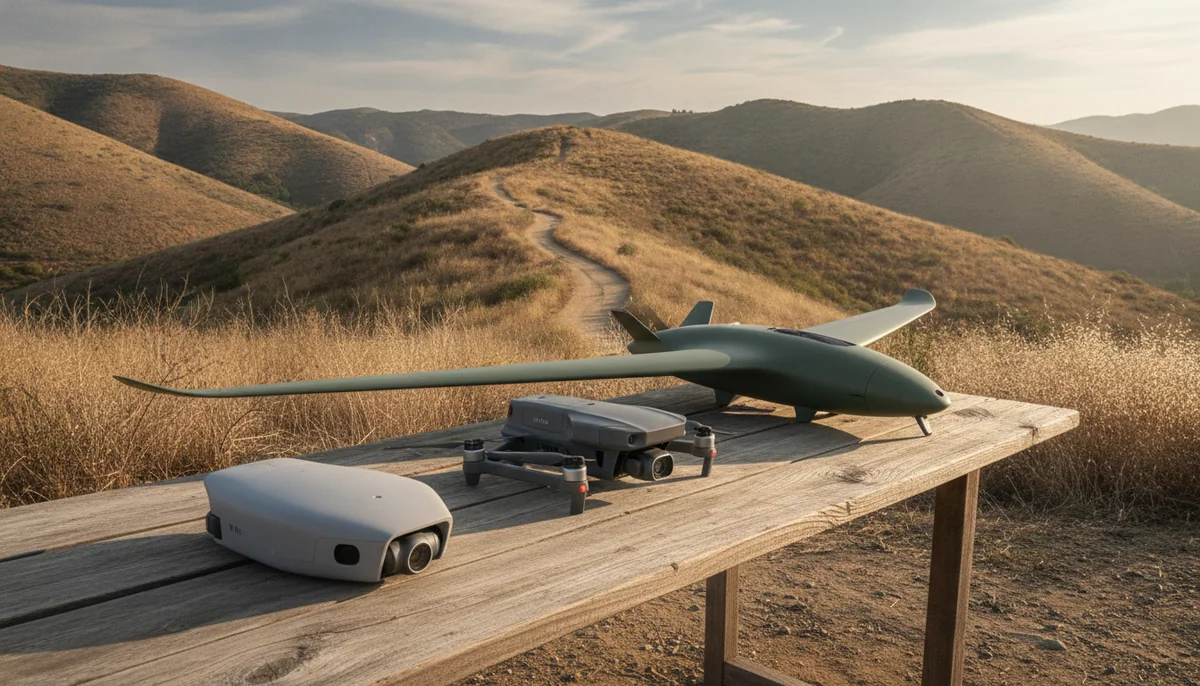
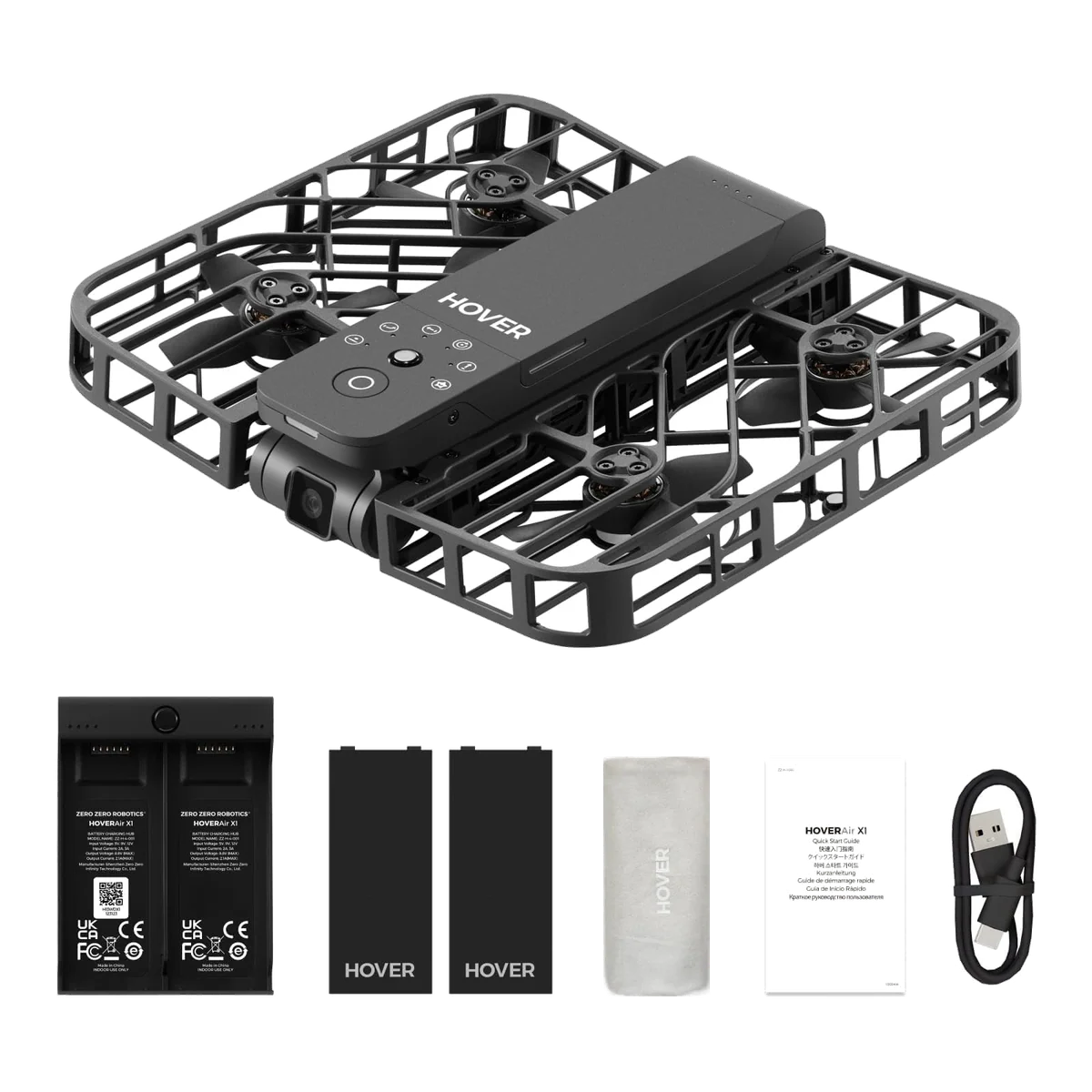
HOVERAir X1
X1 Pro
Start with the thing that makes this comparison hard to research. Most of the good HOVERAir writing on the internet is about the Pro or the Pro Max, and almost none of it flags that the specifications do not transfer downward. The two newer aircraft have a second stabilised axis, a microSD slot, smart batteries that will not fit the original, rear collision detection, roughly double the tracking speed on the maker's own figures, and clearance to fly over water. Read a Pro Max review, buy the cheap one, and you have bought something else entirely.
Quadcopter Bench should be straight about the shape of the evidence here, because it is lopsided. The original X1 has a deep public record: two independent long-form reviews that reached opposite conclusions, several years of owner argument, and our own review of it. The Pro and Pro Max have far less behind them, mostly owner discussion in the brand's community and a long-form review of the Pro Max from a bikepacking tester who reports noticeably longer flights than the base model manages. So this page is confident about what you are leaving behind and more careful about what you are stepping into, and it will say which is which as it goes.
Now the frame that actually decides this. The original X1 has a fence drawn around it in the manufacturer's own FAQ: it is not designed to fly over water, over cliffs, or over terrain without distinct ground texture. Set that next to the fact that it has no GPS and no return to home, so when it loses you or meets wind it cannot beat, it descends and lands on the spot rather than coming back. Those two facts together are the product's real boundary. The upgrade is not a quality tier, it is a permissions tier, and that is why the question of whether to pay it has almost nothing to do with the number of pixels.
At a Glance
| Feature | HOVERAir X1 | X1 Pro |
|---|---|---|
| Price Range | $200–$500 | $3,000+ |
| Finish | Black | — |
| Configuration | Combo Plus | — |
| Check Price on Amazon |
What the extra money actually buys
Here is the whole difference set, with the base column drawn from the record on the model this site has reviewed and the right-hand column from what the maker and owners of the newer aircraft report. Where the record does not support a figure, this table says so instead of filling the gap.
| The difference | Original X1 | X1 Pro and Pro Max |
|---|---|---|
| Stabilised axes | One, so wind moves the frame | Two |
| Storage | 32GB fixed, no card slot | microSD slot |
| Cleared to fly over water | No, ruled out by the maker's own FAQ | Yes |
| Tracking speed | Testers measured a ceiling near 17.6 mph | Roughly double, on the maker's figures |
| Rear collision detection | None; the cage is the safety system | Yes, looking behind |
| Batteries | Non-smart, and they swell if stored charged | Smart, and deliberately not backward compatible |
| Flight time | Ten to twelve real minutes per cell | Longer on the Pro Max by its reviewers' accounts |
| Maximum descent rate | 1.5 m/s, which is what kills downhill use | Not established by the record here |
The second gimbal axis is the one spec-sheet line worth arguing over
The listing for the base model advertises a triple stabilization system. What independent testing found under that phrase is a single stabilised axis, and the consequence shows up exactly where you would expect: image quality scored 4.5 out of 10, the lowest mark that tester gave the aircraft, and wind that pushes the airframe around ends up in the footage because there is no second axis to absorb it. That is the honest case for the Pro. It is not that 2.7K is embarrassing, because a reviewer who shot an entire published review in unedited 2.7K rated the colour and low light as solid. It is that one axis makes the footage conditional on the weather, and two axes make it less so. If you have never had to think about this, our piece on gimbals versus electronic stabilisation explains why the axis count decides how a clip looks more reliably than the resolution does.
The card slot is the difference people put second on their list and should probably put last. Fixed 32GB sounds punishing until you do the arithmetic: at roughly 700MB per minute that is around three quarters of an hour of 2.7K, and nobody flies a follow camera in long takes. Storage is a mild annoyance sold as a privacy feature. It is not a reason to spend.
Speed, gradient and the two numbers that end the argument
The base model's tracking tops out around 17.6 mph, which covers walking, hiking, trail running and mountain biking on the flat or uphill, and does not cover a road cyclist with any intent. What matters is not that it falls behind but how it fails: it does not sprint, it does not wait, it lands, possibly on the road you have just left. Cyclists in HoverAir's own community have been saying this for years, and one well-known cycling channel summed the base X1 up as being like taking a three-year-old to a supermarket, in that it follows you for a while and then decides to do something else. Doubling the tracking speed is the single change that turns that sentence false, and if you ride on tarmac it is worth the entire price difference on its own.
Skiing fails on a different number, and this is the one buyers keep missing because it is buried in the manual rather than printed on the box. The base model cannot descend faster than 1.5 m/s. Point it down any real pitch and you will simply leave it behind, hovering over the slope you were on, and the retrieval is a hike back up through fresh snow. Cross-country is fine. Downhill is not, and no amount of extra tracking speed fixes a vertical limit. Quadcopter Bench has not established what the Pro pair do on descent rate, so if that is your sport, treat the upgrade as unproven rather than solved and go and check that specific figure before you spend.
The battery difference nobody puts in the comparison charts
This is the quiet upgrade and, for a certain kind of owner, the most valuable one. The original's batteries are not smart cells, so they do not bleed themselves down to a storage charge when you leave them alone. HoverAir's own support desk explained the consequence to an owner who lost three of them in two years of gentle use, against a battery warranty of one: cells held at a high charge for long stretches generate gas and swell, whether or not you have been flying. The mitigation is to store them at around 60 per cent, keep them out of heat, and cycle them every month or two, none of which appears on the product page and all of which you have to remember for the life of the aircraft.
The Pro and Pro Max use smart batteries, and they were made incompatible with this model on purpose. Two things follow. First, a maker that redesigns a component and refuses to make it fit the old aircraft is telling you what it thought of the old arrangement. Second, upgrading means buying a whole new set of cells and hub, so the real cost of stepping up is higher than the difference between two headline figures, and the spare batteries in your case become worth nothing to you. Whichever you end up with, buy it with the second battery and the hub. Our usual scepticism about bundle packs does not apply to a flying camera that gets ten to twelve minutes per cell.
What the upgrade does not fix
Rear collision detection is worth having on an aircraft that flies behind you, and it is not obstacle avoidance in the sense a DJI owner means it. Nothing in the record turns any of these three into a drone that will route itself around a tree it is flying towards, and on the base model the cage rather than the sensors is what saves it: one thorough account logged 130 flights with between thirty and forty ending in a crash, several head-on into trunks, with the aircraft still serviceable at the end. That durability is genuinely impressive and it is also the reason the missing sensors have not been a scandal. What avoidance systems actually catch is worth reading before you assume a newer model has bought you licence to stop looking.
None of the three becomes a landscape drone either. The automatic modes track people, the manual mode you fly from the phone is slow and clumsy, and on the base model the usable range is roughly 30 to 50 metres with a ceiling of about fifteen metres above whatever it is flying over. If your reason for wanting a step up is that you want to photograph a valley rather than yourself, you are in the wrong product line and should start at the best camera drones instead.
And newer does not automatically mean better looked after. An owner of a later aircraft in this same line documented a firmware update that made his drone crash on takeoff, a support response that blamed him for flying indoors in a mode explicitly sold for indoor use, and a declined warranty claim. That sits awkwardly against the base model's support record, which is unusually good in owners' accounts, including a large refund on a water kill that was entirely the owner's fault. Buy the newer aircraft for its flight envelope, not for an assumption that the company treats its flagship customers better.
Where the Pro Max stops earning it
The top model is the one this comparison is least enthusiastic about, and the interesting part is that the pushback comes from people who own it. In the brand's own community, Pro Max owners regularly describe it as more aircraft than the job needs and point at the middle model as the sensible buy. The longer flight time its reviewers report is real and it is the one thing the top model offers that a hard day out actually consumes. If you are choosing between the two upgrades rather than between upgrading and not, the burden of proof sits on the Pro Max, and endurance is the only argument this record supports it winning.
Who should stay on the cheap one
Strip out everything above and one group is left holding a very good deal. If you walk, hike, trail run or ride singletrack, the base model's limits are drawn around behaviours you do not have. It goes from pocket to airborne in about five seconds with no phone and no controller, announcing its mode out loud so you never look at a screen. The follow mode that works flies the route you flew rather than a straight line towards you, which is why the lock survives wooded trails that would put a direct-line tracker into a trunk. Nothing in the upgrade improves that particular trick, because it already works.
It is also the cheapest honest way to find out whether you will use a follow camera at all. Plenty of people buy one, use it four times, and discover they do not much like being the subject. Finding that out on the entry model rather than the flagship is worth more than a second gimbal axis, and if you turn out to love it, the aircraft is small enough that keeping it as the one you take when weight matters is not absurd.
The one to buy if you move at human pace and just want to be in the shot
For a solo hiker, trail runner or traveller with nobody to hold the phone, this is the model whose limits you will never meet, and its route-following lock through trees is the part the newer aircraft do not do better.
The non-smart batteries swell if you store them charged, so this is a purchase that comes with a recurring calendar reminder to cycle them every month or two.
Who should not be buying a HOVERAir at all
If you have read this far and your sport is on water, the answer is not the base model and it may not be this brand either, but it is certainly not the cheap one; the clearance to fly over water is the newer aircraft's headline permission and the older one's explicit prohibition. If you want something that follows you and also flies like a normal drone when you point it at a view, the DJI Flip does both jobs at the cost of being something you unpack rather than something you pocket. The obvious head-to-head rival shoots 4K, flies longer and tracks more calmly, and the trade is that the HOVERAir shoots vertical and holds its lock more consistently by owner accounts, though those accounts are made in a community affiliated with the brand and carrying affiliate links, which is worth knowing before you weigh them. We have set that pair out neutrally in the X1 against the DJI Neo, and the wider roundup of drones that follow you is the view from above the whole category.
One last practical note that applies whichever way you go. The base model weighs about 127g on a tester's scale, comfortably under the threshold most registration regimes draw, and that figure belongs to that aircraft alone. Do not assume it carries up the range, check the weight of the model you are actually buying, and read our guide to registration and Remote ID rather than a cheerful Amazon review, because the rules differ by country and move often.
Frequently Asked Questions
Do my existing batteries work if I move up to the Pro?
No, the newer aircraft use smart batteries that were made incompatible with the original on purpose, so the true cost of upgrading includes a fresh set of cells and a new hub.
Can the Pro and Pro Max really fly over water when the original cannot?
Yes, water clearance is the clearest single line between the generations, and the original's own FAQ rules out water, cliffs and terrain without distinct ground texture.
Will upgrading let me film myself skiing downhill?
Treat that as unproven rather than fixed, because what defeats the original on a descent is a 1.5 m/s vertical limit rather than its tracking speed, and this record does not establish the newer aircraft's descent rate.
Is the Pro Max worth it over the Pro?
Only for endurance, since its reviewers report meaningfully longer flights while its own owners keep calling it more drone than the job needs.
Has the cheaper model been left behind on features?
Less than you would expect, because firmware since launch added Snapshot, Dolly Track, Side Track and a gesture-driven control mode that the listing's feature list still does not mention.
Does the original's footage actually look bad?
It looks fine for what it is and unremarkable next to a modern 4K drone, with two specifics worth knowing: vertical framing drops the recording to 1080p, and the phone preview is far coarser than the file the aircraft keeps.
Should I just buy a DJI instead?
If you want calm, cinematic footage of a place rather than aggressive footage of yourself, yes, and the Neo 2 review is the closest comparison point on this site.
Ready to Choose?
Sources (5)
- Amazon listings and customer reviews — Hoverair X1
- Owner reports across r/HoverDrone, r/drones threads
- Bikepacking — Article — bikepacking.com
- Techgearlab — Article — www.techgearlab.com
- Co — Article — dronexl.co