The batteries are cheaper in the box, and on half these drones they are the drone
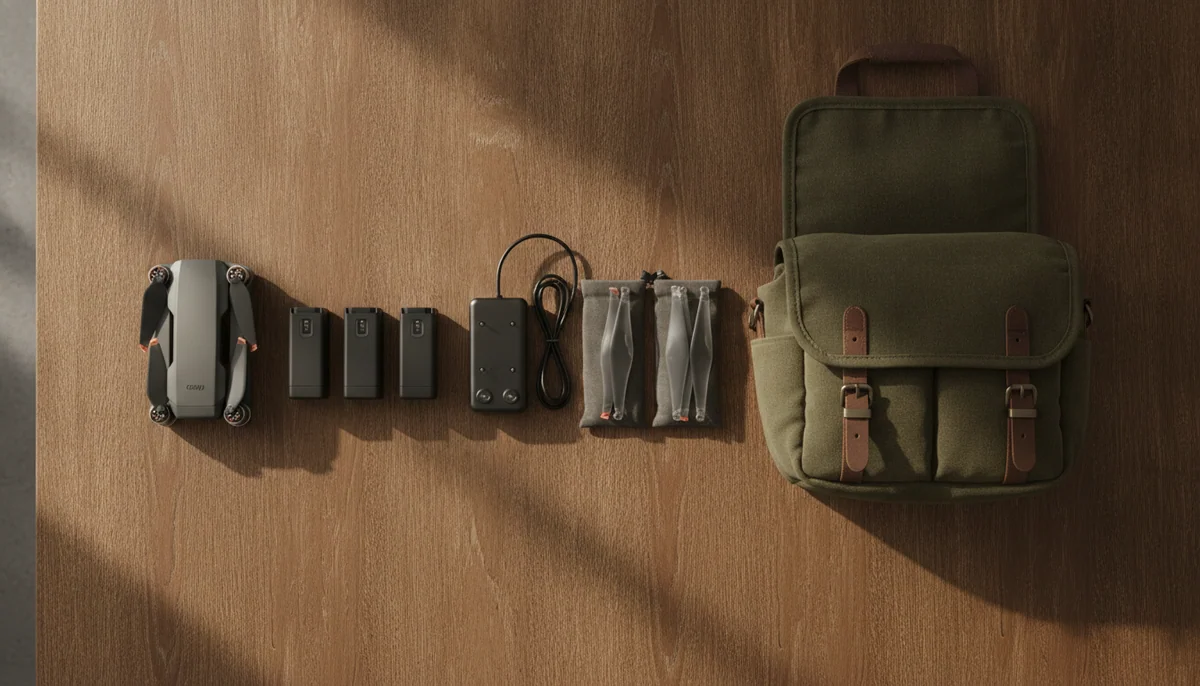
A Fly More Combo is a consistent thing across brands: the aircraft, two more batteries than the base box, a charging hub, usually a bag and a set of spare propellers. What it is not, on any listing Quadcopter Bench read for this piece, is a complete kit. That gap matters, and we will get to it. But the gap is the second question. The first one is arithmetic, and almost nobody does it before buying.
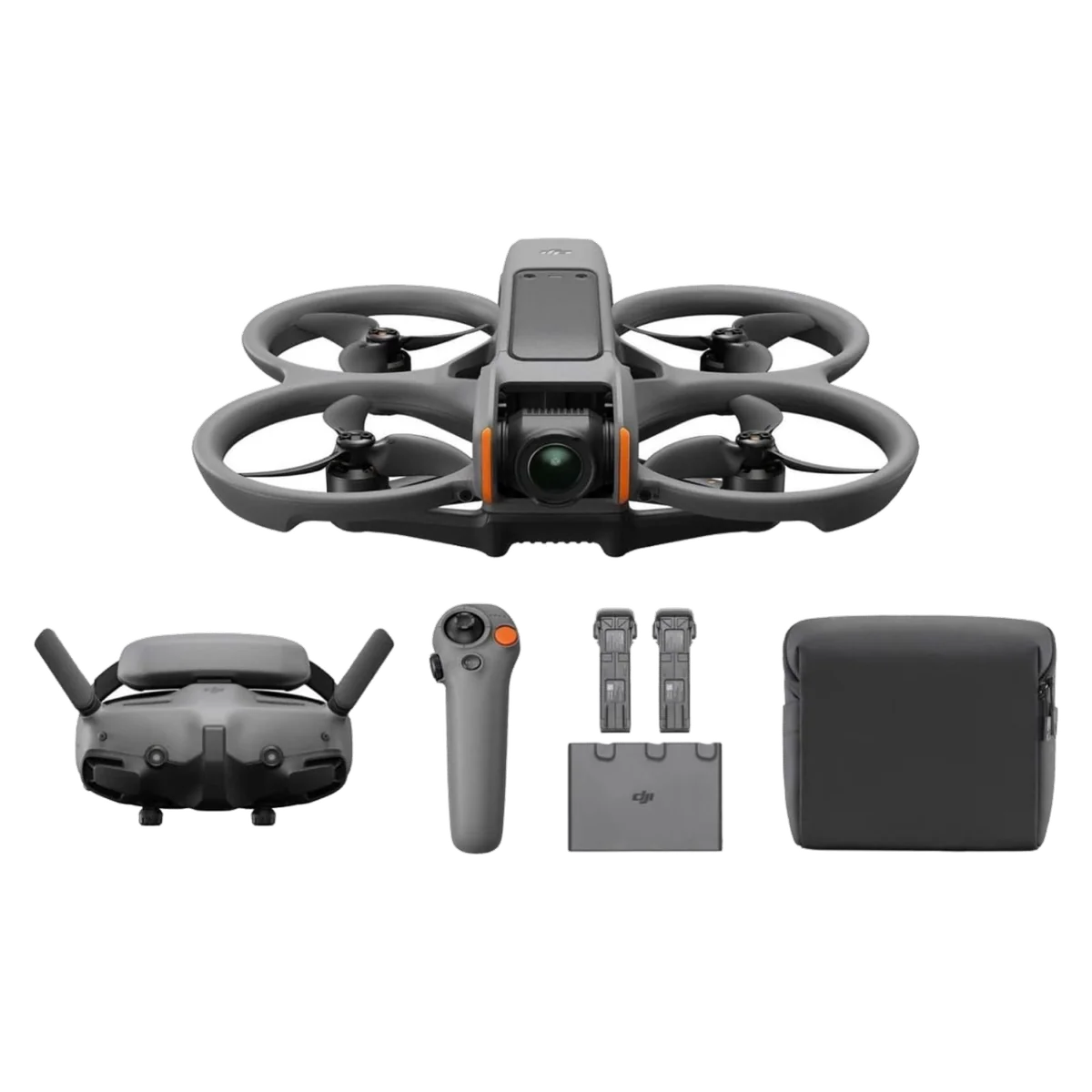
Here is the arithmetic, using the drone with the widest spread between claim and reality. DJI rates the Avata 2 at twenty-three minutes, and the footnote under that number explains how: a constant 21.6 kph, in a windless environment at sea level, with the camera set to 1080p/30 and video mode switched off, flown from a full battery down to zero. Nobody flies like that, and owners consistently report around fifteen minutes, one of them defining his figure properly as full charge down to a twenty per cent landing. Against that, a pack takes roughly forty-five minutes to refill on the hub, or around eighty-eight if you charge it through the aircraft.
Fifteen minutes of flying against forty-five minutes of charging is the entire argument on this page. At that ratio a single battery is not a drone, it is a demonstration. Three batteries and a hub turn the same aircraft into a continuous afternoon, because the first pack is ready by the time the third one dies. The bundle stops being an accessory pack and starts being the operating configuration, and the single-battery box becomes the trap.
One battery, one flight, one wait
Run that ratio across everything this page covers and the drones sort themselves into two groups without much argument.
| Aircraft | On the box | What owners fly | Why the extra packs matter |
|---|---|---|---|
| DJI Neo 2 | 19 min | 10 to 15, and one owner reports a hot pack must cool before it will charge at all | The hub fills three in 68 minutes, so the rotation only works if you own three |
| DJI Avata 2 | 23 min | About 15, up to 17 or 18 if you are gentle | Roughly 45 minutes per pack on the hub against 15 in the air |
| DJI Flip | 31 min, sold as 93 across three | 24 to 25 | An owner puts it plainly: with one battery, driving somewhere to fly is a waste of the journey |
| DJI Mini 4K | 31 min, sold in one, two and three-battery sets | 20 to 28 | The only aircraft here where a single pack is a defensible flight on its own |
| Potensic Atom 2 | 32 min, sold as 96 across three | 15 to 23 | The hub fills all three in about 1.3 hours, which is a day's flying in one charge cycle |
| DJI Mavic 4 Pro | 51 min | No measured figure appears anywhere in our record | Three packs arrive, but they charge one after another until you buy a bigger adapter |
The Neo 2 is the clearest case in the set. DJI advertises nineteen minutes; owners report ten to twelve with the obstacle sensors working, and one who bought this exact bundle tells other buyers to figure on around ten and then adds the detail nobody advertises, which is that a warm pack has to cool before the hub will fill it. The hub does its half of the job well, charging all three in sixty-eight minutes and doubling as a power bank for a phone. None of that helps you if you own one battery. Every one of those figures is the ordinary gap between a laboratory number and a flight, and it is worth understanding how those box figures are produced before you compare any two aircraft on endurance at all.
The Mini 4K is the exception that proves the rule, and it is worth saying why rather than just noting it. DJI sells that drone in one, two and three-battery sets, and states the test conditions for its thirty-one minutes on the listing: a constant 17 kph in a windless laboratory, in photo mode, taking no photographs, from full to flat. Owners land at twenty to twenty-eight. Twenty real minutes is a proper flight, so a first-time buyer working out whether they enjoy this at all can honestly start with one pack. On the Neo 2 or the Avata 2, the same person would be buying a fifteen-minute hobby with a forty-five minute intermission.
What the word "combo" does not include
Every one of these bundles is sold on completeness, and every one of them is missing something that stops you flying or stops you filming on the first afternoon. This is the part of the purchase where the record is most consistent and the marketing is least helpful.
The wall charger. DJI's own description of the Flip ends by stating that the battery charger is sold separately and recommending a 30W or 65W USB-C unit. Wattage is not a nicety here: the hub will not charge two packs in parallel unless you feed it enough power, and one Flip owner says his batteries fill in very little time only because he separately bought a 100W charger. The Neo 2 has the same hole, and an owner spells it out: the charger does not come with a USB adapter, and he had to buy a 60W unit to charge more than one battery at a time.
The memory card. An Atom 2 buyer flags it in capitals in his own review, because the Fly More Combo includes everything you need except the microSD card, and Potensic's listing does not put one in the box. On the Flip the internal storage holds only a handful of high-resolution frames before it is full, so the card is part of the purchase price rather than an accessory.
The case, and the filters. The Neo 2 combo ships without one, which the same owner notes and suggests you budget for. At the other end of the range, the Mavic 4 Pro Fly More Combo carries no ND filters at all, on a drone built around a camera whose entire discipline is controlling exposure.
And on one aircraft, the charger that makes three batteries worth having. DJI's own description of the Mavic 4 Pro is explicit about which box gets what: the Fly More Combo includes three batteries and a charging hub, while the 240W power adapter and the parallel charging hub belong to the 512GB Creator Combo. The practical consequence is the sharpest thing on this page. An owner who unboxed the Fly More version found a 100W brick with two outputs sharing that hundred watts between them, and other owners describe flying for months before realising their three packs were filling sequentially rather than together. Buy the bigger adapter afterwards and you close the charging half of the gap for a fraction of what the step up between combos costs, which is exactly the sum we work through in the Fly More against Creator Combo comparison.
Half of these boxes are selling you a screen, not a battery
The other thing that muddies the question is that "combo" has stopped meaning one thing. Some of these bundles add cells. Some add a controller. Some add both and charge you as though the batteries were the point.
The Flip is sold in four configurations: with the RC-N3 that clamps your phone, with the RC 2 that carries its own screen, as this Fly More box which is the RC 2 plus three batteries and a parallel hub, and as a drone-only two-battery kit that assumes you already own a controller. The Neo 2 Fly More Combo on this page ships the RC-N3, which has no screen of its own and uses your phone as the display, with cables for both platforms in the box. The Atom 2 is the cleanest illustration: the version with the PTD 1 screen controller and the version with the phone clamp contain the same aircraft, the same three batteries and the same hub, so the entire premium is a display, and Potensic states on its own listing that the PTD 1 is compatible with the Atom 2 and nothing else.
Buying the controller separately later is a real option, and the DJI RC 2 is sold that way: a 5.5-inch full-HD screen, four antennas, 420 grams, and a compatibility list on its own listing that names specific aircraft rather than the whole range. The honest drawback is one that owners find rather than reviewers: it has no internet connection of its own, so maps have to be preloaded in small tiles, and one Flip owner who fought that decided he would rather have a cheaper controller tethered to a phone that is always online. Which way you jump is a genuine argument, and we have it out properly in whether you need a real controller at all and in what the RC 2 will actually fly. The point for this page is narrower: before you compare two bundles, work out whether you are comparing cells with cells or cells with a screen.
Box by box, and what each one costs you
The Avata 2 Fly More Combo. Buy this version and no other, because fifteen usable minutes against a forty-five minute recharge makes three packs the minimum viable configuration rather than an upsell. The drawback is not the batteries: this aircraft has no forward obstacle avoidance despite being designed to fly close to things, its return-to-home climbs vertically before it heads for you and will fly straight into a canopy, and true manual flight needs a stick controller that is not in this box.
The Neo 2 Fly More Combo with the RC-N3. Buy it, in this configuration and no other, because three batteries and a hub are the direct answer to this drone's single biggest weakness. The drawback is that the nineteen minutes never happens, that at 151 grams it cannot punch into a headwind and the breeze that triggers warnings is milder than buyers expect, and that neither a case nor a mains adapter comes in the box.
The Flip Fly More Combo with the RC 2. This is the most sensible package in DJI's cheap tier, and the screen removes the friction that stops people taking a drone out at all. The drawback is that it does not broadcast Remote ID, which rules it out of paid flying in the US without a bolt-on module, that the propeller cages act like sails and it starts refusing its cleverer modes in wind well below its published rating, and that obstacle sensing covers forward and down only.
The Mini 4K. This is the one aircraft here where the single-battery box is a defensible purchase, and the cheapest honest way to find out whether you enjoy flying before spending real money. The drawback is everything it does not do: no obstacle sensing in any direction, no subject tracking of any kind, and an Android setup that requires sideloading DJI Fly from DJI's website before the drone can even be activated.
The Atom 2 Fly More Combo with the PTD 1. Worth it when it is discounted hard and the screen is genuinely the thing you want, because the drone underneath is a stable, quiet, properly gimballed sub-250g machine. The drawback is that there is no forward or side obstacle avoidance, 4K is locked to 30fps, the controller works with this aircraft and nothing else including Potensic's own successor, and a slow memory card will stop it recording at all. Our shortlist of what this drone actually needs covers the rest.
The RC 2 on its own. Buy it separately if you already own a compatible aircraft, fly in bright sun and resent the cable and clamp ritual before every takeoff. The drawback is the offline maps, and the compatibility list, which is shorter than most buyers assume.
The Mavic 4 Pro Fly More Combo. If the footage pays for itself, buy the three batteries and then buy the 240W adapter, because that combination costs less than stepping up to the Creator Combo and gets you most of the way there. The drawbacks are stacked: no ND filters, a listing bullet that describes a seven-inch RC Pro 2 which is not in this box, no DJI Care Refresh for US buyers, and owners reporting repair queues quoted in months. If it is a hobby rather than a tool, the money is better spent on the Air 3S and the difference kept for the crash you have not had yet.
The case for buying batteries later, which is stronger than it looks
Everything above pushes one way, so it is worth being straight about where the opposite argument actually wins, because it is not nowhere.
The first and best reason is that batteries age from the date they were made, not the date you first fly them. Three packs bought together age together, and the person who flies twice a year is paying now for cells that will be tired by the time they are needed. The bundled hubs make that worse rather than better: an Avata 2 owner who logged his own discharge curves points out that the hub charges sequentially, reports nothing about temperature, voltage or cycle count, and has no storage-charge mode for packs you are about to leave alone for a month. If you fly weekly none of that matters. If you fly at Christmas and in August, it is a real longevity cost that the bundle quietly hands you.
The second is that the aftermarket sometimes beats the box. The same owner wants a third-party charger of the kind that fills three packs concurrently and shows him what each cell is doing, which the supplied hub cannot. And a Mini 4K owner who bought the basic kit because that was the version on offer went back afterwards for a renewed two-battery-and-charger set, a protection case, a landing mat and filters, and still ended the review advising anyone with the budget to take the Fly More pack instead, because it makes a saving. That is the honest shape of the counter-case: buying later can work, and the people who have done it mostly still recommend the bundle.
The third limit is behavioural rather than financial, and it is the one that decides most of these purchases. Buying later only saves money if you actually buy later, and the drone sitting at home with one flat battery is the drone that does not get flown, which is how nearly-new aircraft end up on the used market with forty minutes on the clock. If you are still working out whether this is a hobby or a phase, start with the cheapest capable aircraft and one pack, and read the shortlist of drones worth learning on before you commit to a bundle at all.
Frequently Asked Questions
Do the spare batteries genuinely cost less inside the bundle?
Owners who have done the sums afterwards consistently report that two spare packs and a hub bought separately eat most or all of the difference between the base box and the combo, which is the pricing pattern these bundles are built around.
How many batteries do I actually need?
Enough that the first one is charged by the time the last one is flat, which on a fifteen-minute aircraft with a forty-five minute recharge means three and on a twenty-five minute aircraft can mean two.
Will a spare pack still be healthy in two years if I barely fly?
Lithium packs degrade on a calendar as well as on a cycle count, and none of the bundled hubs here offer a storage-charge mode, so the occasional flyer is the one buyer with a real reason to buy cells when they need them.
Does the charging hub fill all the batteries at once?
Only if you feed it enough power, which is why the Flip's own description recommends a 30W or 65W charger it does not include and why Mavic 4 Pro owners find their three packs charging one after another until they buy the 240W adapter separately.
Is a memory card included?
No, on any of these, so budget for a fast, reputable card as part of the purchase rather than as an afterthought.
Is the bundle still worth it on a drone that flies for half an hour?
It is a convenience rather than a necessity there, because twenty-plus real minutes is a proper flight, so take it if the gap is small and skip it without guilt if it is not.
Should I pay extra for the version with a screen controller?
Yes if you fly in bright sun or resent the cable and clamp before every takeoff, and no if you were going to use your phone happily anyway, because on the Atom 2 that premium buys a display and nothing else.
Which of these bundles is the weakest deal?
The Mavic 4 Pro Fly More Combo, because it is the only one that supplies three batteries and withholds the adapter that would let you charge them together.
Sources (3)
- Amazon listings and customer reviews
- Owner and reviewer video, 1 channel
- Oscarliang — Article — oscarliang.com