The drone that keeps up with you is rarely the one with "follow me" on the box
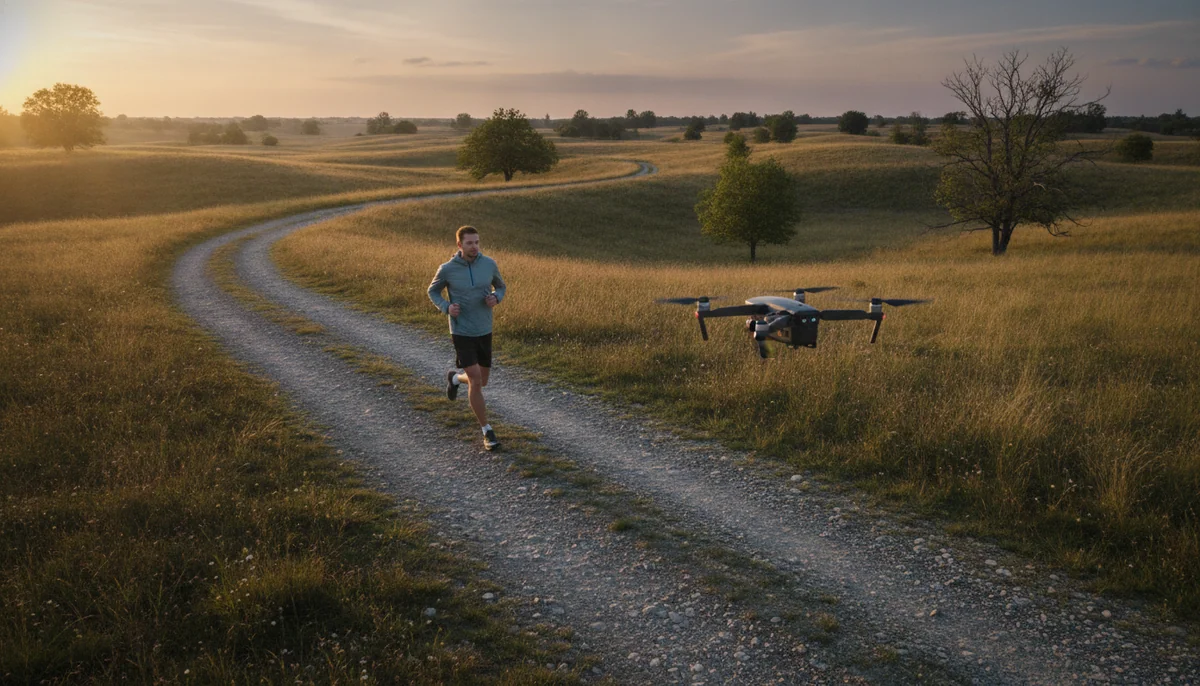
Most of the listings here use the word follow, and it is doing at least three different jobs. On a Neo 2 or a HOVERAir X1 it means a camera that recognises a human being and keeps that human in the frame. On a Potensic ATOM SE or a Holy Stone HS175D it means the aircraft flying toward the GPS position of the transmitter you are carrying, which is the same word attached to a different machine: it is following your pocket, and it would follow your pocket just as happily if you left it on a bench. And on the DJI Mini 3 it means nothing whatsoever, because the tracking modes were withheld from that model entirely and the listing quietly talks about QuickShots and panoramas instead.
The number that decides everything after that is not the sensor count, it is how fast the tracking mode is allowed to go. The original X1's measured ceiling is somewhere around seventeen and a half miles an hour, which covers walking, hiking, trail running and climbing on a bike, and does not cover a road cyclist with any intent. The first DJI Neo is rated at twelve miles an hour, and the owner who spent an afternoon testing it concluded it lost him on any hard turn and could not hold a bike or a scooter past a light jog. The Neo 2 is rated at twelve metres per second, roughly twenty-seven miles an hour, and that one number is most of the reason it sits at the top of this page.
Skiing is where the marketing and the record part company completely. Quadcopter Bench could find exactly one published descent rate across this whole field, and it belongs to the X1: a maximum of 1.5 metres per second down. You will exceed that on any real pitch inside a second, at which point the drone is left hovering above empty snow, and because it has no GPS and no return to home, what it does next is land wherever it happens to be. Cross-country and gentle traverses are inside the envelope. A descent is not, and for every other drone here nobody has published the figure at all, which is not the same as the figure being good.
- Buy one if
- you are the subject of your own footage, you move under your own power, and the alternative is no footage rather than better footage.
- Buy a different kind of drone if
- you want to film scenery, a vehicle, or anything over water, because tracking is built to recognise people and the failure mode over a lake is terminal.
- Spend more than you meant to if
- your riding is fast or your trails are wooded, because obstacle sensing is the difference between a follow shot and a retrieval.
Three different machines, one word on the box
Before the individual picks, here is the sorting that actually matters. Read the middle column first and the third column second, and most of the field disqualifies itself before you have looked at a single camera specification.
| Drone | What follow means here | The limit that decides it |
|---|---|---|
| HOVERAir X1 | Visual, flying the route you flew rather than a line straight at you | Around 17 mph, 1.5 m/s descent, and no return to home when it loses you |
| DJI Neo | Visual, from behind by default | Rated 12 mph, and it drops the lock on hard turns |
| DJI Neo 2 | Visual ActiveTrack with omnidirectional sensing and forward LiDAR | Battery, at a realistic twelve minutes rather than the nineteen advertised |
| Potensic Atom 2 | Visual, in Spotlight, Follow and Parallel modes | Nothing looks forward or sideways at all |
| DJI Flip | Visual subject tracking on a three-axis gimbal | People only, and the caged airframe behaves like a sail in wind |
| karuisrc GPS drone | GPS, following the controller | A short link that owners report giving out well before the advertised distance |
| Potensic ATOM SE | GPS, following the controller | Single stabilised axis, so the horizon tips whenever the airframe leans |
| Holy Stone HS175D | GPS, following the controller | Refuses to engage below roughly thirteen metres, and nothing damps the camera |
| DJI Mini 3 | It does not follow you | The tracking modes were left out of this model |
| DJI Air 3S | Visual, with omnidirectional sensing and LiDAR | 724g, so registration, Remote ID and a drone people can hear |
| DJI Avata 360 | Visual, on a camera that records every direction at once | Any usable crop out of that sphere resolves nearer 2.5K |
What actually saves a follow drone in trees
There are two answers and they are not the same answer. One is sensors: the Neo 2 pairs omnidirectional sensing with forward LiDAR, and the Air 3S carries the most complete array here. The other is a cage, which is why the X1, the Neo, the Neo 2 and the Flip survive strikes that would end a folding aircraft. Cages are the more reliable of the two, because sensors are fallible in exactly the situation tracking creates: Neo 2 owners have watched theirs clip a stop sign and hit a parked car with avoidance switched on. DJI's own copy for the first Neo invites you to dive around your house and through tree branches without worry, on a drone with no forward sensors whatsoever; the guards mean the drone survives the branch, not that it sees it. Our piece on what avoidance actually catches is the longer version of that distinction.
The worst possible combination is a tracking mode with nothing watching where it goes, and the Potensic Atom 2 is the drone that has it. AI Track is the feature Potensic sells hardest, and the aircraft carries only a basic downward vision system with nothing forward or to the sides. There is a second, quieter catch on that model: tracking only engages with the gimbal tilted between roughly twenty-five and seventy-five degrees, which removes a large slice of the shots people imagine when they buy a tracking drone.
Vehicles, water and the two claims to disbelieve
These systems are trained to recognise a person. Point one at a car, a quad or a side-by-side and it will not lock on, whatever speed you crawl at, and Flip owners have documented exactly that. Water is the other hard boundary and it is not a matter of taste: HoverAir's own FAQ says the X1 is not designed to fly over water, cliffs, or terrain with indistinct ground texture, which read alongside the missing return to home tells you precisely how you lose one. If your sport happens on or near water, the base X1 is the wrong model and the Pro and Pro Max exist because HoverAir knew it; we set the three out against each other rather than pretending the cheap one stretches.
The two numbers to discount on sight are flight time and range. Holy Stone's forty-six minutes is two batteries added together, and Potensic's ninety-six minutes is three; both are arithmetic rather than flights. Range claims fare worse on the cheap end, where an HS175D owner lost the camera feed at 210 metres against a settings screen that will happily let you dial in 500. We take the endurance habit apart properly in advertised versus real flight time, and the wind question, which bites hardest on caged drones and on anything near 150 grams, in how much wind a lightweight drone can handle.
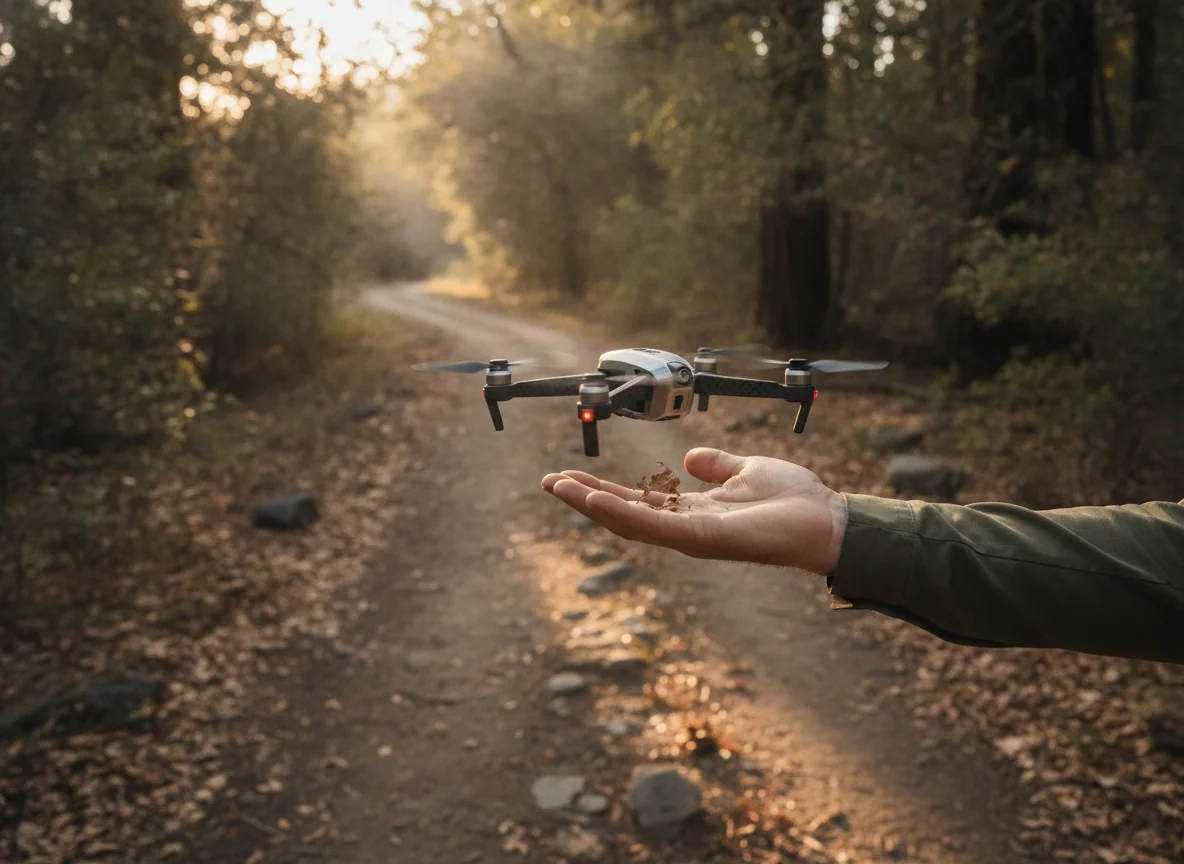
The eleven, sorted by whether they can keep up
The first four are the drones built around the job. The rest are here because they are sold for it, they are bought for it, or they are the honest thing to buy instead.
The one to buy if the drone has to keep up with you
Tracking rated to twelve metres per second, omnidirectional sensing and forward LiDAR are the combination that holds a cyclist or a mountain biker through trees instead of losing them at the first turn.
Nineteen minutes is not achievable and twelve is the honest planning figure, so this is an afternoon of short flights rather than one long one.
The pocket camera for people who move at human speed
It is airborne in about five seconds with no phone and no controller, and its follow mode holds the lock through wooded trail because it flies the route you flew rather than a straight line at you.
It falls behind above roughly seventeen miles an hour, cannot descend faster than 1.5 metres per second, and having no return to home it answers losing you by landing on the spot.
The cheapest honest way to find out whether you will use a follow camera at all
At 135 grams inside a full propeller cage it launches off your palm, needs no flying skill and does the entire trick for less than anything else here.
Follow is rated at twelve miles an hour and drops you on any hard turn, which covers a walk and a steady jog and nothing quicker.
The follow drone for people who care more about the picture than the chase
A 1/1.3-inch sensor on a three-axis gimbal puts it ahead of every other caged drone here on image quality, and its tracking has held a moving rider at road speed down a narrow street.
It tracks people but not vehicles, it cannot turn to look for you again without dropping the lock first, and the propeller cages act like sails once the wind gets up.
Below this line the tracking is either blind, second-hand or absent, and each of these earns its place for a different reason.
Real tracking with a proper camera behind it, and nothing watching where it goes
It is the only drone here that pairs genuine subject tracking with a three-axis gimbal, a screen controller you do not have to bolt a phone to, and 4K HDR.
There is no forward or side obstacle avoidance at all, which is the worst possible pairing with a mode whose entire purpose is to send the aircraft chasing you past trees.
The follow drone for the day the wind is up
Seven hundred and twenty-four grams of mass is what holds a frame steady in gusts that leave a caged 150-gram drone bouncing, and the 70mm second camera lets it track you from far enough away that you cannot hear it.
It must be registered and it broadcasts Remote ID, the obstacle sensors switch off entirely in Sport mode, and owners report visible wobble while tracking in heavy wind even when the recorded footage stays smooth.
Point it near yourself and decide where the camera was looking afterwards
Recording the whole sphere means the tracking shot no longer has to be framed correctly while it happens, which is the closest thing on this page to a guarantee you came home with it.
Any normal-looking crop out of that sphere resolves nearer 2.5K than 8K, and every clip has to pass through DJI's own software before it becomes usable footage.
GPS follow at the price of a decent pair of running shoes
It holds a hover, comes home accurately to within a metre or two and survives learning, which is a lot of aircraft for very little money.
Follow Me here is the drone chasing your controller's GPS position rather than seeing you, and the single stabilised axis cannot keep the horizon level while the airframe leans into wind.
A trainer that happens to have a follow mode, rather than the other way round
It hovers steadily, returns to its launch point accurately and shrugs off the crashes a first month contains, which is exactly what a first GPS drone should do.
Follow Me silently refuses to engage below roughly thirteen metres, nothing damps the camera against the airframe, and the video link gives out a couple of hundred metres out.
A follow-me label attached to a beginner's GPS quadcopter
The screen built into the controller and the sub-249g weight make this the cheapest way to get a GPS aircraft with automatic return into the air without a phone in the loop.
An owner measured the link at half the distance printed on the box and then watched the drone fly itself into a tree while trying to come home, which is a poor foundation for any mode that sends it away from you.
The one here that does not follow you at all
It earns a place on this page as the thing to buy instead, because if what you actually photograph is landscape rather than yourself, the flight time, the vertical shooting and the screen controller all beat everything above it.
FocusTrack and ActiveTrack were withheld from this model entirely, so every shot of a moving subject has to be hand-flown from start to finish.
Two honest notes about the cheap end. The karuisrc listing promises Follow Me, Waypoint and Orbit alongside a 400-metre control distance, and the owner record on that listing is a beginner's record rather than an athlete's: easy to fly, decent value, and one buyer whose drone auto-returned itself into a tree when the signal dropped. The ATOM SE's Sport mode is gated on battery temperature, which is a specific problem if the plan was to film in snow. None of that makes either a bad first drone, and our beginner shortlist is where they belong; it makes them the wrong purchase for a page about keeping up with a moving human.
Quadcopter Bench has not flown any of these aircraft. Everything above is a reading of the public record for each one: the manufacturers' own listings and footnotes, the customer reviews those listings retain, and the published hands-on reviews and owner threads by people who did fly them, checked against each other. Where the record disagrees with itself, and it does on how twitchy the X1's tracking feels and on how much wind any of these will take, we have said so instead of picking the tidier answer.
Frequently Asked Questions
Which of these will genuinely stay with me on a bike?
The Neo 2 by a clear margin, with the Flip and the Atom 2 capable of road speed in a straight line, while the X1 and the original Neo both fall behind anything faster than a hard jog.
Will any of them follow me downhill on skis?
Not on a real descent, because the only aircraft here with a published descent rate is capped at 1.5 metres per second and nobody has published the figure for the rest, which makes cross-country and slow traverses the defensible claim and a fast run down a slope an expensive guess.
What is the difference between GPS Follow Me and proper subject tracking?
GPS follow sends the drone toward the coordinates of the controller in your hand, so it is chasing a radio rather than a person, while visual tracking recognises your body in the frame and keeps the camera pointed at it.
Can one of these follow my car or my quad?
No, because the tracking on every drone here is built to recognise people and simply will not lock on to a vehicle at any speed.
Do I have to register a follow-me drone?
Most of this field sits under the 249-gram line and stays clear of US recreational registration, but the Air 3S is well over it and any paid flying changes the answer regardless of weight, which is what our registration and Remote ID guide is for.
Can any of them follow me over water?
Treat that as a no across the board, since the downward sensors these drones rely on have nothing to read over water and the X1's maker states outright that the aircraft is not designed for it.
If the drone flies itself, do I still want a controller?
Yes for anything except the shortest clips, because a controller is what turns range from the limiting factor into a non-issue and unlocks the manual camera settings the automatic modes never expose, an argument we make in full in whether you need a real controller .
Which of these survives being flown into a tree?
The caged aircraft, meaning the X1, the two Neos and the Flip, with the Avata 360's ducted body in the same category, while the folding drones here treat a branch strike as a repair rather than an anecdote.
Is the 360 camera drone a gimmick for this kind of filming?
It is the opposite of a gimmick for action, because recording every direction at once removes the one thing that ruins most follow shots, namely that the camera was pointed slightly wrong at the moment that mattered, though you pay for it in resolution and in an evening at the computer.
Which one should I buy if I mostly want landscape footage and occasionally want to be in the shot?
Something with a real camera and no tracking at all, because a Mini 3 or an Air 3S will make everything except the follow shot look better, and the Mini 3 review and our camera drone roundup are where that decision lives.
Is a three-battery bundle worth it on a drone like this?
On the caged trackers it genuinely is, because twelve real minutes per pack is the constraint that shapes a whole session, which is the rare case where the Fly More Combo argument comes out in favour.
Why does my footage still look shaky if the drone is holding position?
Because the airframe leaning into wind is a separate problem from the camera being stabilised, and a single-axis or electronic system cannot level a horizon the way a three-axis gimbal can, which our gimbal explainer works through properly.
Our Top Recommendation
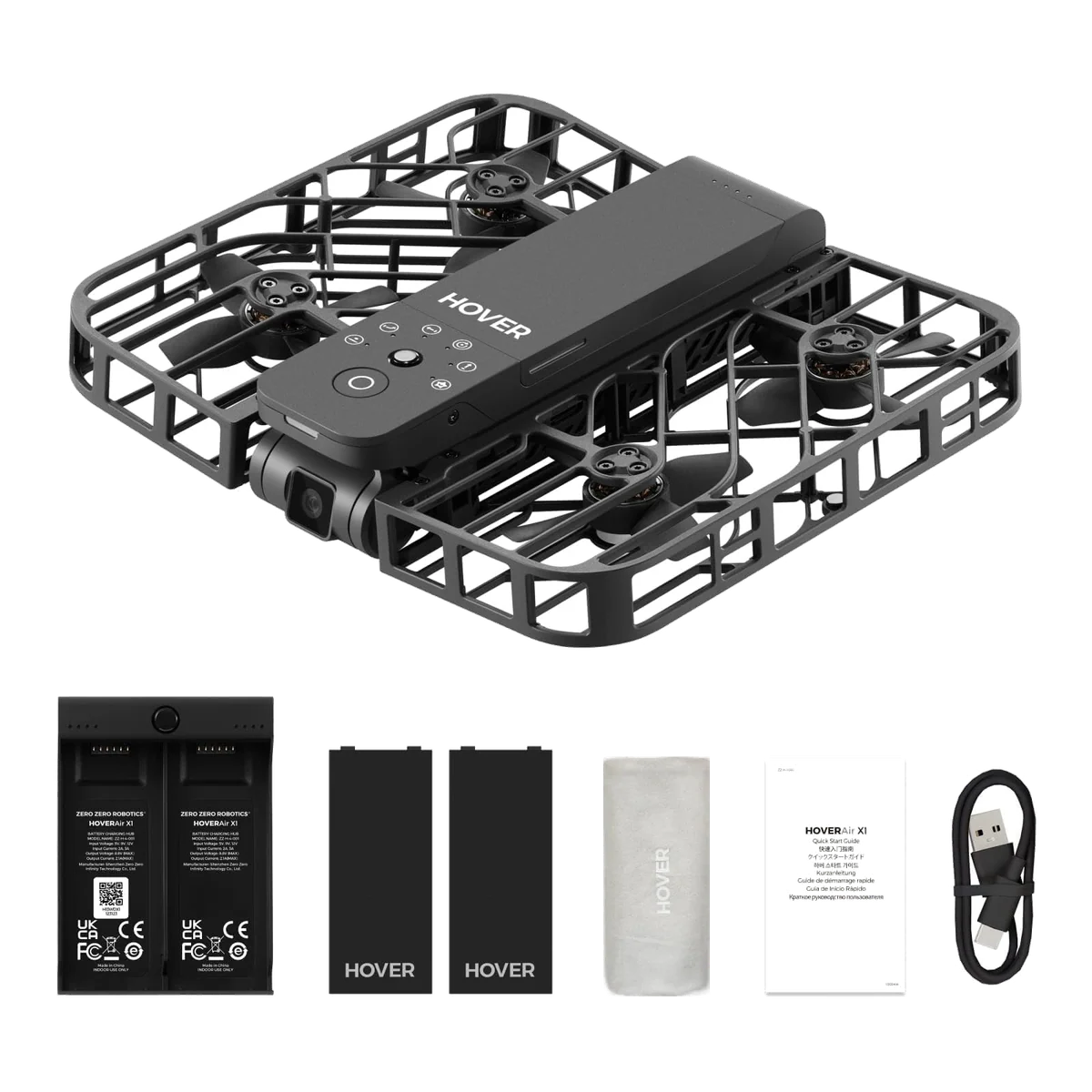
Based on our research, the HOVERAir X1 is our top pick — follow me drones.
Sources (5)
- Amazon listings and customer reviews
- Owner reports across r/HoverDrone threads
- Co — Article — dronexl.co
- Techgearlab — Article — www.techgearlab.com
- Firstquadcopter — Article — www.firstquadcopter.com