DJI Avata 360 review: buy it for the shot you never had to frame, not for the 8K
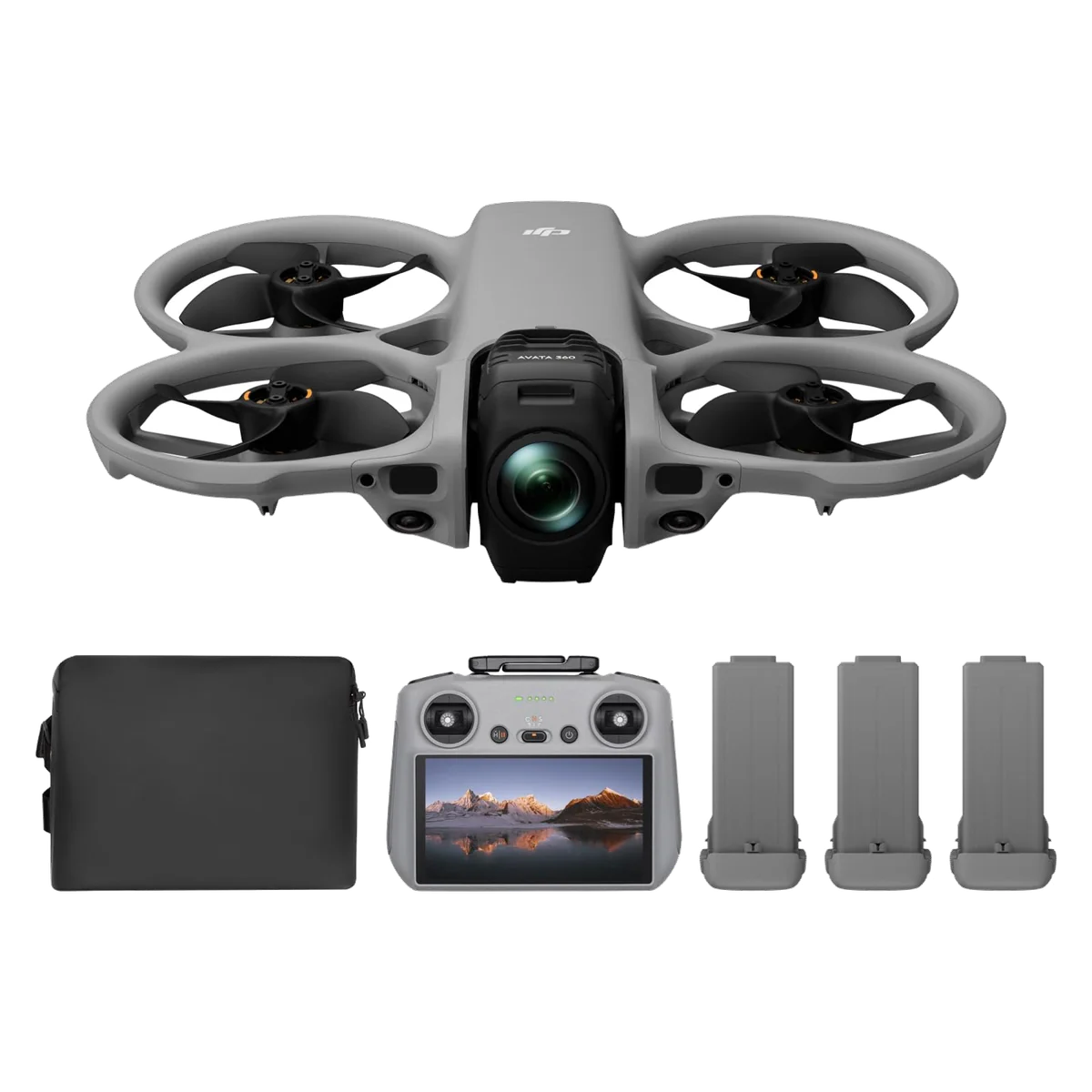
Buy the Fly More Combo with RC 2 if you want moving shots that no single-lens drone can produce and you accept that you will edit them into existence afterwards; walk away if what you actually want is sharp 4K, long flights, real acro, or a drone you can send a long way from where you are standing.
Based on 227 owner ratings, 3 owner discussions and 5 other sources. We have not tested this machine ourselves.
We earn a commission if you buy through our links, which does not affect what we say.
Read how this site works →
Who should press the button
Buy it if you film movement: bikes, boards, boats, anything that will not hold still while you frame a shot, and anything where you get one attempt. Buy it if you already work with 360 footage and the words "reframe in post" describe a Tuesday rather than a chore. Buy it if you shoot alone and the spotter requirement has been keeping you out of goggles anyway, because the RC 2 solves that specific problem better than anything else in the lineup.
Do not buy it to fly. The Avata badge is the single most misleading thing about this product, and the people warning that it would sell to freestyle pilots who would then be disappointed were right. Do not buy it as your only drone if you also need a clean, sharp establishing shot for a client, because a Mavic 4 Pro or an Air 3S will make that shot look better with a fraction of the post-production. And do not buy it expecting 8K, in the sense the word normally means.
What you are buying, and what the record supports, is a guarantee. Point it at the thing, fly for four minutes, and the shot exists whether or not you were looking the right way at the time. For the right person that is worth more than sharpness, and it is worth every one of the tolls above.
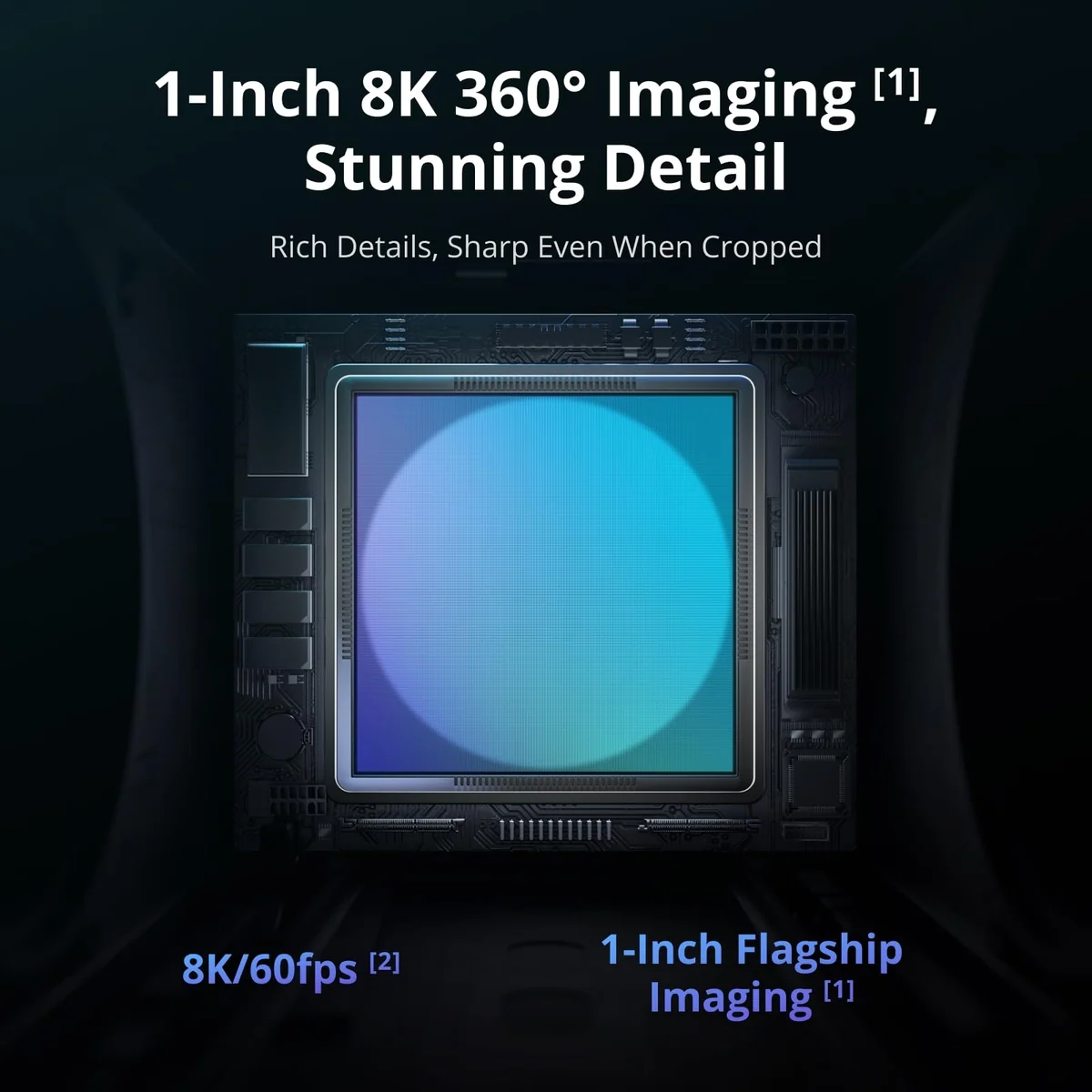
Almost every argument about this drone is really an argument about one number. The listing leads with 8K, and 8K is true, in the sense that the sphere the Avata 360 records is 7,680 pixels around. It is not true in the sense a buyer hears it. A normal drone shot covers something like a third of that sphere, and a third of 7,680 is roughly 2,560 pixels across, which is short of 4K and a long way short of what a Mini or an Air puts on the same screen. The people who have flown it say the same thing in plainer language: reframe hard and the file behaves like 2.7K, not like 8K.
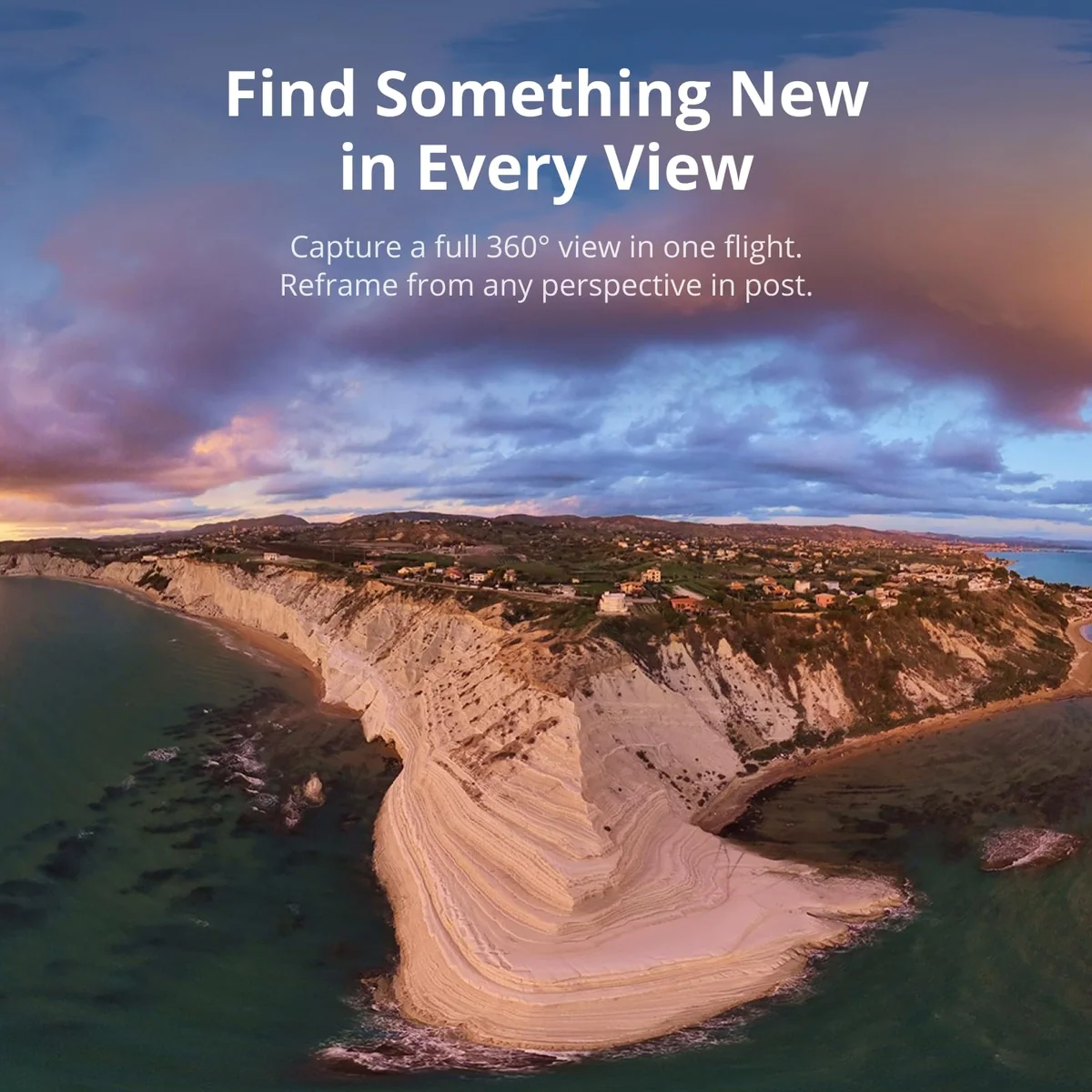
So the honest pitch is not resolution. It is that you point the drone near the thing and you have already filmed it, from every angle, and you decide where the camera was looking after you land. One pilot with eight years and a shelf of home-built quads behind him described cutting a finished video out of about thirty minutes of total flight time, and said it had become the drone he grabs on the way out of the door. That is the product. If that sentence excites you, the rest of this review is a list of the tolls you pay for it. If it does not, buy a DJI Air 3S and enjoy a sharper picture and a longer flight.
Quadcopter Bench has read every hands-on account of this aircraft that exists in public, and the striking thing is how consistent the complaints are and how consistent the enthusiasm is. Nobody who has flown it says the image beats a conventional camera drone. Nobody who has flown it says the shots are ordinary either. One working filmmaker's summary is the fairest line written about it: you can create shots with this drone that simply are not possible with any other.
Key Specifications
What the listing claims, and what the record found
Four of the bullets on this listing need translating before you can act on them. None of them is a lie. All of them are doing more work than a reader will assume.
| The claim | What it means in use |
|---|---|
| 1-inch 8K 360° imaging | Two 1/1.1-inch sensors, described as 1-inch-equivalent in the listing's own footnote; the 8K is measured around the whole sphere, so any normal-looking crop out of it lands nearer 2.5K. |
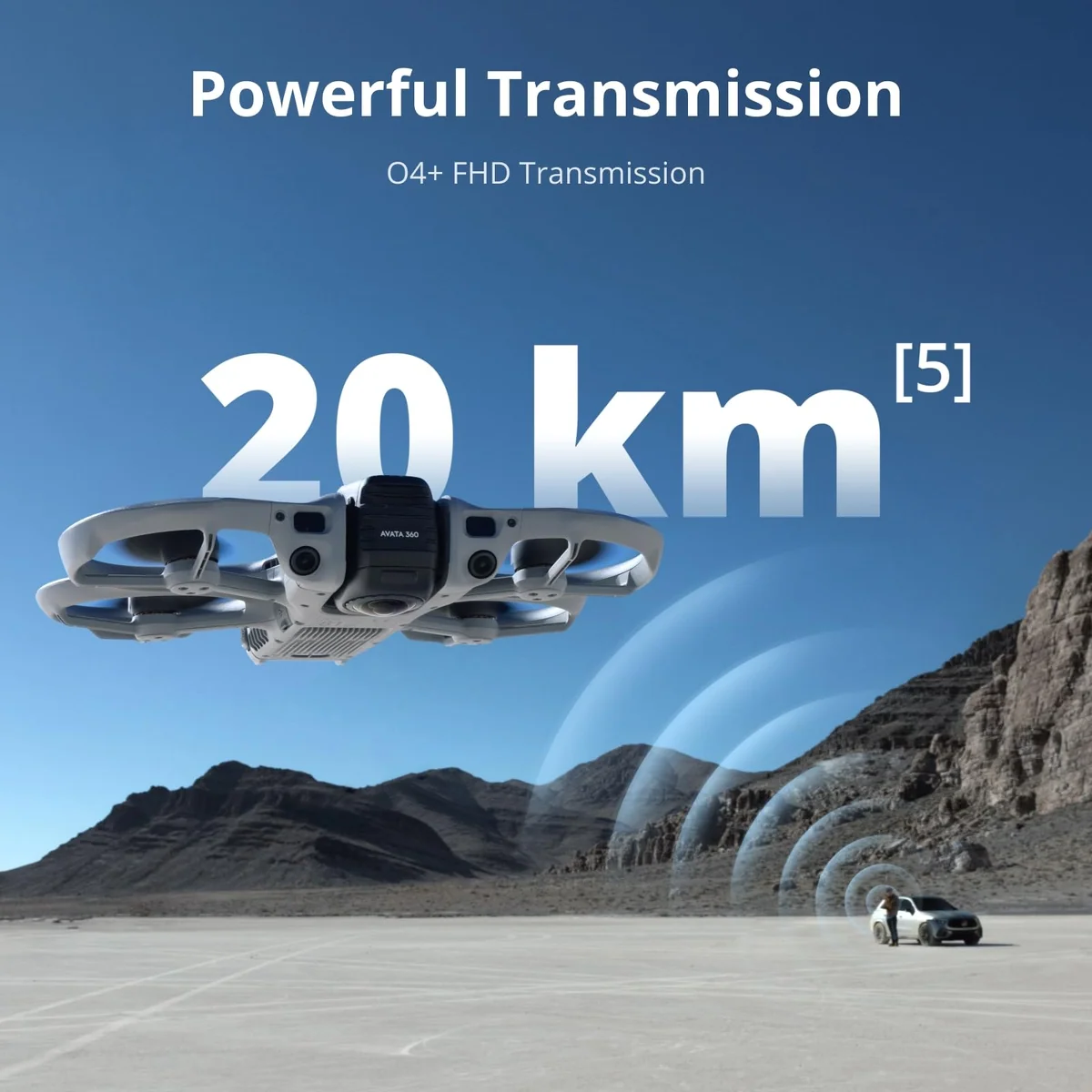
| O4+ transmission, up to 20 km | A best-case figure; in an open field with no obstructions, the link warned at about 3,700 m and dropped at 3,970 m into automatic return-to-home. |
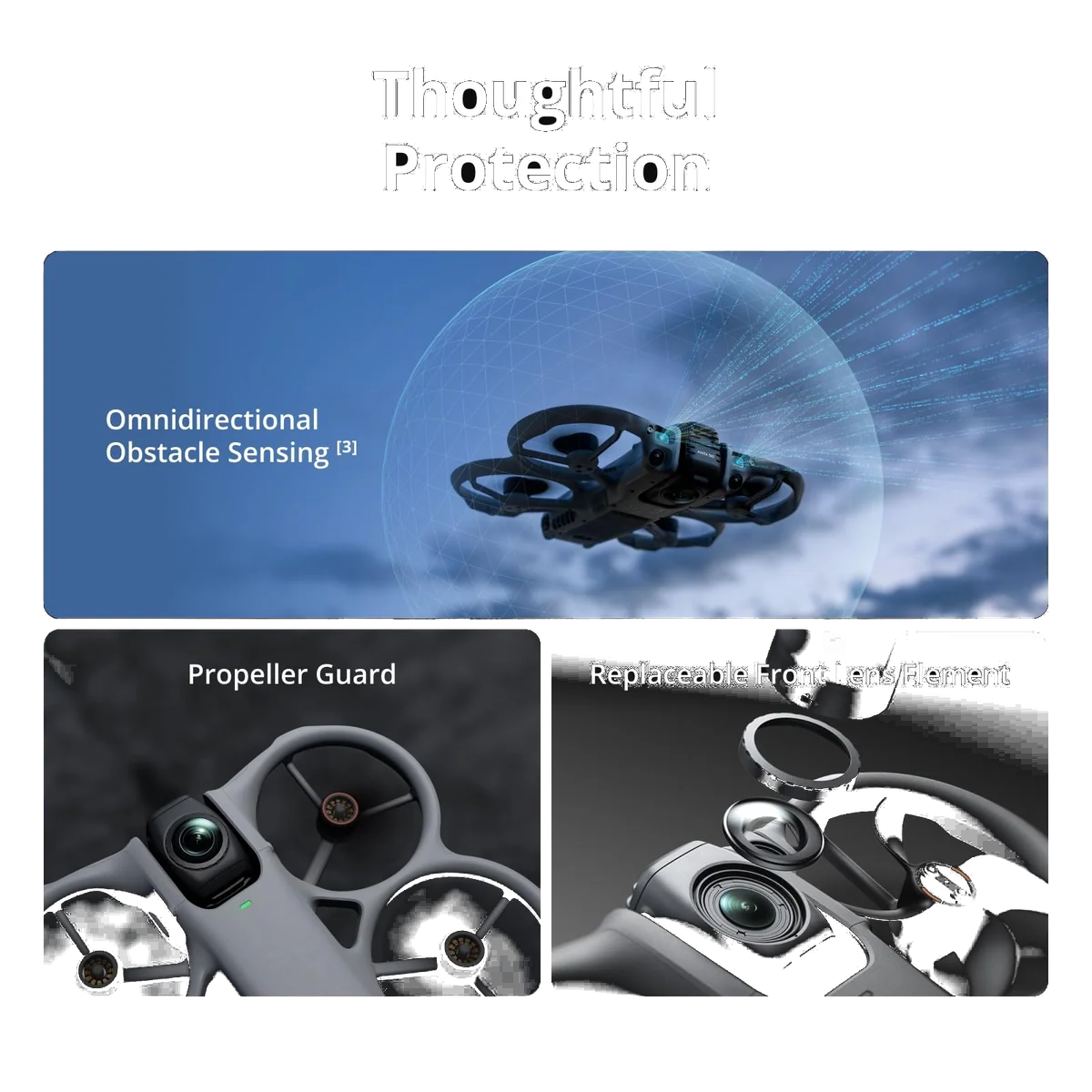
| Omnidirectional obstacle sensing | Front vision sensors with LiDAR and downward time-of-flight, with the all-round part derived from the two main cameras, which means single-lens mode falls back to front and downward only. |
| Classic Avata-style filming | There is no full manual mode, only an assisted "Easy Acro"; the flips are performed for you. |
The range figure is the one that should change a purchase. That measured drop happened in an open flight field at a constant seventy metres with low interference, and the same reviewer held a stable link well past seven kilometres on the same RC 2 controller with a different aircraft. DJI's own published table is more candid than the Amazon bullet, giving something like 1.5 to 4 km in a city and dropping under a kilometre once buildings get between you and the drone. Treat the twenty as marketing arithmetic and plan your flights around a couple of kilometres at best.
The 8K number deserves one more sentence of defence, because it is not worthless. It is what makes reframing survivable at all, and it is genuinely generous for stills: the spherical photo comes out at 15,520 by 7,760, which leaves enough headroom to crop into something that still looks like 4K. The rule a working user landed on is the one to remember: the wider you leave the final shot, the better it looks, because the more of the captured pixels you are actually using.
Strengths & Limitations
Strengths
- Reframing after the flight means you rarely come home without the shot, which changes how much you have to plan and how long you have to stay in the air.
- The ducted airframe takes bumps that would end a folding drone, including a branch strike the sensors missed.
- The RC 2 lets you fly this alone and line of sight, with no spotter and no goggles.
- Spherical stills at 15,520 by 7,760 leave enough pixels to crop hard and still look like 4K.
- 10-bit capture with a D-Log M profile gives the footage real colour latitude despite the modest per-crop resolution.
- Single-lens 4K/60 mode is there when you want a conventional shot without a second aircraft.
- It undercuts the only comparable 360 drone by a wide margin.
Limitations
- Any normal-looking crop out of the 8K sphere resolves closer to 2.5K, so it is beaten on picture by every conventional camera drone at this money.
- The measured link dropped just under four kilometres in ideal open conditions, against a listed twenty.
- There is no true manual mode, only assisted acro, which makes the Avata name misleading for anyone buying it to fly freestyle.
- Every clip has to pass through DJI Studio before it becomes usable footage, and 8K spherical editing needs a capable computer.
- Obstacle sensing is front and downward hardware with the all-round part derived from the cameras, and it drops to front and down only in single-lens mode.
- At around 455 g it needs registration and Remote ID, and it is loud enough to hear from five hundred metres.
- Single-lens footage cannot roll to compensate, so a gust that makes the aircraft lean puts a slight Dutch tilt in your shot.
How it flies, and where the guarantees run out
The flying itself is the least controversial part. It is a ducted design with integrated prop guards, it takes off from a table indoors, and it shrugs off contact that would end a folding drone. During tracking tests it clipped a small branch that the sensing missed, wobbled, and carried on; a conventional airframe would have gone down. That is the whole case for a cinewhoop body, and it holds.
The sensing itself should not be trusted past that. It is front-and-down hardware wearing an omnidirectional label, it is less precise than the dedicated vision arrays on the Mini and Air series, and it is switched off entirely in Sport mode. Thin branches and wires defeat it the way they defeat every system of this kind, which is the same conclusion we reach in our guide to what obstacle avoidance actually catches.
Flight time is rated at twenty-three minutes and one recorded flight in moderate wind, with the camera running, landed at nineteen with seven percent left. By the standards of how badly drone battery claims usually overpromise, that is unusually honest of DJI. It is still short, and it is short in a way that matters more here than elsewhere, because a 360 capture means you can afford to fly less and still come back with more angles. The independent reviewer who called battery life the drone's weakest point and the owner who said the batteries are plenty are both right; they are describing different flying.
Two things will surprise people coming from a Mini. First, it is loud, audible from around five hundred metres, which rules out discreet flying in a park or over a quiet street. Second, at roughly 455 g it is nowhere near the 249 g line, so registration and Remote ID apply even for recreational flying. The Remote ID is worth noting as an advantage rather than a chore: it is what makes this drone usable by licensed pilots, unlike the cheaper DJI models that omit it.
The thing FPV pilots need to hear first
This is not an Avata 2 with a better camera. It has no true manual mode, and the assisted acro tricks are performed by the aircraft rather than flown by you. Worse, some of the spectacular Avata 360 footage circulating is reframing rather than flying: rotate the virtual camera hard enough in post and straight-and-level flight looks like a roll. If you want to throw a quad around, buy the Avata 2 or something from our FPV shortlist, and read our head-to-head between the two Avatas before you decide. The clearest published advice on that fork puts it well: take the Avata 2 for a simpler workflow and footage you can use immediately, take the 360 if you enjoy editing and want maximum creative control.
Why the RC 2 changes what you are buying
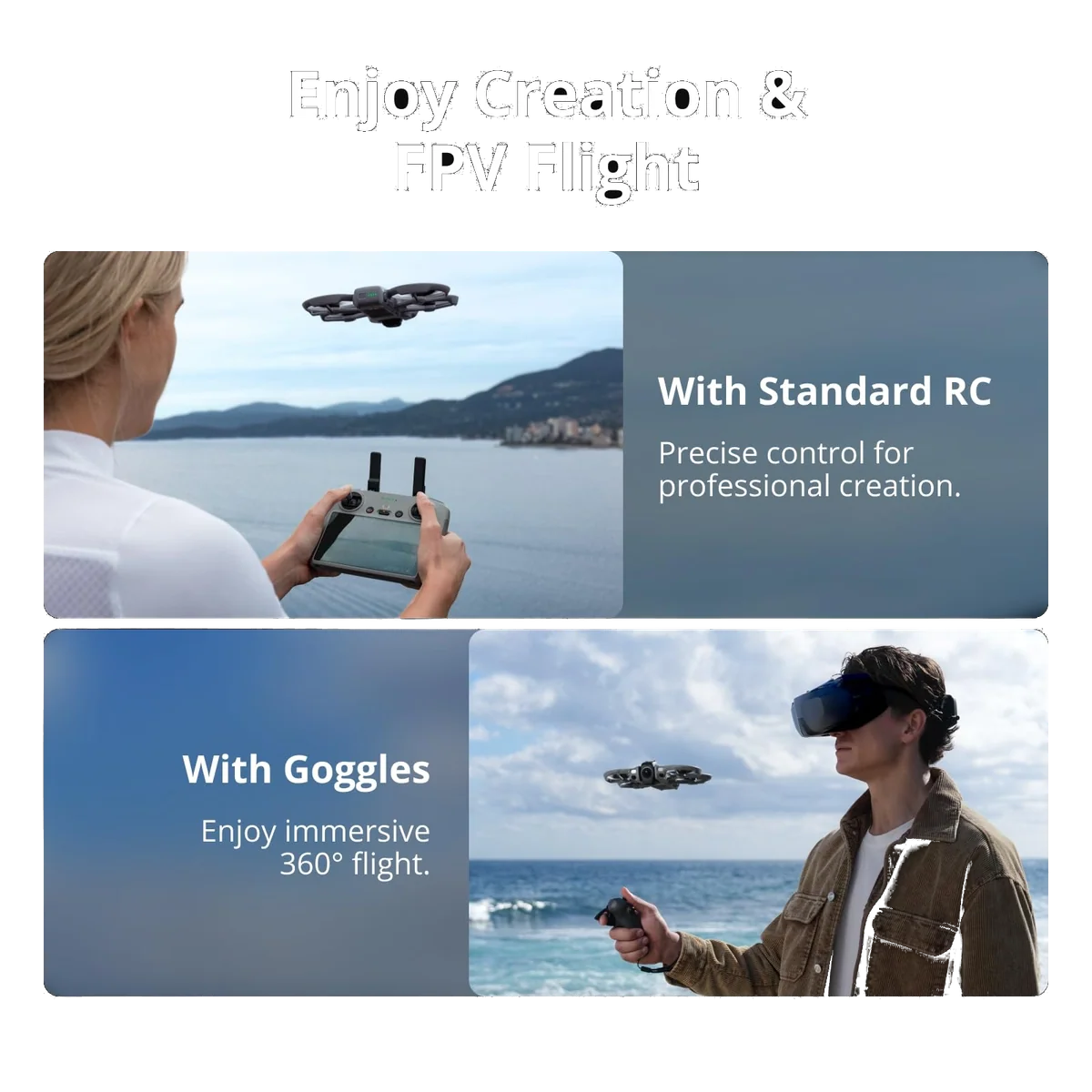
The controller in this box is a decision, not a packaging detail. The RC 2 has its own screen, so you fly line of sight, alone, without a spotter, which in most jurisdictions is what goggles legally require you to have. For a solo creator that is not a compromise, it is the reason to pick this configuration over the goggles bundle. The experienced owner who bought both setups reached the same conclusion by a different route: the goggles are his favourite way to fly it, and the RC 2 is the one he actually uses.
The catch is real and easy to miss. An RC 2 cannot be paired with the goggles, so if you buy this bundle and later decide you want the immersive experience, you are buying a Motion 3 or an FPV controller as well, not just the headset. If you already own DJI kit, our page on which drones the RC 2 works with is the faster way to check what you can reuse; note that the RC Pro 2 is not on the compatible list for this aircraft.
On the combo question itself: this is one of the few cases where the Fly More upsell is not really an upsell. Nineteen usable minutes per pack, on a drone whose entire method is fly briefly and reframe later, means three batteries and a charging hub are the working configuration rather than the luxury one. The box also contains a folding landing pad and a camera protector, neither of which appears in the listing bullets, plus spare props, the sling bag and a cellular dongle for the controller.
Against the obvious rival, the Antigravity A1, the Avata 360 wins on price, on being flyable with a normal controller rather than goggles only, on having a single-lens 4K mode at all, and on having prop guards for indoor work; it loses on weight, on flight time and on noise. We lay that out properly in the Avata 360 against Antigravity A1 comparison.
What owning it actually costs after the purchase
The editing tax is the part nobody budgets for. Footage lands in DJI's own .osv format and has to go through DJI Studio, where you reframe, level the horizon and set the field of view, before it becomes something an ordinary editor can open. Once you know what shot you want it is quick; the danger is that you can get lost in a file that contains every possible shot. The owner who loves this drone lists exactly two complaints alongside the missing FPV mode, and one of them is that 360 footage fills storage fast and needs a decent computer or phone to process. Internal storage is 42 GB, a single five-minute clip can exceed six gigabytes, and a card is not optional. If you are still weighing whether the format suits you at all, our piece on what 360 capture really buys you is the place to start.
There is one stitching artefact worth knowing about before it ruins a shot. When the drone is close to something, or changes speed or direction sharply, the seam between the two lenses can travel through the frame. DJI improved this before release, but the advice from someone who watched it happen is to bank a turn or slow gradually rather than stopping hard, if you want to keep that part of the take.
The lenses stick out, and they are meant to. The camera module rotates 180 degrees on takeoff and landing to keep the glass off the ground, and the lenses are designed to be swapped by the owner in the field with a kit, because DJI expects them to get scratched. One reviewer's warning is that shuffling the drone around on the ground before launch can spin the module and rest a lens on the dirt.
The unresolved question: buying this in the United States
Sources that ought to agree do not. One buying guide states flatly that new DJI releases including the Avata 360 have not been allowed on sale in the US directly because of the FCC covered list, and notes that some importers find ways around it. A US reviewer, meanwhile, gave the drone an Editors' Choice award in a lineup they describe as vetted for availability. A third hands-on reviewer says no official US availability is expected and that warranty repairs may be problematic for grey-market units, and advises buying a spare lens kit or two on that basis.
Quadcopter Bench cannot resolve that from the public record, and will not pretend otherwise. What we can say is what it means for you: check who the seller of record is before you commit, expect that service may be awkward, and read our standing explainer on the DJI situation in the US and what to do about insurance now that Care Refresh has gone. On a drone this size, designed to be flown near things, cover is not an upsell. One more practical note from the listing itself: the DJI Fly app has been pulled from Google Play, so Android owners download it from DJI's site.
Frequently Asked Questions
Is the DJI Avata 360 actually a good drone?
It is a very good 360 camera platform and a mediocre camera drone, so it is good if you want shots that are impossible otherwise and disappointing if you want the sharpest picture at this price.
How far can it really fly?
The listing says up to 20 km, but an open-field test saw signal warnings at about 3,700 m and a disconnect at 3,970 m, and DJI's own published table drops the figure under a kilometre once buildings are in the way.
Does it fly in full manual like a proper FPV quad?
No, it offers an assisted "Easy Acro" mode where the aircraft performs the tricks for you, and there is no true manual flight mode.
Should I get the Mini 5 Pro class of drone instead?
If image quality is your first priority, a conventional camera drone will beat this on every static shot, so the Avata 360 only makes sense if movement and reframing matter more to you than pixel-level clarity.
Can I use FPV goggles with the RC 2 version?
Not with the RC 2 alone, because that controller cannot pair with the goggles, so goggle flight also requires a motion or FPV controller bought separately.
Is the Fly More Combo worth it over the single-battery kit?
Yes, because usable flight is around nineteen minutes per pack and the whole method of this drone is short flights you reframe later, so three batteries and a hub are the working setup rather than a luxury.
Do I have to register it?
Yes, it weighs roughly 455 g, which is well over the 249 g threshold, so registration and Remote ID obligations apply even for recreational flying.
Should I wait for the next one?
Only if you specifically want manual acro, since the successor the FPV crowd is waiting for is a single-lens Avata rather than a better 360, and waiting will not make this drone's footage sharper.
Sources (7)
- Amazon listings and customer reviews — Dji Avata 360
- Owner reports across r/dji, r/fpv threads
- Provideocoalition — Article — www.provideocoalition.com
- Firstquadcopter — Article — www.firstquadcopter.com
- Pcmag — Article — www.pcmag.com
- Oscarliang — Article — oscarliang.com
- Digitalcameraworld — Article — www.digitalcameraworld.com