Learn on the drone you can afford to break, not the one you want the footage from
Most people shop for a first drone the way they shop for a first camera. They read sensor sizes, they weigh 4K against 4K, they stretch the budget by a hundred and then some, and four weeks later a branch takes the whole thing out of the sky and the lesson learned is that drones are expensive. The useful way round is the other way round. Decide what your first crash is allowed to cost, then buy the most forgiving aircraft that fits inside that number, and treat the camera as the thing you upgrade after you have proved to yourself that you like this.
The record supports that more strongly than the marketing does. Holy Stone owners describe crashing the HS175D into trees, knocking it out of a twenty-foot branch and flying it again the same afternoon. DJI Neo owners report flying into tree branches with the aircraft none the worse for it. A first-time Neo 2 owner crashed his and found not a scratch on the case. None of those people are describing luck. They are describing cheap mass, enclosed propellers, or both, which is the entire engineering answer to the beginner problem.
| You are shopping on this page if | You are shopping on the wrong page if |
|---|---|
| You have never flown anything with GPS and want the aircraft to park itself when you let go of the sticks. | Someone is paying you for the pictures, which changes the legal question before it changes the shopping question, and sends you to the drones built for paid work. |
| You expect to hit something in the first month and would rather that be a story than an insurance claim. | You already know your ambition is landscape and light, in which case start with the camera drones and accept a more expensive education. |
| You want to stay under the 249 gram line that keeps recreational flying simple in the US. | The actual job is a camera that keeps itself pointed at you while you move, which is a different mechanism and a different shortlist. |
Ten aircraft are covered below and they are not ten versions of the same thing. Three of them are, to be blunt about it, a different category wearing the same words, and Quadcopter Bench has kept them on the page rather than pretending they do not exist, because a great many first drones are bought at that end and buyers deserve to know exactly what the trade is. The rest split into machines that make you fly and machines that fly themselves, which is the real fork in this decision.
What actually brings a first drone home
Strip the listings down and there are three features that decide whether a beginner's aircraft survives its first month, and they are not the three features that get the bold type.
Satellites, and a button that uses them
GPS position hold is the difference between a drone and a toy. It is what lets you take your thumbs off the sticks in a panic and have the aircraft simply stop and wait for you, which more than one owner on this page credits with saving the drone outright. Return to home is the other half of it, and on the better aircraft here it is genuinely precise: ATOM SE owners report it landing eighteen inches from the pad, and a Mini 4K owner who lost the radio link mid-flight reconnected to find the drone already on its way back to him. Anything without both of those is a drone you will eventually walk into a hedge to retrieve, assuming you can find the hedge.
Something between the propellers and the world
Cages are the other answer, and they are a genuinely different philosophy from GPS. A caged drone does not avoid the tree, it survives the tree, and it lets you launch from an open palm without thinking about your fingers. The cost is aerodynamic and it is real: guards are surfaces for air to push against, so caged aircraft are slower, land sooner and get shoved around by breezes that a bare airframe of the same weight would shrug off. That trade is worth understanding properly before you buy, and what a lightweight drone can genuinely take is where the numbers live.
The two things beginners overpay for
The first is obstacle avoidance. It is worth having and it is not worth relying on, and the evidence for that comes from the drone on this page that has the most of it: Neo 2 owners report the sensing catching almost everything and then watching it clip a stop sign, hit a parked car and, in one case, track its subject straight into a child's bike helmet. Treat it as a backup rather than a guarantee, and read what these systems actually catch before you pay a premium for them.
The second is resolution. Every listing on this page says 4K or 1080p and almost none of them mean the same thing by it, because what makes drone video look expensive is not pixels but stabilisation. A three-axis mechanical gimbal isolates the camera from the airframe. Electronic stabilisation crops and warps the frame after the fact and cannot level a horizon while the aircraft is leaning into wind. The difference is the whole reason cheap drone footage looks the way it does, and we have set it out separately.
Every flight time on this page, decoded
The single most consistent piece of dishonesty in this category is the endurance figure, and it is dishonest in a way that is technically true. Read the table before you compare any two of these on the number printed on the carton, then read how the box figure gets assembled if you want the mechanism.
| The drone | The claim | What it means |
|---|---|---|
| Holy Stone HS175D | 46 minutes | Two batteries added together; owners land at roughly twenty minutes a pack, and low-battery return fires before either is empty |
| DJI Neo | 18 minutes | One battery, and ordinary flying puts it nearer fourteen or fifteen |
| RELIDOL PK01 | 25 minutes | Two batteries, and the same listing's own description concedes ten to twelve minutes each |
| FAKJANK F417PRO | No figure published | Nothing to check, and the only endurance comment in the owner record is a one-star complaint that the battery drains fast |
| karuisrc GPS drone | No figure published | Nothing to check; one owner puts the modular packs at fifteen to eighteen minutes |
| Potensic ATOM SE | 62 minutes | Two claimed thirty-ones; owners consistently report twenty-two to twenty-five each |
| DJI Mini 4K | 31 minutes | A windless laboratory run in photo mode to a flat battery, against twenty to twenty-eight in the air |
| DJI Flip | 93 minutes | Three claimed thirty-ones; owners report twenty to twenty-five per pack across three separate flights |
| DJI Neo 2 | 19 minutes | One battery, and owner accounts cluster at ten to fifteen with the sensors working |
| Potensic Atom 2 | 96 minutes | Three claimed thirty-twos; an owner measuring properly gets about twenty-three per pack |
Two conclusions fall straight out of that table. The first is that no drone on this page flies for meaningfully more than half an hour, whatever the box says, so plan sessions in twenty-minute blocks and buy the multi-battery bundle if the gap is modest; the case for and against that upsell is its own argument. The second is that a manufacturer willing to add three flights together and call it one number is telling you something about how it writes the rest of the listing.
The ten, and who each one is honestly for
The two aircraft at the top of this list arrive at the same destination by opposite routes. One is a cheap GPS trainer that expects you to fly it and does not much mind if you break it. The other removes flying from the equation almost entirely and puts a cage round everything. Between them they cover most first-time buyers, and everything after them is either a compromise on price or a step up in ambition.
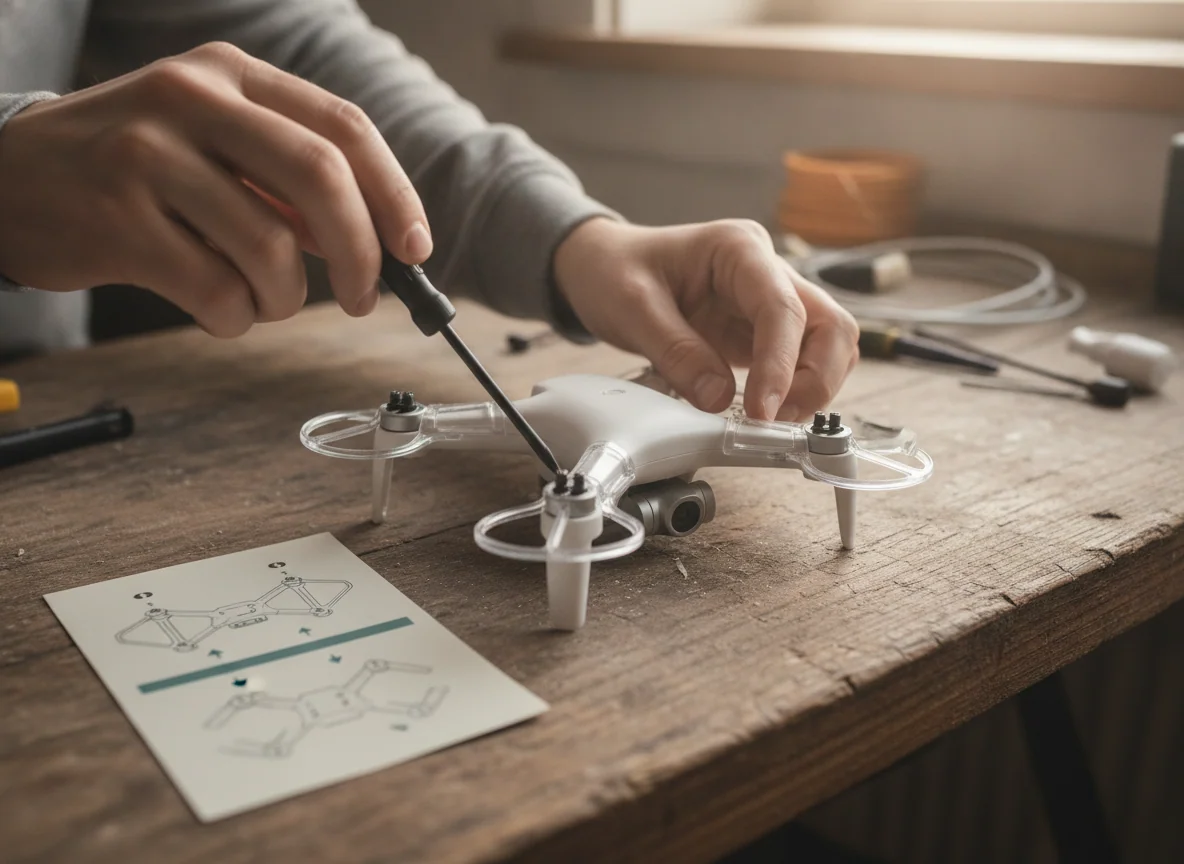
The one to learn on if you are certain you are going to hit something
GPS hold and return to home here are the real thing rather than a bullet point, the airframe absorbs crashes that would end a more expensive drone, and two batteries, a hard case, eight spare propellers and the screwdriver to fit them come in the box.
Nothing damps the camera against the airframe, so every stick input and every gust goes straight into the video, and no amount of practice will fix hardware this aircraft does not have.
The cheapest honest way to find out whether you enjoy being in the air at all
It lifts off your open palm with no controller to pair and no satellites to wait for, the full cage takes tree strikes and hard landings, and internal storage means there is no memory card to forget at home.
There is no obstacle sensing of any kind, so the guards protect the drone rather than prevent the collision, whatever the listing's invitation to dive through tree branches implies.
Below those sits the part of the market where the word beginner is doing the heaviest lifting, and where Quadcopter Bench thinks buyers deserve a warning rather than a euphemism. The next three aircraft cost a fraction of the ones above and below them, and two of the three have no satellite navigation at all. That is not automatically a bad purchase. It is a completely different purchase, and the thing you are giving up is the thing that brings a drone back.
A garden toy that is honest about being one, right up until it is not
For what it costs it hovers steadily on brushless motors, the screen built into the controller keeps your phone out of the flight entirely, and the fairest description in the whole record comes from an owner who called it a drone to fly within your yard.
There is no GPS and no return to home, the usable range is about a hundred feet, and the sharpest account on the listing describes an aircraft that repeatedly stopped answering the controller and flew away while the video feed carried on as normal.
A screen on the controller, and a specification the owner record keeps contradicting
Optical flow hold, a screen that means no phone pairing and a folding body with a case are exactly the right features for somebody's first ten minutes in the air, and most owners describe getting it flying within a few minutes of opening the box.
Two separate owners say the footage is not the 1080p on the box, and one describes an aircraft too fast to control at its lowest speed setting that later would not lift off on a fully charged battery, against a review count small enough that a handful of accounts move the whole average.
Satellites, brushless motors and a big screen, for the money the toys above it cost
On paper this is the shape a beginner's drone should be, with GPS auto return, a 4.5-inch display on the controller, a sub-249 gram airframe and spare propellers in a foam-lined case, and the owners who got it into the air describe precisely that.
The documentation defeats people, with owners reporting instructions that never explain how to trigger the return home at all, one aircraft that stopped responding to climb and descend and was never found, and another that hit a tree after an automatic return fired well short of the range printed on the listing.
From here upward everything is a genuine aircraft, and the question stops being whether it will come back and starts being what you want to be doing while it is up there. The ladder runs from a plain GPS trainer through a properly gimballed camera to two caged machines that will film you while you move.
The forgiving GPS trainer for someone who wants sticks rather than gestures
It hovers without visible drift, comes home to within a foot or two of where it left, and gives you a real radio link with the phone cabled into the controller instead of a phone shouting at a drone over Wi-Fi.
The stabilisation is electronic and the lens is fixed at the wide end with no zoom of any kind, not even digital, so the horizon tilts when the airframe leans into wind and the only way to get closer to anything is to fly closer to it.
The one to buy if you want to learn to fly rather than to be filmed
A three-axis mechanical gimbal, GPS that parks it in mid-air and a return to home owners describe landing within inches make this the least dramatic first drone here, on an airframe old enough to be thoroughly debugged and shared with an enormous stock of spares.
It has no obstacle sensing and no subject tracking whatsoever, so it will not film you and it will not see the branch, and Android owners have to sideload the app from DJI's own site before it will even activate.
The forgiving one for a beginner who already cares what the footage looks like
Folding carbon cages make palm launches and flights near people genuinely safe, and behind them sits the best camera on this page by a clear margin, with the screen controller and three batteries in this configuration removing the two things that stop people taking a drone out.
Those cages behave like sails, so the aircraft starts refusing its cleverer modes and asking to come home in wind that would not trouble a bare Mini, and the wall charger the parallel hub needs is not in the box.
The best answer for a beginner who is going to be in the shot
Cages, omnidirectional sensing and palm launch combine into the drone people on this page fly most boldly and crash with least consequence, and the tracking holds a cyclist at full speed in a way nothing else here manages.
Plan on twelve minutes a battery against the nineteen advertised, and remember that at 151 grams it cannot punch back into a headwind once the breeze gets up.
The most camera on the page, with the least protection around it
A three-axis gimbal, a bright screen controller that removes the phone from every flight, three batteries and a hub that fills all of them together make this the most complete kit here when it is bought well below its list.
There is no forward or side obstacle avoidance at all, which is the wrong pairing with tracking modes built to send the aircraft chasing a moving subject past trees, and the 48 megapixel stills the listing calls 8K are heavily sharpened JPEGs only.
Two comparisons settle most of the remaining hesitation. If you are torn between the two cheap GPS trainers, the head to head between them comes down to whether stabilised video matters to you at all. If you are torn between the two caged DJIs, the Flip against the Neo 2 is a straight swap of camera quality and endurance for tracking and pocketability. And if you have got as far as the gimballed pair at the top of the price range, the Atom 2 against the Mini 4K is the argument worth having, because one of them tracks and the other does not. Anyone who has decided the whole point is to stay under the registration threshold should read the sub-249 gram roundup, and anyone whose ceiling is firm and low should look at the cheaper end of the camera drone market instead of the bottom three here.
Frequently Asked Questions
Should you buy something cheap to practise on before spending real money?
Only if the cheap thing has GPS, because a drifting non-GPS aircraft teaches you to fight a machine rather than to fly one, and the practice routine that actually works matters more than the badge on the airframe.
Do you have to register a drone that weighs under 249 grams?
Not for recreational flying in the US, though the free knowledge test still applies and paid work needs registration and certification regardless of weight, all of which the rules page sets out properly .
Is Holy Stone a brand worth buying into, or should you save up?
For a first GPS drone it is defensible on price, durability and a support department that tends to send replacements, which is the fuller argument our piece on the brand works through.
Are Potensic drones as good as DJI?
Not quite, and the gap is narrower than the forums claim and widest in software polish rather than flying, which the comparison in full takes apart model by model.
Why will the motors not start on a new Holy Stone?
Almost always because both sticks need to be pulled down and inward together on a level surface with satellites acquired, since down and outward is a different gesture entirely, and the pairing and calibration sequence has to be completed first.
Do you need a controller with its own screen?
You do not need one, but it removes the cable, the clamp and the app launch from every takeoff, and whether a real controller earns its price is a bigger question than the screen alone.
Is obstacle avoidance worth paying for on a first drone?
It buys you margin in cluttered space and nothing at all against thin wires, so buy it if you fly among trees and buildings and skip it if you fly in open ground, with the detail on what gets through worth reading first.
How much wind can a drone this small actually handle?
Less than the rating on the box implies, and caged aircraft give up first because the guards act as sails, which is measured out in our piece on lightweight drones in moving air .
What should the first flight look like?
Open grass, no trees, a full battery, satellites locked before takeoff, and one deliberate press of the return-to-home button while the drone is still close enough to walk to.
Our Top Recommendation
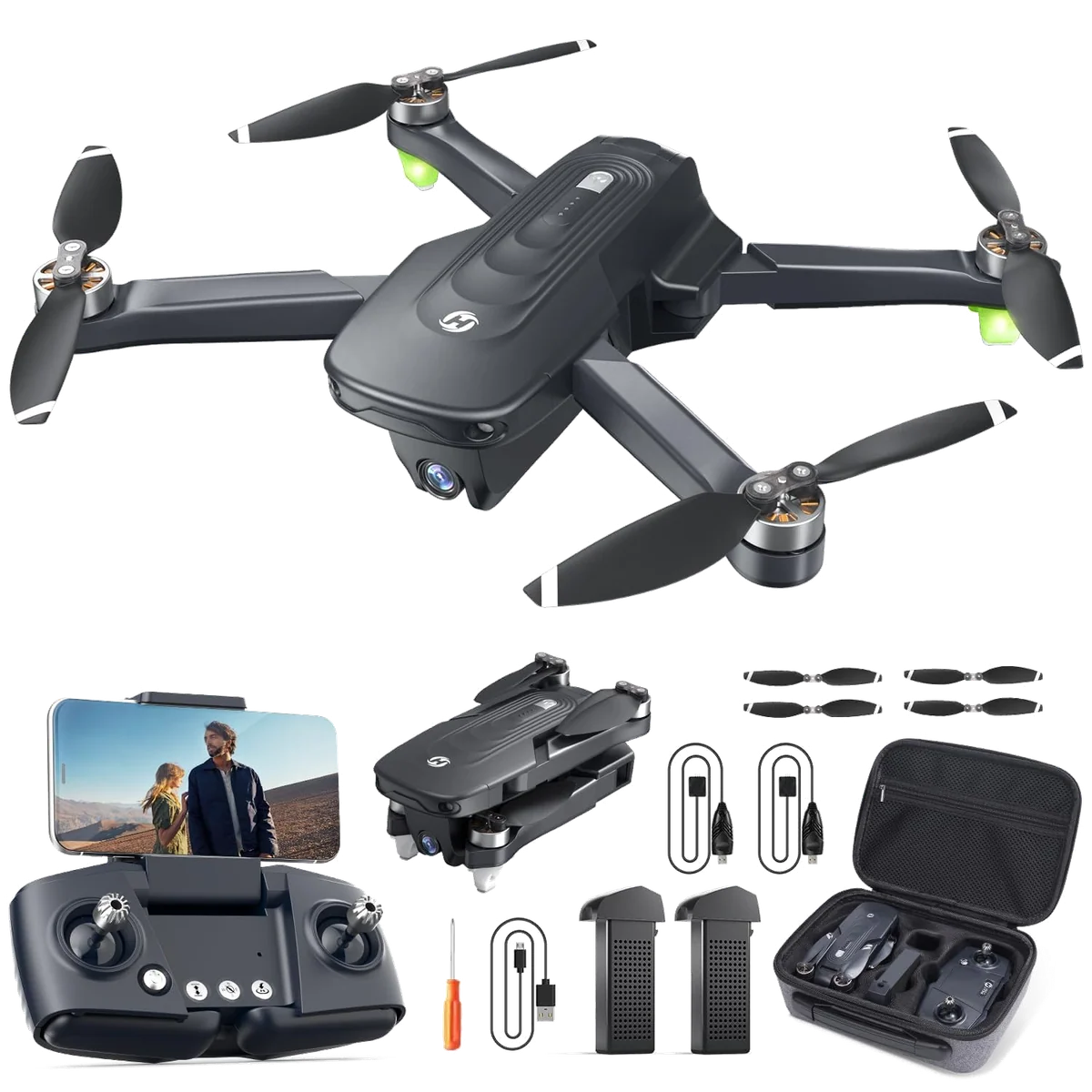
Based on our research, the Holy Stone HS175D is our top pick — beginner drones.