Holy Stone HS175D review: the drone you learn on, not the one you film with
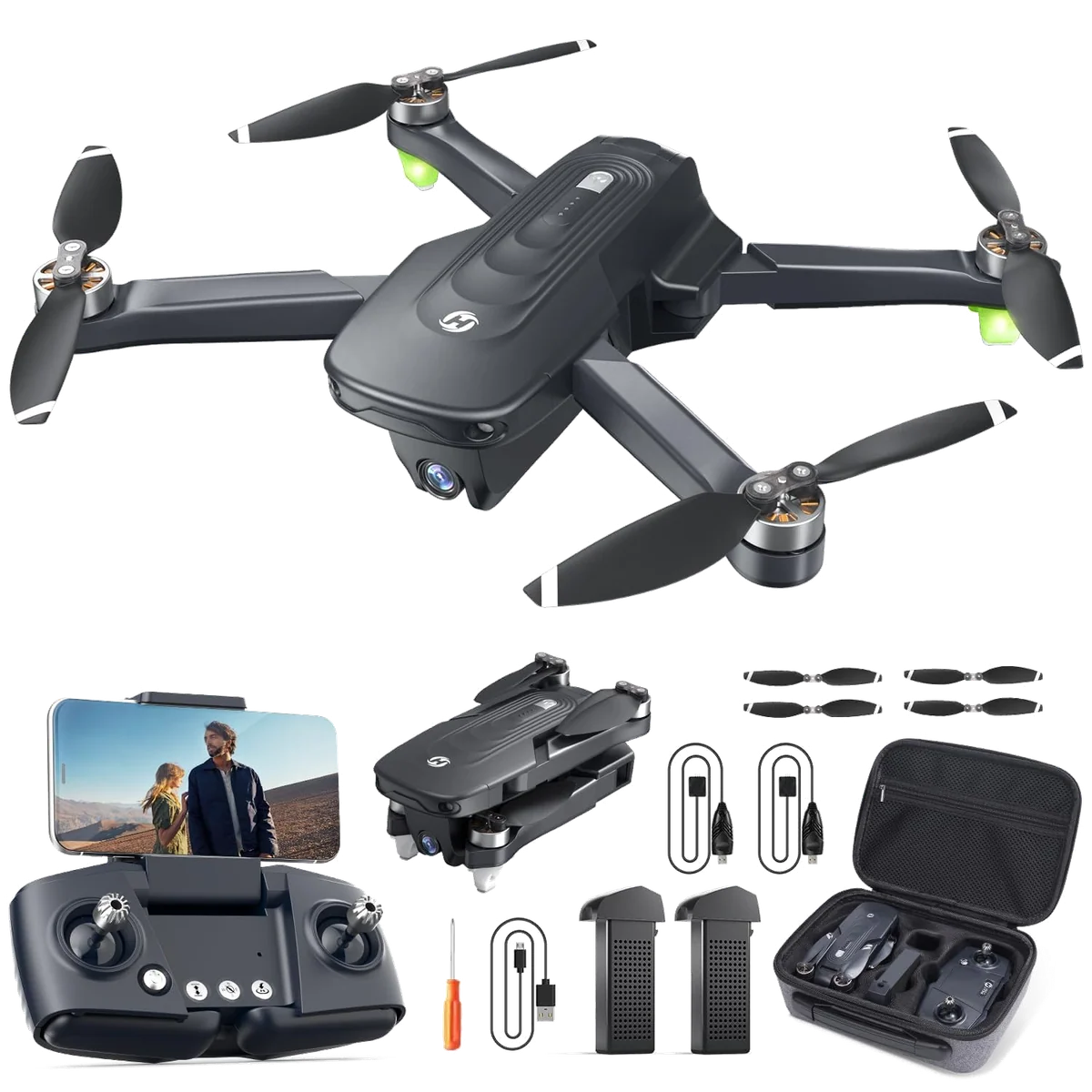
Buy the HS175D if you want a forgiving GPS trainer you can afford to break while you learn, and walk away if you are buying it for the 4K in the title, because there is nothing stabilising that camera.
Based on 7600 owner ratings, 17 owner discussions and 1 other source. We have not tested this machine ourselves.
We earn a commission if you buy through our links, which does not affect what we say.
Read how this site works →
The verdict, stated plainly
One five-star owner titled his review with the claim that this drone performs exactly as advertised, nothing less and nothing more. He is nearly right, and the exceptions are the two things this page has spent its length on: the range does not survive contact, and the 46 minutes is a sum rather than a flight. Everything else on the listing is either true or defensible.
So buy it to learn on. It hovers, it comes home, it takes a crash, it is quiet, and it will tell you within a month whether flying is something you want to spend real money on. That is a legitimate purpose and this aircraft serves it better than the community consensus admits. Do not buy it to make anything. The moment your ambition moves from flying to filming, the missing stabilisation stops being a caveat and becomes the whole story, and no setting in the app will get you round it.
The people who are furious with this drone bought the box. The people who are happy bought it knowing all of the above.
Best for: Beginner drones
This is a beginner's drone that is honest about almost everything except the two specifications people shop on. The flying is genuinely good: it locks onto a hover, it holds position in a breeze that would embarrass a toy, it is quiet enough to fly beside your head, and several owners have crashed one repeatedly and gone on flying it. The camera and the radio link are where the listing gets ambitious. Video shows every twitch of your right thumb, and the Wi-Fi feed gives out a long way short of the distance the app will happily let you dial in.
So the question is not whether the HS175D is good. It is what you actually want a drone for. If the answer involves footage you intend to show people, this is the wrong purchase and no amount of practice will fix it, because the fix is hardware this aircraft does not have. If the answer is that you want to find out whether you like flying at all, without a four-figure aircraft hanging over your head every time the wind picks up, this is one of the most sensible ways to find out.
| Buy it if | Walk away if |
|---|---|
| You have never flown a GPS drone and want return to home, altitude hold and a hard geofence while you build the reflexes. | You want clips that do not wobble, because the camera is a tilting mount and not a stabilised gimbal. |
| You expect to crash, and you would rather crash something you can replace props on with the screwdriver in the box. | You want range, since the video link is ordinary Wi-Fi and behaves like it. |
| You want a sub-249g aircraft that stays under the recreational registration line in the US, which it does with room to spare. | You need obstacle sensing, which this drone has none of, in any direction. |
Everything below is the evidence for that stance, starting with the two claims Quadcopter Bench could not get to stand up.
Key Specifications
The box, line by line, against what people actually got
Holy Stone's listing is a good listing, in the sense that most of it is defensible. The trouble is that the two headline numbers are the two that a buyer weighs hardest, and both of them are doing work that the aircraft does not do.
| What the listing promises | What the record shows |
|---|---|
| Up to 46 minutes of flight | Two batteries at roughly 20 to 23 minutes each, and the drone starts coming home before a pack is empty |
| Smooth 5GHz FPV live view | A Wi-Fi feed that broke up somewhere between about 210 and 290 metres in every account collected here |
| 4K camera with a 90 degree adjustable angle | Good stills, a manually tilted lens, and video that carries every stick input straight into the frame |
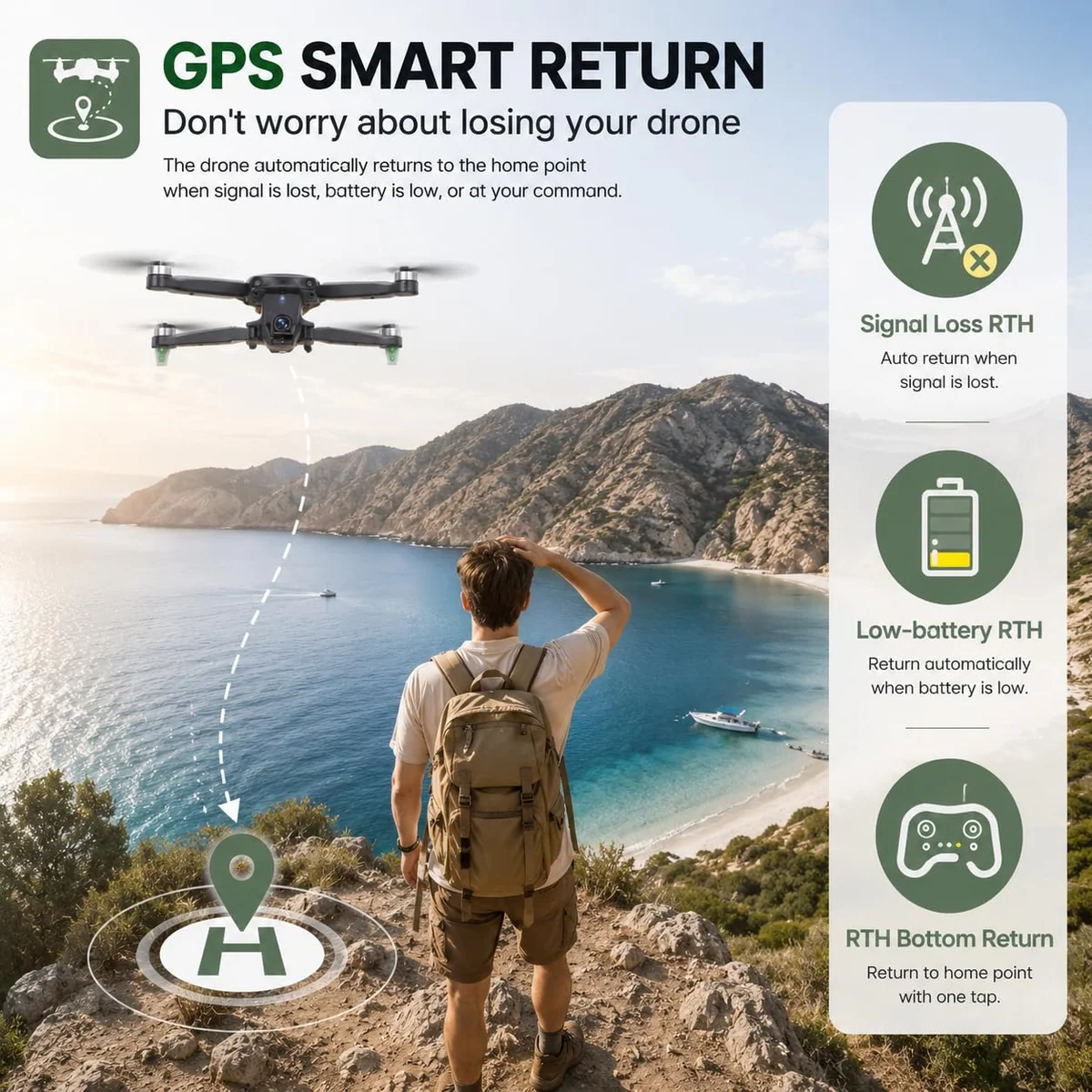
| GPS auto return | The strongest claim on the page, accurate to a few metres when the compass is freshly calibrated |
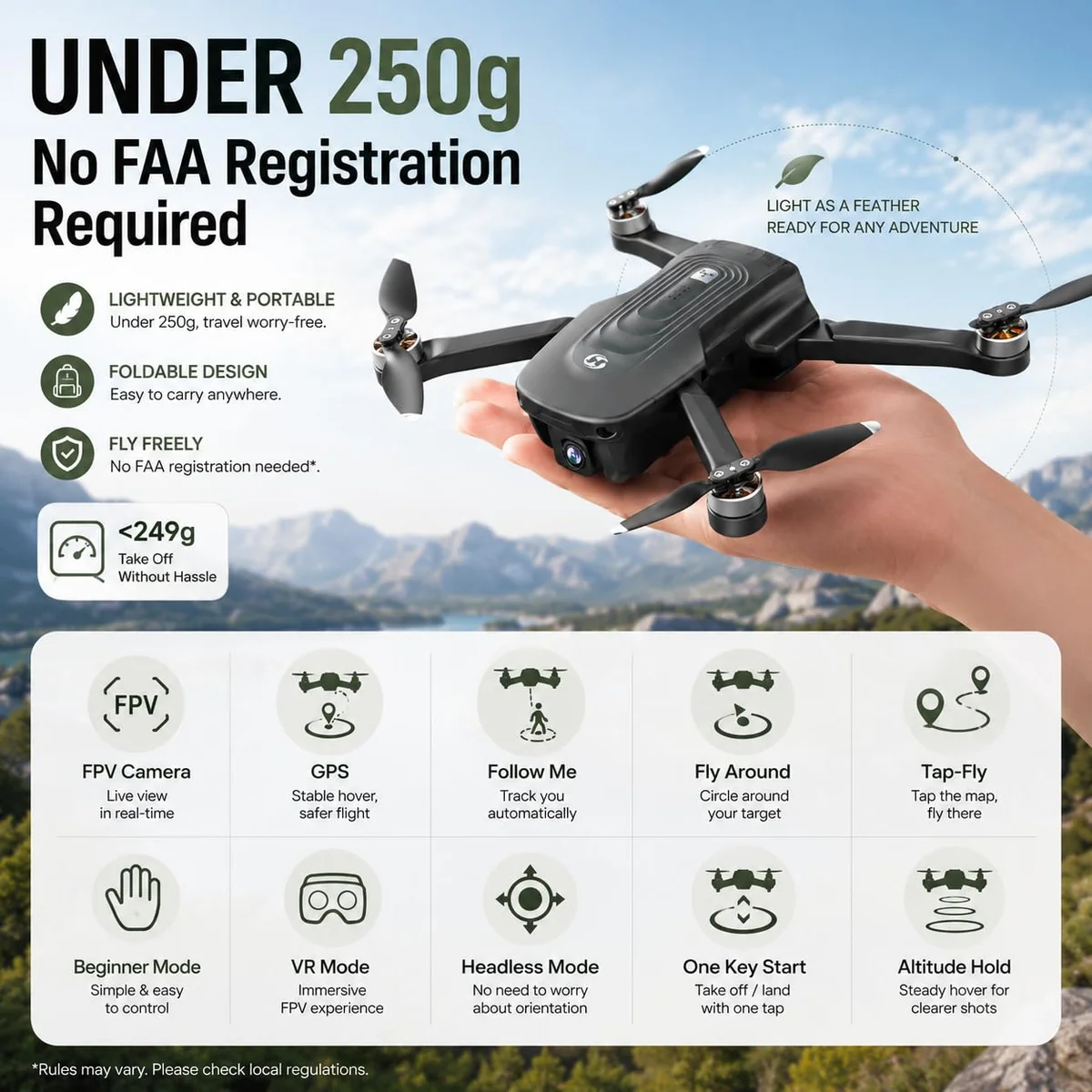
| Under 249g | True, and measured on a scale at about 216 grams |
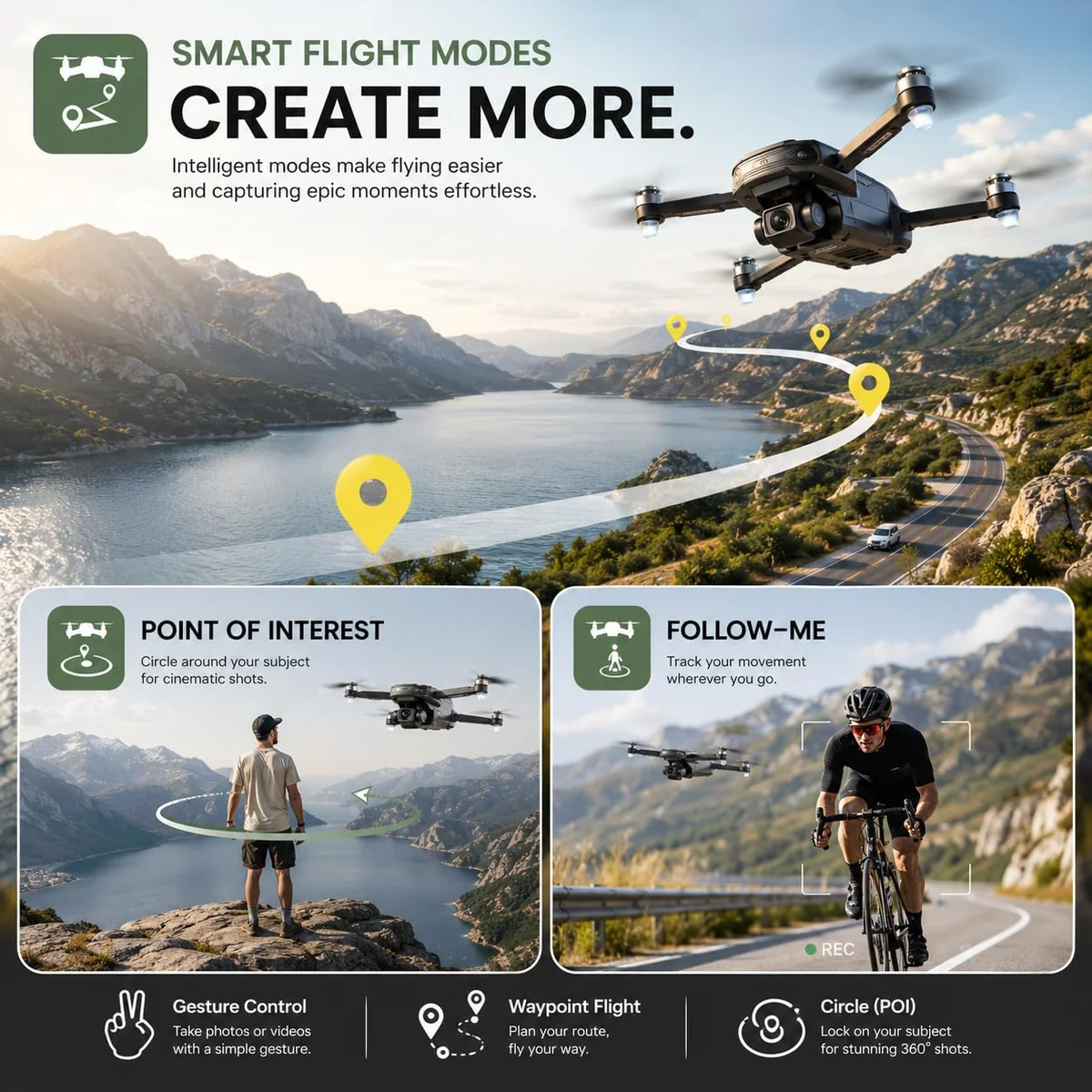
| Follow Me, Waypoint Fly, Circle Fly | Circle is smooth and Follow Me works above a certain height, Waypoint is barely witnessed by anyone |
The 46 minutes is arithmetic, not a flight
Two batteries ship in the case, each rated for a little over twenty minutes, and 46 is what you get if you add the best case of one to the best case of the other. Amazon's own description concedes as much in a line most people will never scroll to. Owners land in the same place independently: about twenty minutes a pack, sometimes a shade over. One three-star reviewer had already done the maths himself and pointed out that he had no desire to fly for forty minutes anyway, which is the right response. This is the standard way flight time gets advertised across the whole category, and it is worth understanding how the box figure is assembled before you compare two drones on it.
Subtract a little more. Low-voltage return to home fires while there is still charge in the pack, so usable flight is shorter than rated flight, a haircut visible on Holy Stone's other models too. Call it forty minutes of actual air time across both packs on a calm day, and you will not be disappointed.
The range claim is where it properly loses
This drone sends its picture over Wi-Fi. That single architectural fact explains the entire cluster of complaints around it: the modest distance, the freezing feed, the requirement to put your phone into airplane mode, the way a hedge between you and the aircraft can end the connection. A dedicated range test topped out around 240 metres before the drone turned itself around; a longer flight review pushed to the high 280s with dropouts along the way. An Amazon owner lost camera transmission at 210 metres and found the aircraft disconnecting at 25 to 30 metres of altitude.
Meanwhile the settings screen will let you set a 500 metre maximum distance, a figure the radio cannot hold. That gap between what the software permits and what the link supports is the single most misleading thing about this aircraft. An owner in the Holy Stone forum described flying over a nine-foot hedge into an adjacent baseball field and losing control instantly, then having to push his arms through a gap in the hedge to get it back. That is the true shape of the range: line of sight, and not much of it.
There is a mitigating point worth making, though it is not a defence of the marketing. If you are flying legally in the US you are required to keep the aircraft in unaided visual line of sight anyway, and a 216 gram drone disappears against a bright sky well before the radio gives up. The 500 metre number was mostly irrelevant to a law-abiding pilot before it was inaccurate.
The camera is the reason not to buy this drone
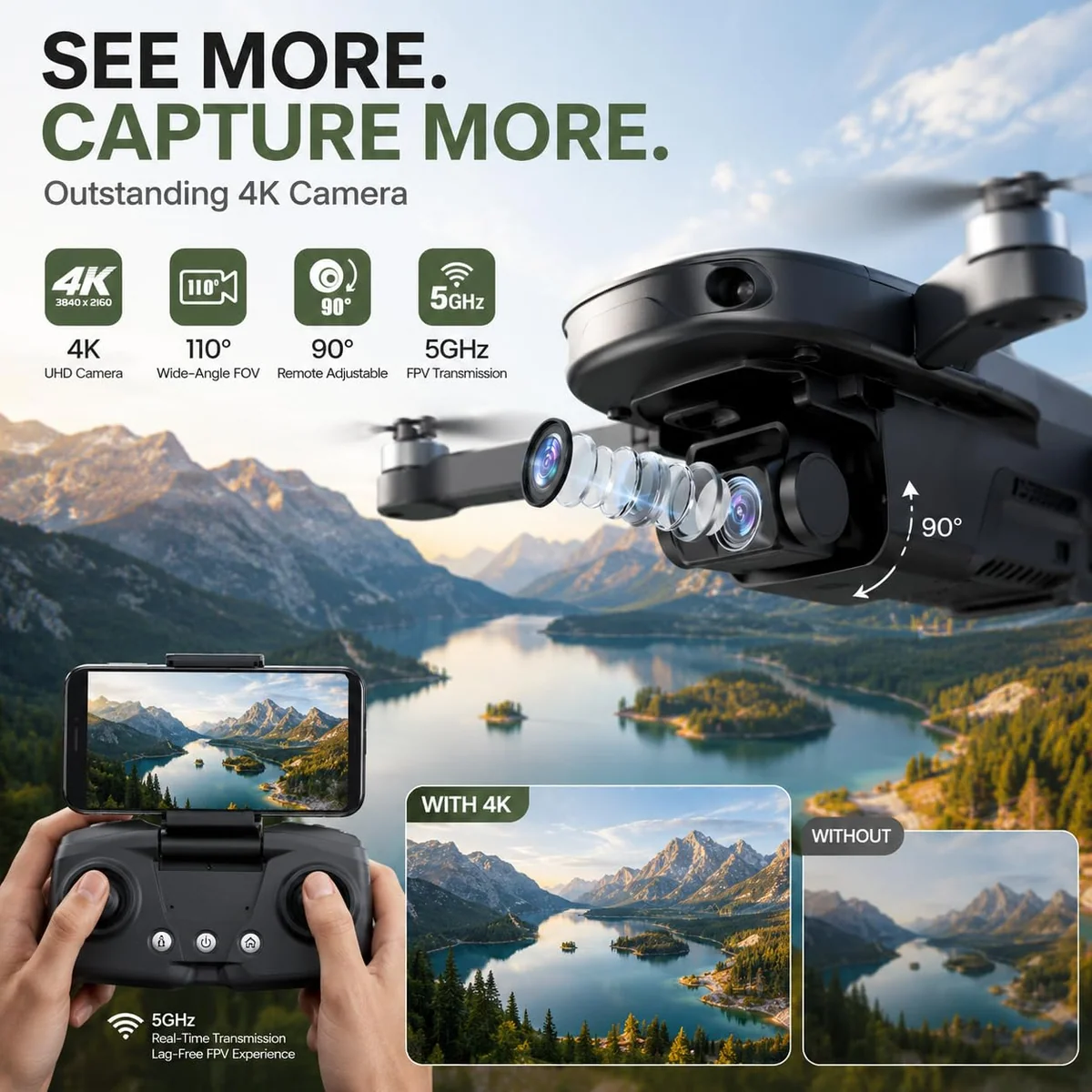
Sources that flew it cannot even agree what to call the mount. One reviewer describes a single-axis gimbal, another counts two, and the listing itself carefully says "90° adjustable angle" and never uses the word gimbal at all. The argument is academic, because the functional answer is unanimous: nothing damps the camera against the airframe, so the footage inherits the aircraft's movement. If you are hazy on why that matters more than the resolution number, the difference between a gimbal and electronic stabilisation is the whole story of why cheap drone video looks the way it does.
Owners converge on the same workaround from both directions. Fly slowly, feed the sticks gently, hover before you shoot, and you get something usable; make a sudden input and the frame lurches. One thoughtful reviewer learned to rotate the aircraft and then wait two full seconds before pressing the shutter, because otherwise the horizon tips. The same reviewer, unable to see his phone screen in the bright light he wanted to shoot in, took to flying without the phone entirely and counting button presses to aim the lens: 44 or 45 clicks for the full 90 degrees, five or six for most landscapes. That is a real craft solution to a real design gap, and it tells you exactly what tier of camera work this is.
The stills are the part nobody argues with. Several owners bought this to do a specific job, one of them photographing an inaccessible roof after inspection quotes came in high, and the pictures did the job. Treat it as a flying camera for photographs and a flying toy for video, and the 4K label stops being a grievance.
Two cautions on that label. Holy Stone has shipped 4K at 20 frames per second on a sibling model, which makes the resolution number less useful than it looks, and no source here states the HS175D's frame rate, so Quadcopter Bench will not guess at it. And judge the output from the memory card, not the live feed: on this class of gear the phone stream is a compressed preview and people have returned drones over image quality they only ever saw through the FPV window.
Strengths & Limitations
Strengths
- GPS hold and return to home are the real thing, landing within a few metres of the takeoff point when the compass is freshly calibrated.
- Brushless motors make it quick for the class and quiet enough to fly near people without irritating them.
- It survives crashes that would end a more expensive drone, with propellers being the usual worst-case damage.
- Two batteries, a hard case, eight spare props and the tools to fit them all come in the box.
- Beginner mode enforces a strict distance and height fence that stops a first flight becoming a search party.
- At roughly 216 grams it sits comfortably under the 249 gram line that governs recreational registration in the US.
- Stills are genuinely good, good enough that owners have used them for real inspection work.
Limitations
- The camera has no working stabilisation, so video carries every stick input and every gust straight into the frame.
- The video link is ordinary Wi-Fi and gives out a long way short of the 500 metre maximum the app will let you set.
- The advertised 46 minutes is two batteries added together, and return to home fires before either one is empty.
- Arming the motors defeats a real number of new owners, and the manual explains setup far better than it explains flying.
- The app stops recording by itself mid-flight and hides the height, distance and beginner mode settings behind an untranslated screen.
- Batteries are the weakest part of Holy Stone's range generally, with swelling and rapid capacity loss reported across sibling models.
- There is no obstacle sensing at all, so a tree is entirely your responsibility.
- Your phone sits in airplane mode throughout the flight, which means no calls or messages for the length of a session.
In the air, it is better than its reputation
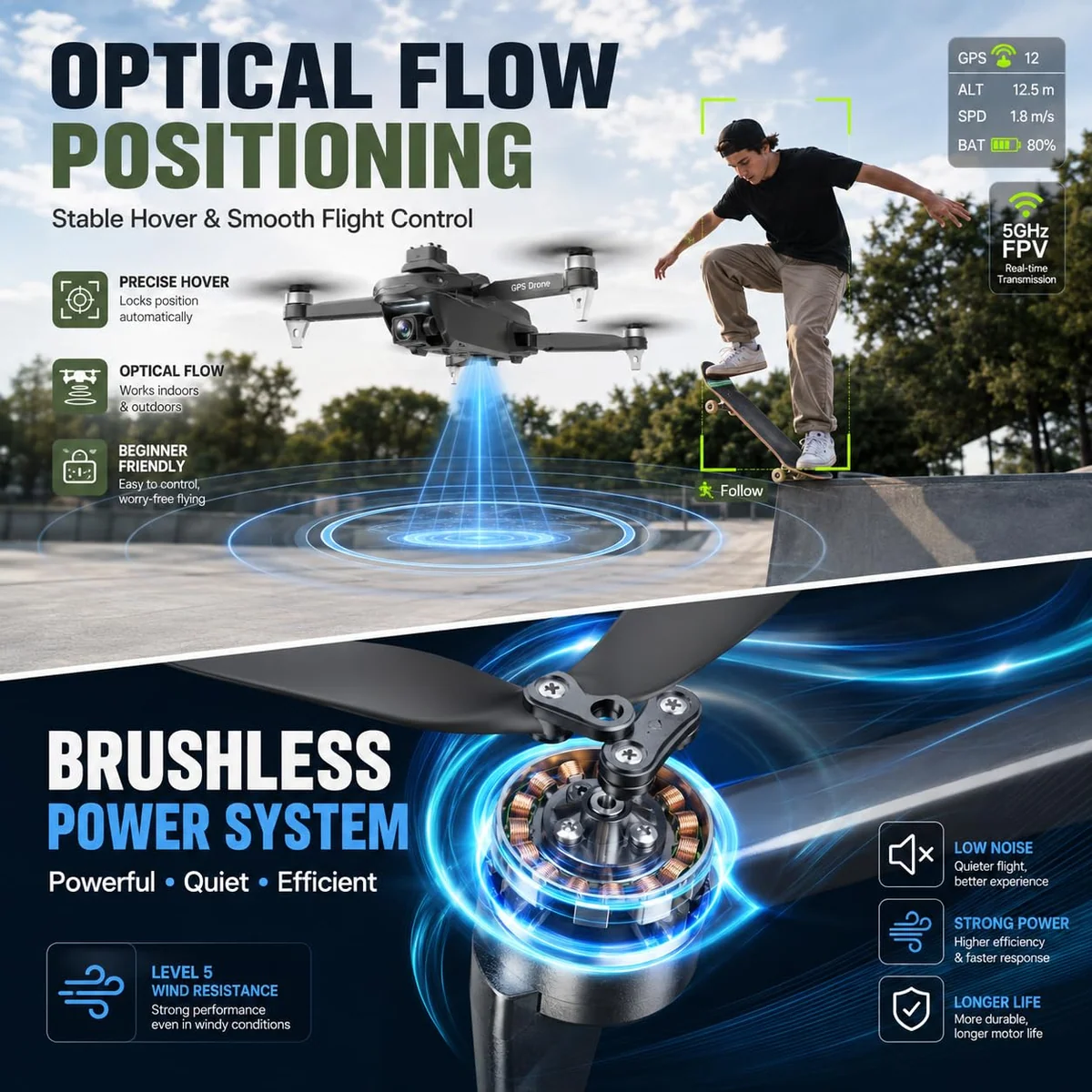
Strip away the camera and the radio and what is left is a well-behaved little aircraft. It lifts off the one-key launch and parks itself. First-time pilots report hovering within a couple of feet of the takeoff point in a light breeze, and the flight reviews describe it as stable for its weight. Brushless motors do two things here: they make it quick for the money, and they make it quiet, quiet enough that one owner flying it beside his head compared it to normal speech.
Radar-gunned, it does 18 miles an hour, which the reviewer holding the gun admitted felt faster than it measured. There is no speed switch on the controller; you press the right stick in to step through the rates, and beginner mode sits below both of them with a hard geofence attached. That geofence is the underrated feature of the whole aircraft. It stops the drone dead at a set distance and a set ceiling, and more than one experienced owner has chosen to stay inside it rather than treat it as training wheels to escape. If you are working out how to build flying reflexes without wrecking anything, an aircraft that refuses to leave the field is doing you a favour.
Return to home, which is the claim that holds
This is the feature that separates the HS175D from the cheap non-GPS drones people simply lose. In testing captured on video it has landed effectively on its takeoff mark, and about ten metres off on a longer flight. On Amazon, one owner measured it back within a foot of the launch point, repeatedly, in wind.
The variable is calibration, and the mechanism matters more than the numbers. One owner who tested it properly found it coming back within three metres when freshly calibrated, and drifting out to about ten metres after several return cycles without recalibrating in between. Recalibrate between flights and the accuracy comes back. It also triggers itself on low battery and on signal loss, and you can cancel it mid-flight if it fires when you did not want it to.
Smart modes: one works well, one has a secret, one is unverified
Circle flies smoothly, to the point that the app froze mid-orbit while the drone kept flying the pattern correctly and had to be force-closed and reopened to get the picture back. Follow Me works, but there is an altitude floor nobody documents: below roughly thirteen metres it simply sits there and does nothing, which is why so many owners conclude the feature is broken. Get above the buildings and it engages. That is arguably sensible behaviour, given the alternative is a drone tracking you at head height, and it is a straight improvement on the older HS720E, where the same mode never worked at all. Waypoint appears in the app and one Amazon owner says it worked well alongside Follow Me, but no flight test in the record actually flew it, so treat it as present rather than proven.
Follow Me here is a GPS follow of the controller, not visual subject tracking. If what you actually want is a drone that keeps a camera pointed at you while you move, this is not the mechanism you are imagining, and the drones built for that job work in a fundamentally different way.
Wind, and the thing wind does to the shot
A 216 gram aircraft is a regulatory advantage and an aerodynamic liability at the same time. The convergent finding across owners is that it holds position into the mid-teens in miles per hour, with one owner verifying 13 to 17 mph afterwards and describing long loops to stop and start before it settled back into a hover. Push past about 35 km/h and another owner says stability is simply not achievable. Our guide to what a lightweight drone can take puts that band in context against the rest of the class.
The nuance is the one that matters most for this particular drone: the aircraft holds, and the picture does not. Wind resistance and footage quality are separate questions when nothing is isolating the camera, and the aircraft passes the first test while failing the second in the same gust.
What it does not have
There is no obstacle avoidance of any kind, in any direction, and the listing is quiet about it because there is nothing to say. On a drone this size that is a smaller loss than it sounds, since what these systems actually catch is narrower than most buyers assume, but you should know it before the first tree. There is also no geofencing in the software sense: this aircraft will not stop you flying somewhere you should not. A handful of owners name that as a reason they prefer Holy Stone, which is fair enough on a closed club field and entirely your problem everywhere else.
The internet will tell you to buy a DJI instead
It is worth engaging with that head on, because if you search this drone you will hit it within thirty seconds. Ask r/drones whether to buy an HS175D and the answers are close to unanimous and not gentle: buy a DJI Mini, buy a used one, buy anything else. A parallel thread about this drone and its stablemate opens with someone calling both of them nice junk, and two other users endorsing that as the correct answer.
Two things about that consensus. The first is that several of the loudest voices concede, when asked, that they have never flown one. The second is that the comparison is between this drone and something that costs a good deal more, which the person making it usually acknowledges in the same breath. In the same thread that calls both drones junk, a rebuttal points out that the refurbished DJI everyone recommends was more than twice the price of the Holy Stones being discussed.
The most useful voice in the whole argument is a DJI owner making the case for the cheap drone against his own equipment: the throwaway-priced drones he owned before the Mini are the ones he did all his reckless flying on, and once he had spent real money he started flying carefully. That is the honest case for the HS175D. It is not that it beats a Mini. It is that the crash you are statistically going to have in your first month is a different event on this aircraft than on that one.
A qualification the pro-DJI camp deserves: the fairest version of their case is not snobbery, it is the worry that a frustrating drone will put a beginner off the hobby altogether. That risk is real here, and it is concentrated entirely in setup rather than in flying, which is the next section.
Where to go instead, if the drawbacks above disqualify it
| If your actual problem is | Look at |
|---|---|
| Footage that does not wobble, at close to the same money | The Potensic ATOM SE, which puts electronic stabilisation behind its 4K, and the head to head between the two |
| The drone the sceptics are actually pointing at | The DJI Mini 4K, which is the model most often named as the thing to save for |
| Simply the best first aircraft, whatever the badge | Our beginner drone shortlist, and the cheaper end of the camera drone market |
One more note on cost, and it cuts in the HS175D's favour. Two batteries, a hard case, eight spare props, spare screws and a screwdriver come in the box. On rival aircraft in this class, a single spare pack is a meaningful fraction of the drone's price, and a case is extra. That is worth remembering when you compare the sticker on this against the sticker on a bare airframe, and it is the same calculation that runs through every fly more combo decision. The street price on this model has moved around a great deal over its life, so the value argument is only as good as the number in front of you on the day.
Setup is the hard part, and the battery is the thing to watch
Nobody in the record struggles to fly this drone. Plenty of people struggle to start it. The search data around Holy Stone is dominated by operational questions rather than comparisons: the app, the instructions, connecting to a phone, the battery. Those are the questions of people who have already bought.
The step that catches most of them is not in the flow you would expect. You have to go into your phone's Wi-Fi settings and join the drone's own network by hand before the app will see the aircraft, and the app does not do it for you. After that comes a calibration ritual that has to be repeated every flight: bind the controller, then a gyro calibration with the sticks, then a compass calibration in the app with the aircraft rotated fully horizontally and then fully vertically. Half-turns will not do it, which is where one owner lost most of an afternoon. Our walkthrough on connecting a Holy Stone to your phone and calibrating it takes that sequence step by step.
The single sharpest failure point is arming the motors. One owner posted that in months of ownership she had never once heard the propellers move, having tried what she believed were all the stick combinations and watched every video she could find; the thread ends without confirmation that she ever flew it. The combination that two independent sources agree on is both sticks pulled down and inward at the same time, on a level surface, with a charged pack and enough satellites acquired, which can take half a minute or more. Down and outward is a different gesture on these aircraft, which is exactly why people get stuck. If you fly mode 1 rather than mode 2, the switch has to be made before pairing by holding the record button while powering on the transmitter, a procedure that exists but is essentially undocumented.
Documentation is the recurring complaint, and it is a specific one. The manual covers setup thoroughly and flying barely at all, which is why one owner ended up in repeated contact with support for things a page of written instruction would have answered, and why another crashed on every attempt for three years, dug the drone out, read the manual properly and found it flew like new. The app also has a settings screen that appears in untranslated Chinese, and it is the screen holding the maximum height, maximum distance and beginner mode switches, which are the three settings a new pilot most needs.
Two app bugs are worth knowing in advance so you do not diagnose them as a broken drone. Recording stops itself: the on-screen record button silently switches off mid-flight, more than once in a single session in one flight test. And taking a still while recording ends the video, while the controller's own video button starts a recording that stops about a second later, so use the button on the phone screen instead. Which phone you use is contested and unresolved: owners blame Android, other owners blame iPhone, and the only thing everyone agrees on is that the app is fragile and cares about the order you switch things on in.
Batteries are the brand's weak point, and this drone lives on two of them
Quadcopter Bench found no HS175D-specific pattern of battery failure in the record, and it would be dishonest to invent one. What is there is a strong pattern across the wider Holy Stone range, and since these packs are made by the same company under the same constraints, it is the risk to watch rather than a defect to allege. Owners of other models report packs falling from twenty minutes to ten within a month, packs that will not hold more than a minute despite showing full, and gauges that simply do not correspond to the charge in the cell. Two separate owners found batteries swollen after storage with almost no use, one of them after two charges and roughly twenty-five minutes of total flight. A swollen pack does not get flown, and it does not get charged.
The practical consequence for a buyer is simple, and it is the strongest advice on this page: exercise both batteries properly inside your retailer's return window, rather than leaving the second one sealed in the case for spring. A dead pack discovered in week two is a return; discovered in month six it is a negotiation.
Support that replaces things, and support that does not
Holy Stone's service is the most consistently praised thing about the company and it is not close. Owners describe replacement drones sent for GPS faults, replacement batteries sent without argument, and in one case an entire new aircraft under warranty with no requirement to return the old one. Set against that, the counter-current is real: owners who reported a flyaway and never heard back, owners cycled through four batteries before being told to buy a new drone, and one who was accused of using the wrong charger. The pattern that fits both is that replacement is generous and fast while diagnosis is thin, and that out of warranty you are on your own. No source here documents the actual warranty term, so this page will not state one.
On durability, the record is genuinely good and consistently so. The one verified long-term owner in the community threads learned to fly on his, crashed it hard several times, had a dog attempt to eat it, and reports propellers as the worst damage, three years in. A reviewer flew one into a tree on camera, unfolded the arms and kept flying. Props are screw-on rather than push-fit on this model, marked A and B, and they must go on the matching arms or it will not fly; the spares and the screwdriver are in the case. Buy a spare prop kit early, because when a drone of this age is discontinued, the parts go with it.
One forward-looking note. Holy Stone's newer flagship answers nearly every complaint on this page with a three-axis gimbal, a longer-range transmission system and over-the-air firmware updates, which the company had not previously shipped. That is where this line is going, and it tells you the criticisms here are not eccentric. It also tells you not to expect the HS175D itself to improve: firmware updates for older models are, by owners' accounts, not a thing that happens.
Frequently Asked Questions
Why will the motors not start?
Put it on a level surface with a charged pack, wait up to a minute for satellites, complete the compass calibration, then pull both sticks down and inward at the same time, which is the combination that trips up most new owners because down and outward is a different gesture entirely.
How do you get it connected to your phone?
Power the drone on first, then open your phone's Wi-Fi settings and join the drone's own network by hand before opening the app, because the app will not make that connection for you and everything downstream fails without it.
Do you need to buy a microSD card?
No, since the app saves photos and video to your phone automatically, though a card records to both at once and is worth having if you care about image quality, because the phone feed is a compressed preview rather than the footage.
Why does Follow Me do nothing when you press it?
You are almost certainly too low, because the mode refuses to engage below roughly thirteen metres and simply sits there instead of telling you why.
Why did the recording stop on its own?
That is a known app bug in which the on-screen record button switches itself off mid-flight, and it is worth glancing at the button periodically rather than assuming a long clip is still running.
Does it need FAA registration or a Remote ID module?
Flying recreationally in the US it does not, because it comes in well under the 249 gram threshold, though flying commercially is a different question and the rules are worth reading properly before your first flight.
Can you fly it without the phone attached?
Yes, and some owners prefer to, because the controller handles takeoff, landing, camera tilt and return to home on its own, though you lose the live view, the smart modes and the settings that live in the app.
Is Holy Stone a brand worth buying into at all?
For a first GPS drone it is defensible on price, durability and a support department that tends to send replacements, which is the fuller argument our piece on the brand works through.
Sources (3)
- Amazon listings and customer reviews — Holy Stone Hs175d
- Owner reports across r/drones, r/HolyStone, r/drone_photography threads
- Owner and reviewer video, 7 channels