Nobody needs a crash drone: the one that survives your mistakes is the one you actually wanted
- Buy the drone you want, now
- if you already know you want aerial footage of your own life, and you are shopping in the caged, sub-250g, satellite-stabilised class where a tree strike is an anecdote instead of an invoice.
- Buy something cheap first
- if the pilot is a child, if you suspect the whole idea might bore you by the third flight, or if the money for the good one is not there yet and waiting is worse than starting.
- Do buy a practice regime either way
- because the money that actually prevents crashes goes on spare batteries, an open field and a boring first hour, not on a second aircraft.
The logic behind the practice drone feels airtight until you look at what makes a modern drone easy to fly. What holds one of these still is satellite positioning and a downward vision sensor, and what makes it survivable is a cage around each propeller and a body light enough that there is not much energy to dissipate on impact. Cheap aircraft tend to be short on the first thing and offer the second only as a bag of plastic hoops. Take away position hold and you have not built a training aid, you have built a machine that drifts toward the hedge whenever you look at the screen, which is a harder flying problem than the one you were trying to prepare for.
Meanwhile the survivability at the good end has quietly become absurd. One first-time owner crashed a DJI Neo 2 and reported not a scratch on the case; another flies deliberately low near trees and his own house because the aircraft simply stops. A DJI Flip owner reports bumping walls with zero damage to props or airframe, and another says outright that he has crashed it and it is fine. The clearest demonstration in the whole record is not from a pilot at all: somebody handed a Neo 2 to a four-year-old at Christmas, nobody read the manual, and the first flight went ahead anyway. That is what you are being asked to buy a separate trainer for.
What actually crashes a beginner's drone
Almost nothing in the record shows a new pilot crashing because their thumbs were bad. The failures cluster around five or six specific misunderstandings, and every one of them is cheaper to fix with an hour of reading than with a spare airframe.
| How it goes wrong | What stops it |
|---|---|
| Trusting obstacle sensing | Treating it as a backup and not a guarantee: one cycling owner had a Neo 2 clip a stop sign and, separately, hit a parked car, and a reviewer watched tracking fly one into a child's bike helmet. |
| Flying backwards for a reveal | Knowing which way your drone can see, because the Flip watches forward and down and nothing else, so the single most tempting cinematic move is flown blind. |
| Wind you did not notice on the ground | Checking before you launch rather than after the warnings start, since a 151g airframe with cages cannot punch back into a headwind at all. |
| Believing the flight time on the box | Planning with the number owners get, not the number printed on the carton, and turning for home on a percentage you decided in advance. |
| Taking off before the satellites are in | Waiting on the ground for a solid lock and confirming the home point is set, because an aircraft that never had one will not come back to it. |
| Switching to sport mode to look competent | Not doing that for a month: on the Neo 2, sport mode turns the safety features off entirely. |
Take the sensing point seriously, because it is the one that catches confident people. The Neo 2's omnidirectional detection is a real generational change and it is good enough that a reviewer repeatedly failed to make it hit bare winter branches, the classic case that defeats vision systems. It has also, in ordinary ownership, hit a stop sign and a parked car. Both facts are true and the second one is the one that matters on your first afternoon. The Potensic Atom 2 makes the trade explicit by not having forward or side sensing at all, which an owner comparing it to a DJI Mini 2 spotted immediately and marked it down a star for. Our fuller account of what these systems catch and what they fly straight through is worth twenty minutes before your first flight, not after it.
Wind is the other reliable beginner-killer, and it does not need to be dramatic weather. A Flip owner dropped his rating to four stars purely to say that when it is windy the aircraft struggles to hold control and the warning messages start, while the video keeps looking perfectly calm. A reviewer flying it in roughly 20mph found it would still hold station but would refuse the clever modes outright, well below its published rating. That combination, steady picture and struggling airframe, is genuinely dangerous for a new pilot, because your screen does not tell you the aircraft is losing the argument. We have written up where the real ceiling sits for a drone this size.
The first hour, in the order that makes it boring
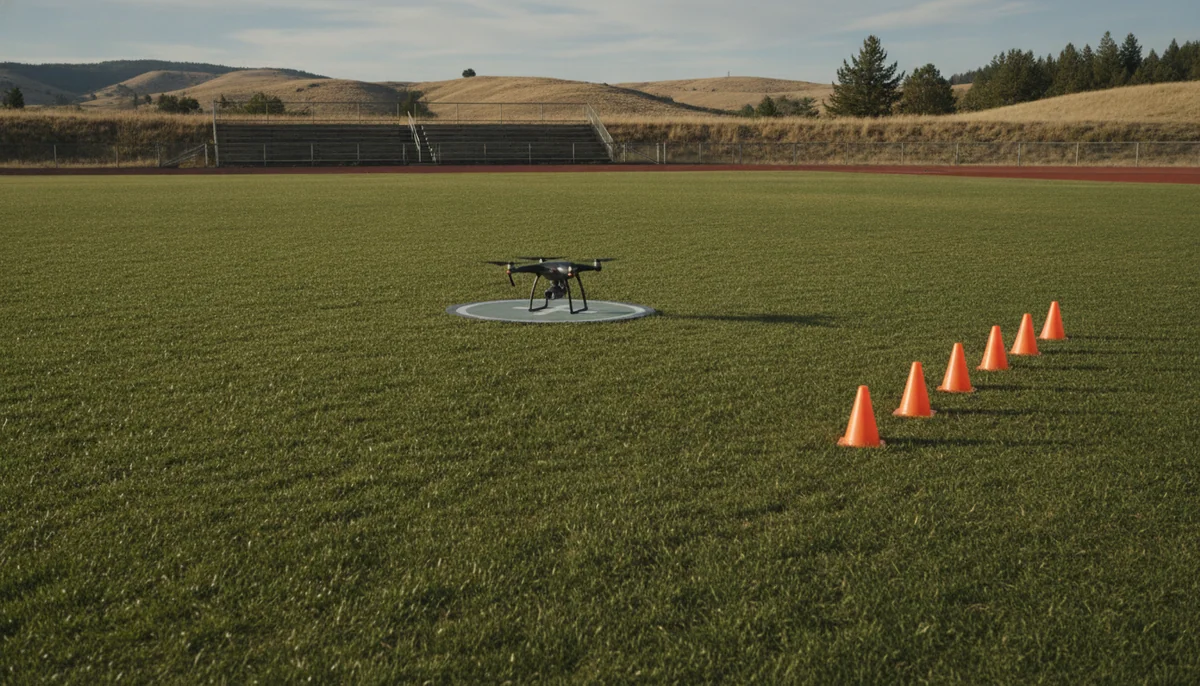
There is a reason the good advice sounds unglamorous. Almost every crash in the record happened during a shot somebody was excited about, so the first battery should contain no shots at all. Quadcopter Bench would spend it like this.
- Pick grass, not gravel, and nothing to hit. A playing field on a still morning. No trees at the edge you have to think about, no water, no people who might walk into frame and into the propellers.
- Take off and do nothing. Hover at head height for a minute and watch how much the aircraft moves on its own. This is your baseline: on a healthy modern drone it should be close to nothing.
- Fly a box, low and slow, with the nose pointed away from you. Left, forward, right, back. Repeat until it is dull.
- Turn it around and fly the same box nose-in. This is the part everyone skips and the reason people panic later: with the nose facing you, left on the stick moves the drone to your right. Ten minutes here is worth more than any simulator.
- Trigger return to home on purpose while it is thirty metres away. Watch where it lands, and how close to the takeoff point it actually gets. Learn that now, in a field, rather than later, over a balcony.
- Fly it down to the low-battery warning once. You need to know what the aircraft does when it starts insisting, and how much time you really have after the first nag.
Two additions if the drone is new out of the box. Do that first battery close in and over open grass whether or not you feel ready, because a small minority of aircraft arrive wrong, and the Neo 2 listing carries one blunt account of erratic control and a mid-air stall fifty yards out. Better to discover that walking twenty metres than swimming. And check the paperwork before the first flight rather than the first weekend: the sub-250g class keeps you outside recreational registration in the United States, but the free knowledge test still applies, and the registration and Remote ID rules have more edges than the listings suggest.
Which of these you should actually learn on
All three of the drones here are survivable enough to be a first aircraft. They fail differently, and the difference is what should decide it.
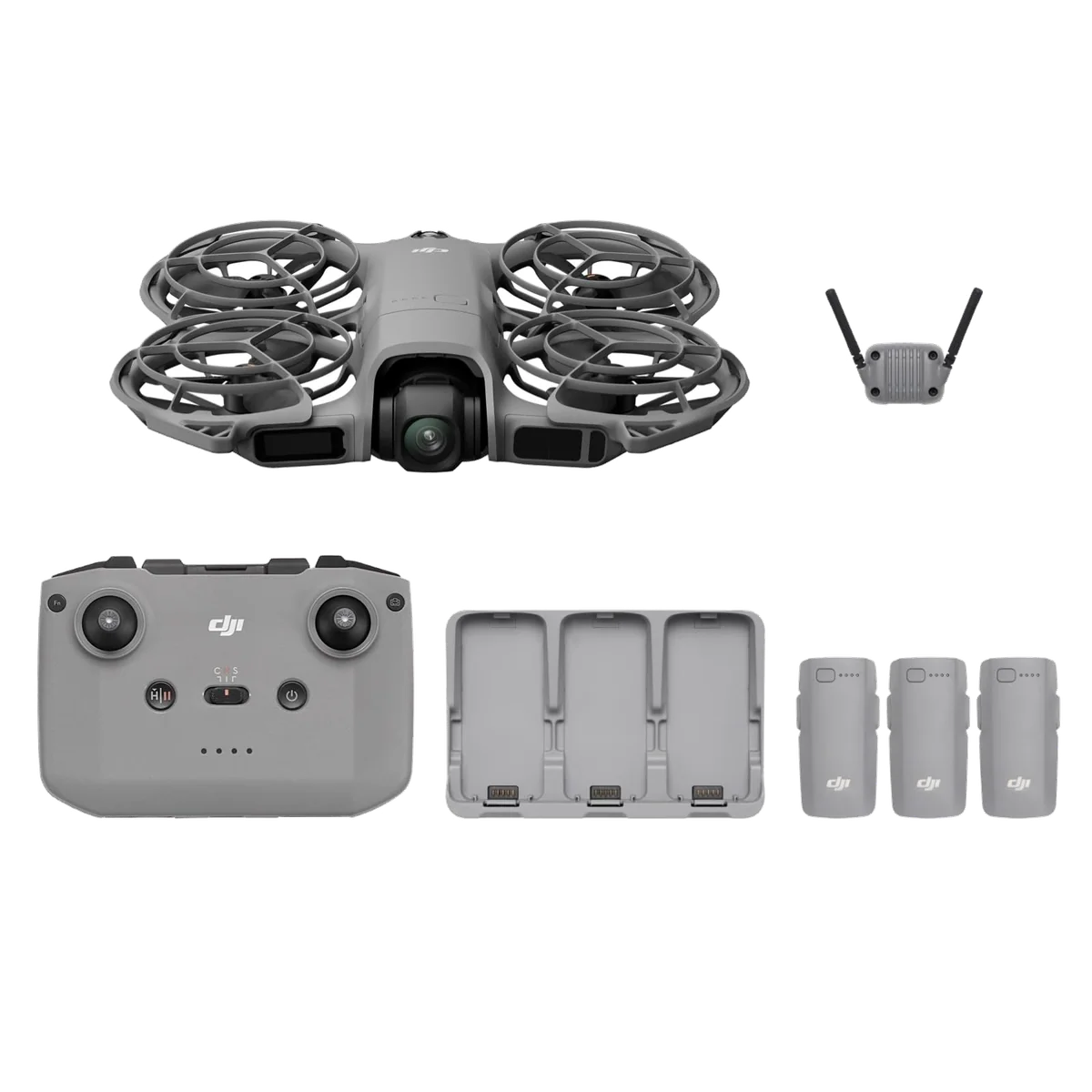
The DJI Neo 2 in the three-battery kit is the most forgiving thing on this page and the one Quadcopter Bench would put in a nervous adult's hands. It weighs 151 grams, carries fixed cages around every propeller and lifts off your open palm, so the first flight needs no controller and no clear patch of flat ground. Owners report it being ready to fly almost as soon as it powers on, with no calibration ritual. The honest drawback is endurance and air: the nineteen minutes on the box is not a number anyone gets, with owners reporting ten to twelve with the sensors working, and at that weight it is pushed around by a breeze you would not notice standing up. Learning on it means learning in short bursts on calm days, which is not the worst discipline to acquire.
The DJI Flip with the RC 2 and three batteries is the one to take if you want the learning to produce footage you will keep. The carbon-fibre guards fold flat, palm launch works, and the camera is the part nobody argues about. Its drawback is bigger than a spec: it does not broadcast Remote ID, which an owner flags plainly on the listing as the thing to know if anyone is paying you, and its sensing covers forward and down only, so the reveal shot you will want to try within a fortnight is flown with nothing watching. The 93 minutes in the product title is DJI's 31-minute laboratory figure multiplied by three batteries; owners who actually fly report roughly 24 to 25 minutes a pack. If you are torn between these two, we set them out side by side in Flip against Neo 2.
The Potensic Atom 2 with the PTD 1 screen controller is the option that removes the safety net on purpose. Owners describe it going straight up and hovering tight, holding a line in wind that should trouble something this light, and surviving hard landings that were expected to end the day. The drawback is unambiguous and it is the reason it is not our default recommendation for a first drone: there is no forward or side obstacle detection, only a downward system, and the AI Track modes the listing sells hardest exist to send the aircraft chasing a moving subject past trees nothing on board is looking at. There is a respectable argument that flying without a net makes you a better pilot, and plenty of owners make it. Make sure you are choosing that, rather than discovering it. Its 96-minute headline is the same three-battery arithmetic, and real packs run nearer 15 to 23 minutes. The way these box figures are built is worth understanding once and then applying to every drone you ever buy.
Sticks or a phone, and whether to buy a controller separately
This is the one accessory question that changes crash rates rather than convenience. Flying from a phone puts a settings panel in your hands; flying from sticks gives you fine throttle, which is precisely what a light aircraft needs in a breeze. On the Neo 2, the owner reports about wind split along exactly that line, and the controller does not add thrust so much as add the precision to use what there is. Flip owners are blunter still: one tells you to get the screen controller because it is so much better than a phone or the phone-tethered alternative. Our general answer is in whether you need a real controller at all.
The DJI RC 2 is the screen controller that appears in those conversations, and the useful thing to say about it here is a warning rather than a recommendation. It has the DJI Fly app preinstalled and a 5.5-inch screen, so you power on and launch instead of unclamping a phone and finding a cable, which is genuine friction removed from every single flight. Its limitation is compatibility, and it is a hard one: DJI lists it for the Flip, Mini 4 Pro, Air 3, Air 3S and Neo, which means it does not fly the Neo 2 in this page's combo, and it has nothing to do with the Atom 2, whose PTD 1 controller Potensic states works with that drone and no other. Buy it as a replacement or an upgrade for a drone you already own, not as a first purchase, because if you are buying a Fly More box the controller is already in it. If you are untangling which unit fits what, the compatibility picture is its own page.
One more thing the bundles get right by accident. Three batteries do not just buy flight time, they buy repetition, and repetition is the actual training. A single-battery box means one nervous twelve-minute flight per trip to the field, which is the slowest possible way to learn anything. Whether that reasoning generalises to every drone is a separate argument, and we make it both ways in whether the Fly More Combo is worth it.
When a cheap drone genuinely is the right first purchase
Three cases, and none of them is "to crash it".
The first is a child, where the point is not skill transfer but a machine nobody minds losing. The second is honest uncertainty: if you are not sure you will still care in March, the sensible move is a real but inexpensive camera drone rather than a toy, which is why we would point you at the DJI Mini 4K or the wider shortlist of the cheapest camera drones worth flying before anything with hoops and a bind button. If the brand question is what is stopping you, we have taken it head-on in whether Holy Stone is a good drone brand and in whether Potensic drones match DJI. The third is goggles. Flying first-person is a different skill with a different failure mode, and a simulator is the standard and sensible preparation there, whereas for a GPS drone that holds its own position the field beats the screen every time. If that is where you are heading, start at the FPV shortlist rather than here.
What none of those cases supports is the original premise: buying a bad drone so that a good drone will be safe later. The skill that transfers is orientation, wind judgement and battery discipline, and you can practise all three on the aircraft you intend to keep, in an empty field, for the price of one extra battery. If you have not settled on a machine yet, our list of drones to learn on is the shorter version of this argument. And because the safety net people used to rely on is gone in the United States, it is worth knowing what is left for insuring one before you take it anywhere expensive.
How Quadcopter Bench arrived at this
We have not flown these aircraft, and nothing above is a measurement we took. This page is built from the published record: the manufacturers' own listings and specifications, every customer review Amazon retained on the three drones covered here, published long-form reviews, and a one-month ownership account. Where owners contradict each other, as they do constantly on wind, we have said why both accounts can be true rather than picking the flattering one. The drills above are our judgment about how to spend a first hour, not a finding, and the reason they look so unexciting is that the record is full of people who skipped straight to the exciting part. One useful detail for anyone starting without a controller: the Neo 2 carries a small display and buttons on the body, so a helix, a dronie or an orbit can be set up without a phone in your hand at all. Android owners of either DJI here should also know the Fly app is no longer on Google Play and must come from DJI's own site, which is an odd first evening on a product whose pitch is that there is no setup.
So: no crash drone. Buy the one with cages, three batteries and a controller, spend the first hour doing nothing photogenic whatsoever, and accept that the aircraft will eventually meet something solid anyway. The whole point of this class is that when it does, you get a story instead of a bill.
Frequently Asked Questions
Should I buy a cheap drone to practise on before a good one?
No, unless the pilot is a child or you genuinely might lose interest, because a caged sub-250g drone already survives beginner mistakes and a toy without position hold is harder to fly, not easier.
Do I need a flight simulator first?
Not for a GPS drone that holds its own position, though a simulator is genuinely the right preparation if you are heading straight into goggles and first-person flying.
What is the single most useful drill on the first battery?
Flying a slow box with the nose pointed back at you, because that is the orientation that panics people later and ten minutes of it now is worth more than any amount of forward flying.
Will obstacle avoidance stop me crashing?
It will stop most crashes and not all of them, having been recorded in ordinary ownership hitting a stop sign, a parked car and a child's bike helmet.
Which of these three is the most forgiving for a complete beginner?
The Neo 2, because full propeller cages, 151 grams and palm takeoff remove the two hardest parts of a first flight, at the cost of roughly twelve real minutes per battery and poor tolerance of wind.
Does the Potensic Atom 2 have obstacle avoidance?
No, it has a downward system only and nothing watching forward or to the sides, which is the wrong combination with tracking modes that send it chasing a moving subject.
Can I use the DJI RC 2 with any of these drones?
It is listed for the Flip, Mini 4 Pro, Air 3, Air 3S and Neo, so it will not fly the Neo 2 in this combo and has no relationship at all with the Atom 2, which uses Potensic's own controller.
How windy is too windy for a first flight?
If you can feel it on your face in the car park, wait for another morning, because these aircraft start refusing modes and posting return-to-home warnings well below their published wind ratings.
How many spare batteries do I actually need to learn properly?
Three, because repetition is the training and a single-battery box gives you one nervous flight per trip to the field.
Do I have to register a drone before I practise with one?
Flown recreationally under 250 grams you stay outside US registration, but the free knowledge test still applies and anything flown for someone else changes the answer entirely.
Sources (5)
- Amazon listings and customer reviews
- Owner and reviewer video, 2 channels
- Ca — Article — vancouverislanddrones.ca
- Fstoppers — Article — fstoppers.com
- DJI — Article — www.dji.com