Care Refresh is gone in the US, and no policy you can buy puts it back
Buy a plan if the drone is a tool you invoice against, if the plan comes from the manufacturer rather than a general electronics underwriter, and if you have read what it does when the aircraft never comes back at all.
Skip the plan and buy less drone if this is a hobby, if the only cover you can find was written for phones, or if the honest answer to "could I absorb losing this outright tomorrow" is no.
Two things happened to American drone buyers in close order. PCMag's reporting has the FCC adding all new foreign-made drones to its Covered List in December 2025, with DJI filing suit in February 2026 in a case that could still overturn it, and the agency's chair saying consumers can keep buying and flying the models it had already approved. Separately, and at almost the same moment, the accident plan went. A professional who bought a Mavic 4 Pro says DJI removed the two-year Refresh option after his purchase and calls it one of the biggest reasons he had stayed loyal in the first place. A five-star reviewer of the same drone says plainly that you cannot buy an extended warranty from DJI and recommends going to Asurion instead. A Neo 2 buyer describes activating his aircraft and finding no Refresh option presented at all. The forums say the same thing in the same words. Nobody we have read states the reason for the withdrawal, so treat the connection between the two events as inference rather than fact.
What has actually been removed matters more than why. Refresh was not a warranty. It was the arrangement that turned a crash into a fee, which is the correct product for this hobby, because drones are almost never returned broken by the factory. They are returned broken by a thin branch, a stop sign, a gust at fifteen metres, or a lake. Quadcopter Bench has read every alternative people are now recommending to each other, and the uncomfortable finding is that most of them are built to pay out on the failure that does not happen.
The warranty you kept is not the cover you lost
The factory warranty still exists and still covers defects, and it is worth being clear what that gets you in practice rather than in principle. The most detailed ownership account in the record comes from a pilot on his fifth DJI drone, running a business on it, whose first Mavic 4 Pro developed a gimbal fault at eighty-five days: it began vibrating mid-flight, calibration and resets changed nothing, DJI sent a form letter warning that repair could run to ninety days or more, and his local repair shop wanted more than the aircraft had cost to replace the gimbal outright. He bought a second one and the first is parked. The one-star reviewer on that listing tells a version of the same story from the other end, having been quoted a sixty to ninety day wait before he could even send an older drone in.
So the exposure a working pilot carries is not only the cost of the aircraft. It is the weeks of not having one, and there is no policy on the market that ships you a replacement on Tuesday. The only cover for downtime is a second airframe, which is a purchase, not a premium.
Four things get called drone insurance and they do different jobs
These are not competing products. They cover different halves of the same afternoon, and buyers keep conflating them, which is how people end up paying for something that would never have paid out.
| Cover | What it is good at | Where it stops |
|---|---|---|
| A maker's own accident plan | Replacing the aircraft after your own mistake, at a known fee, from the company that built it | It only exists if your maker sells it to you, and US buyers of these DJI drones report that it is no longer offered |
| A third-party electronics plan | Damage to a device you still have in your hands afterwards | The wording was written for phones and laptops, so whether an aircraft you flew into a river qualifies is the question to settle before you pay, not after |
| A home or renters policy | Occasionally a scheduled item, if your insurer will name it | The only claim anywhere in this record was refused on the grounds that the flight was commercial |
| Drone liability cover | Everything the drone hits: a car roof, a greenhouse, a person on the ground | Never the drone itself, which is a feature rather than a fault once you know it |
| Buying less drone | Every failure mode, including the flyaway that nothing else pays for | The premium comes out of your sensor rather than your bank account, and you pay it whether or not you crash |
Two footnotes on that table. The liability row is the one American readers skip and European readers cannot: an Atom 2 owner in Germany walks through his own compliance list and includes drone third-party liability as legally required alongside registration and the e-ID label on the airframe. And the electronics-plan row is not a sneer. An owner of this Mavic combo recommends exactly that route in place of DJI's own cover, and it is the closest substitute anyone in the record has actually named. Quadcopter Bench has not bought or claimed on any of these policies, so read the wording yourself; what we can tell you is which failure to read it against.
One word decided the only claim in the record
A Mavic 4 Pro owner reports that a friend of his, flying recreationally, had a State Farm claim denied because the insurer classed the flight as commercial, and he is convinced that will be the default answer going forward. The same owner adds that when his gimbal failed, his insurer told him it was the manufacturer's problem. That is one account and it is not a pattern, but it is the shape of the risk, and the shape is worth planning around: general policies exclude business use, and "business use" is defined by the underwriter and not by you.
The line is sharper than most hobbyists assume. Anything you fly for someone else in the US, paid or unpaid, sits under Part 107 rather than recreational rules, and registration and Remote ID apply to every aircraft above the 249g threshold regardless of who is flying it. If you have ever shot a friend's house before it went on the market, you already have a fact pattern an adjuster can point at. Our page on what registration and Remote ID actually require sets out where those lines fall, and it is worth reading before you describe a flight to anyone, not after.
The practical move is unglamorous and free: ask your insurer in writing, before you need to know, what they count as commercial and whether an aircraft that is never recovered counts as a loss at all. Keep the answer.
Price the crash into the drone, because that is the premium you can pay
This is where the argument stops being about paperwork. If cover is unavailable, the risk has not gone anywhere; it has moved onto your balance sheet. The only way to reduce it is to reduce what falls out of the sky.
The flagship, if and only if it earns
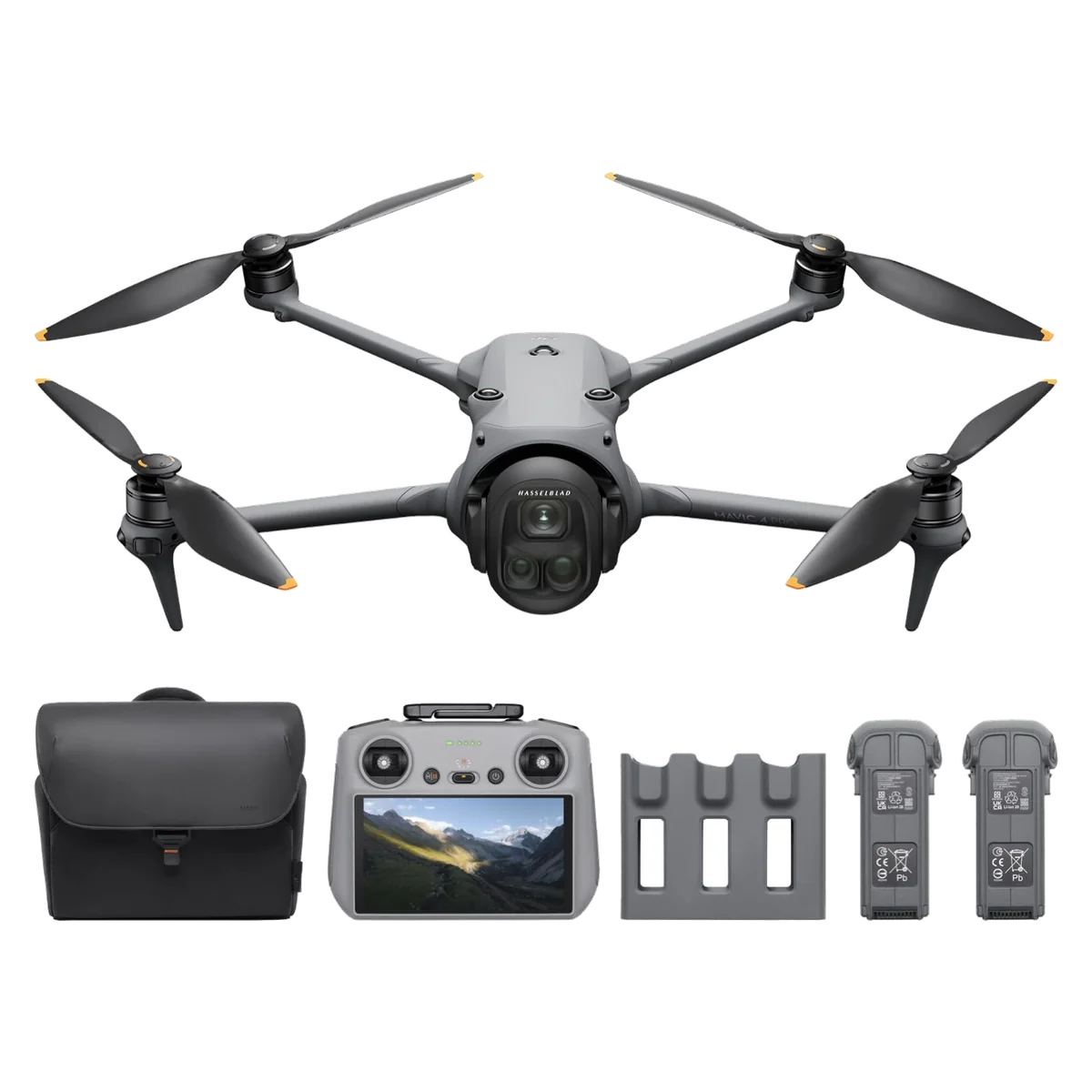
DJI's listing sells the Mavic 4 Pro as a flagship tri-camera aircraft built around a 100MP Hasselblad main camera, which is exactly the class of object you do not want to be self-insuring by accident. Our verdict on it has not moved: it is the best drone in its class and the worst one to own right now, and the deciding question is whether the footage pays for itself. An owner doing commercial work puts it better than we can, saying that treating the aircraft as an expense made the decision easy and that if it crashed tomorrow he would order another that afternoon, while for strictly recreational flying he would take the Air 3S because it is much easier to absorb. The drawback is not the drone, it is everything downstream of it: no manufacturer accident plan for US buyers, repair queues quoted in months, and at least one owner already on his second unit inside three months. If that is a business cost, buy it, and our full review covers what else the box does and does not contain. If it is a Saturday morning, the comparison against the Air 3S is the page you actually want.
The one where the loss is trivial by design
The DJI Neo 2 weighs 151 grams, carries fixed cages around every propeller and takes off from an open palm, and its Fly More box adds the RC-N3, three batteries and a charging hub. Its relevance here is durability as a substitute for cover: a first-time owner reports crashing it and finding not a scratch on the case, and a month-long ownership account written by a flight school describes it as surprisingly tough. When the worst realistic outcome is a replacement propeller cage, the absence of a plan stops being frightening.
The honest drawback is the same one our review named. The obstacle sensing is good and it is not a guarantee: one owner cycling with it had the drone clip a stop sign and, on another occasion, hit a parked car, and his own conclusion is that the avoidance is a backup rather than a promise. The same buyer who found no Refresh option at activation is flying without cover exactly as you would be. Read what these systems catch and what they fly straight through before you rely on the sensors as your insurance, and note that at this weight the wind is a likelier cause of loss than anything in front of the aircraft.
The one that still sells you a plan
Here is the finding that reframes this whole page for anyone shopping under the flagship. Potensic's own listing states that Potensic Care is available through its Eve app, in-app chat included. Owners describe it working the way Refresh used to: one bought the two-year replacement plan and says it covers multiple replacements of the aircraft, another misread the purchase window, let it lapse, and had support manually reset the timer so he could still buy it, and a third snapped an arm and wrecked the gimbal through what he freely calls his own goof, worked through a fortnight of timezone-lagged email, and was sent a replacement drone. That is the plainest evidence in the record that manufacturer accident cover still exists for an American buyer, and it belongs to the cheaper brand.
Now the drawback, which is large and directly connected. The Atom 2 has no forward, side or upward obstacle avoidance whatsoever, and the downward vision system is barely detectable in use, which is an awkward pairing with the AI tracking modes that exist to send it chasing a moving subject past trees. You are more likely to need the plan on this drone than on either DJI above it. Our review of the PTD 1 combo also documents a company that is excellent at fixing your individual problem and poor at acknowledging faults that affect everybody, which is worth weighing when you are buying a promise rather than a part. If the brand question is what is holding you up, we answer it at are Potensic drones as good as DJI, and the wider field at this weight is at the sub-249g shortlist.
What to do in the first hour, before you need any of this
- At activation, look for a plan and screenshot the screen whether one appears or not. If your maker offers cover, the window is usually short, and at least one owner has needed support to reopen it.
- If a manufacturer plan exists, buy it then. Nothing else in this article replaces it, and the substitutes are all worse at the two failures that matter: total loss and pilot error.
- Email your home insurer and ask, in writing, what they treat as commercial use and whether an unrecovered aircraft is a covered loss. File the reply with the receipt.
- Register the aircraft if it is above the threshold, and take the free recreational test if you are in the US. An unregistered flight is a bad opening paragraph for any claim, and the rules are not optional regardless.
- Fly the first battery over open grass, close in, before you take a new drone anywhere near water, a canyon or a crowd. This is how you find a bad unit while it is still a warranty question.
- Then set your own excess honestly. If the sentence "I could replace this next month" is false, you are flying too much drone for the cover available to you, and the fix is at the checkout rather than in a policy document.
The regulatory backdrop keeps moving, and the availability of cover has moved with it once already, so treat everything above as the position at the time of writing; we keep the wider situation current at our standing page on what you can still buy and fly. What will not move is the underlying arithmetic. With the maker's plan withdrawn from American buyers of these DJI aircraft, the cheapest reliable insurance on the market is a smaller drone, the second cheapest is a manufacturer's plan from whichever brand still sells you one, and everything else is a document you should read before you need it rather than after.
Frequently Asked Questions
Can American buyers still get DJI Care Refresh?
Owners of both the Mavic 4 Pro and the Neo 2 report that it is simply not offered to them, with one Neo 2 buyer describing no Refresh option appearing at all when he activated the drone.
Does the factory warranty cover me if I crash?
No: it covers faults the manufacturer caused, and the record here shows that even a genuine fault can leave an aircraft grounded for months while it queues for repair.
Will my home or renters policy pay for a crashed drone?
It might, but the only claim anywhere in this record was refused because the insurer classed the flight as commercial, so get their definition in writing before you need it.
Is a third-party electronics plan a real substitute?
It is the closest substitute anyone in the record actually names, and the thing to check before paying is whether it covers an aircraft you no longer physically possess.
What covers a flyaway or a drone that goes into water?
Nothing in what we have read shows a policy paying out on an aircraft nobody recovered, which is why that failure is the one you are self-insuring whatever you buy.
Do I need liability insurance to fly recreationally?
The US rules we cover do not require it for recreational flight, though an Atom 2 owner in Germany notes that drone liability cover is legally mandatory there, and in either case it pays for what you hit rather than what you lose.
Is there any drone here that still comes with a plan you can buy?
Potensic sells its own multi-year replacement cover through its app, and owners describe it replacing a drone one of them broke himself.
Did the ban cause Care Refresh to disappear?
Owners connect the two and the timing invites it, but nothing we have read states a reason, so treat that link as inference rather than fact.
Which drone should I buy if I cannot get cover at all?
The one you could replace without flinching, which for most readers means stepping down a class rather than paying a premium.
Sources (4)
- Amazon listings and customer reviews
- Owner reports across r/dji threads
- Pcmag — Article — www.pcmag.com
- Ca — Article — vancouverislanddrones.ca